
Remuneration report
Strategic remuneration decisions to attract, motivate and retain talent have become critical to support the delivery of our business strategy.

PART 1: BACKGROUND STATEMENT
In recent years, the challenging socio-political landscape and fluctuating rand have significantly influenced the internal and external environment in which Tiger Brands operates. In response, we have focused on reorganising the group to create greater efficiencies and reduce operating costs, providing the necessary fuel for growth. In addition, we have refocused our strategic and financial targets to ensure long-term sustainable growth (Strategic review).
In this context, strategic remuneration decisions to attract, motivate and retain talent have become critical to support the delivery of our business strategy. We also drew on key elements of our human resources development initiatives to further this aim.
Focus areas
We continued to consolidate and simplify remuneration structures in 2017. This included creating one recognition programme under the umbrella of Tiger Stripes. Underpinning these focus areas, we sought to ensure that our key financial performance measures were clearly defined so that, if met, we would achieve our business strategy and employees would be rewarded for the value created.
In addition, specifically for key black managers in critical positions, and with no further shares being available for allocation in terms of the two black managers schemes, the current policy of granting restricted shares has been adjusted to also allow for the use of restricted shares as an attract-and-retain mechanism.
Shareholder feedback
In addition to internal imperatives, remuneration decisions in the review period were influenced by the outcome of the non-binding advisory shareholder vote on our 2016 remuneration policy. Key concerns from shareholders included the removal of strategic objectives from the short-term incentive scheme, the rationale for additional cash payments to the group CEO and CFO, the perceived relaxation of performance conditions/targets in various instruments under the long-term incentive (LTI) scheme, and the use of a single measure of headline earnings per share (HEPS) in the short-term incentive (STI) scheme for executive directors.
Meeting objectives
We trust that our various engagements with shareholders to address these issues and our concerted effort to improve disclosure in this year's report will demonstrate that we have considered shareholder feedback.
Future focus areas
We have commenced our journey to comply with King IV and will be fully compliant in our next report.
To ensure that our remuneration offering is competitive, fair, ethical and transparent, we periodically enlist the services of PwC South Africa to assess specific aspects of this offering. The committee is satisfied that PwC is independent.
Mark Bowman
Chairman - Remuneration Committee
28 November 2017
PART 2: OVERVIEW OF REMUNERATION POLICY
The purpose of our remuneration policy is to:
- Attract, engage and retain high-performing employees
- Inspire and motivate people to outperform against the business strategy, goals and targets
- Drive, reward and recognise performance excellence and innovation by significantly differentiating reward for top performers, ie pay for performance.
The strategic review details how the company drives growth and hence sustainable value creation. In addition to ensuring that our remuneration policy and its implementation is fair and responsible, we set and deliver sustainable business goals and results that are relevant to the socio-economic environment in which we operate.
Our approach to remuneration is simple; we adopt a holistic remuneration philosophy. We have implemented a balanced design with monetary and non-monetary components as shown below. This allows us to integrate our remuneration offering with other benefits outlined in our human resources development policies to create a compelling, well-rounded offering to our employees.
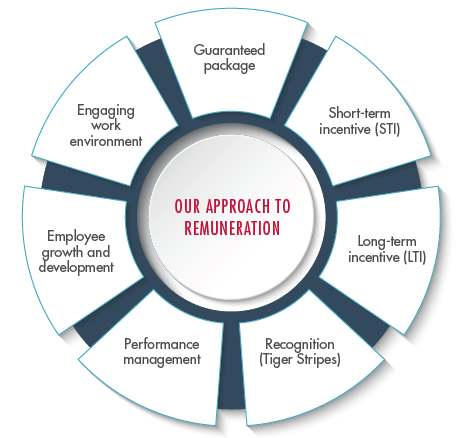
Summary of our remuneration elements
The monetary components of our remuneration offering comprise fixed remuneration in the form of a guaranteed package, and variable remuneration in the form of short-term and long-term incentive schemes.
Guaranteed package (GP) (excluding bargaining unit employees)
- Comprises base pay and benefits
- Benefits include retirement fund contributions, funeral cover, permanent health insurance, death-in-service cover and travel allowances (where applicable)
- Reviewed annually as per the factors below
- Factors determining GP: personal performance (KPIs based on balanced scorecard which includes financial and non-financial metrics), business performance (budget) and market competitiveness (national and sector benchmarks)
- Market benchmark for executive management and prescribed officers – bespoke survey of public data of South African companies listed on the JSE, based on market capitalisation and sector-appropriate peer companies
- Anchor point for market competitiveness
- Premium paid for high performance, high potential and scarce/key skills.
Short-term incentives (for employees in management and above)
- Paid annually in cash
- Primary intention - improve business performance by focusing participants' attention on key financial, strategic, functional and personal performance objectives (KPIs based on a balanced scorecard) for sustainable value creation
- By incorporating personal performance, the STI:
- Drives achievement of our short-term and long-term strategic goals
- Allows for differentiation in rewarding high performers
- The on-target percentage is benchmarked against the South African market to ensure we are aligned with market practice. It is based on affordability and the STI payment is based on achieving the objectives noted earlier
- Non-financial strategic measures are included in the personal performance objectives. Personal performance is incorporated through the personal performance multiplier, a discretionary percentage ranging from 0% to 175%. This facilitates the appropriate focus on the non-financial and strategic drivers that are key to sustainably achieving the business's long-term goals, particularly since the personal performance multiplier can significantly impact the quantum of an employee's STI
- Changes for FY18
- Based on shareholder feedback and an internal review, primary financial KPIs for executive directors have been revised to include HEPS (35%), earnings before interest and taxation (EBIT) (35%), sales volume growth (15%) and working capital management (15%).
Long-term incentive
Management and above
- Long-term sustainable performance is enabled by granting annual allocations of share appreciation rights (SARs) and bonus matching shares under the Tiger Brands Limited 2013 Share Plan (LTIP). In addition, ownership in the company's shares is encouraged by permitting a portion of the STI to be deferred. Key elements of the LTIP are summarised below:
- Annual awards of SARs, with a performance vesting condition of real HEPS growth, combined with an overarching condition that the company's return on capital must exceed its weighted average cost of capital. Targeted HEPS growth is equal to CPI and the annual growth in GDP. Vesting is on a sliding scale
- Annual awards of bonus matching shares are linked directly to achieving the short-term incentive bonus (STI) in the prior financial year. If no bonus is earned, bonus shares are not awarded
- A performance differentiation tool (PDT) is used to modify the standard quantum of SARs and bonus-matching shares, based on an individual's personal performance, leadership and ability. This is a discretionary percentage ranging from 0% to 200%
- Executive management and other senior management may voluntarily defer a portion (25%, 33% or 50%) of STI into company shares (deferred bonus shares), which are then matched 1:1 by the company (company matching shares)
- Vesting periods
- Bonus matching, deferred bonus shares and company matching shares: these are subject to continued tenure for three years after being granted
- SARs: these will be available to be settled in equal thirds on the third, fourth and fifth anniversaries of the date of allocation, but need not be exercised until the sixth anniversary, when they must be exercised or lapse. Vesting will depend on the company's performance relative to specified conditions, as set out above, measured over a three, four and five-year period, respectively
BEE schemes
Two schemes were previously established as part of the company's empowerment initiatives:
- Tiger Brands Black Managers Trust (BMT I)
- Established in 2005 to attract and retain talent
- Rights allocated - Tiger Brands shares. Rights are settled after making the required capital contributions to BMT I at any time after the specified lock-in period, ie from 1 January 2015. For all rights allocated after 31 July 2010, the lock-in date varies depending on the date of allocation
- Tiger Brands Black Managers Trust II (BMT II)
- Established in 2009
- As a mechanism to attract and retain talent, black managers received a once-off allocation of shares which vest on termination of the scheme on 31 December 2017 (after Tiger Brands has exercised its right to repurchase a certain number of shares from BMT II under an agreed formula). Periodically, new allocations were made to new joiners and top-up allocations were made to existing participants promoted to higher grades as shares became available after forfeitures
- As part of the company's plans to retain black talent, the remuneration committee has approved a specific retention allocation at 30 September 2017 to a select group of black managers (37), including two executive committee members. The lock-in period will run from 1 October 2017 to 30 September 2020. Participants defined as bad leavers during this period (eg resignation) will forfeit their allocation of shares. For those who remain employed until 1 October 2020, the shares will vest fully
- Thusani Trust
- Established in 2005 as part of the company's BEE phase I empowerment initiative. The trust's resources were enhanced in 2009 in terms of the company's BEE phase II transaction
- As part of our social investment initiatives, the trust provides bursaries for tertiary education to dependants of permanently employed black employees who might not otherwise be able to afford this cost
- Changes for FY18
- Given the success of the two black manager schemes in attracting and retaining key talent, and with no further shares available for allocation, the current policy of granting restricted shares has been adjusted to allow for the use of restricted shares as an attract-and-retain mechanism.
Historical LTI information
The last award of performance shares was made in May 2016.
Vesting of performance shares is determined by the company's comparative total shareholder return (TSR) relative to the TSR of the constituent members of the FINDI 30 index over the three-year vesting period as follows:
- Position 15 out of 30: the targeted number (one-third of maximum number) of performance shares awarded will vest
- Position 7 or better: the maximum number (three times targeted number) of performance shares awarded will vest
- Position 23 or worse: all performance shares awarded will be forfeited
- Between position 7 and 15, or between 15 and 23: a pro-rated number of performance shares will vest.
Any performance shares that do not vest at the end of the three-year period will be forfeited.
Performance conditions for SARs allocated before December 2016
For outstanding SARs allocated before December 2016, the performance vesting conditions are based on a targeted rate of 3% per annum real growth in HEPS over three, four and five-year periods.
Percentage threshold levels for real HEPS growth and corresponding percentage of allocation to vest:
 |
>0% and <0,5% | 5% |
|
≥0,5% and <1,0% | 10% |
|
≥1,0% and <1,5% | 16% |
|
≥1,5% and <2,0% | 27% |
|
≥2,0% and <2,5% | 44% |
|
≥2,5% and <3,0% | 75% |
|
≥3,0% | 100% |
- Dilution
- Under the rules of the Tiger Brands Phantom Cash Option scheme (which has been replaced by the LTIP), at any point the aggregate number of unexercised phantom options is limited to 10% of the total issued share capital of the company. As at 30 September 2017, aggregate outstanding options under the scheme represented 0,06% (2016: 0,18%) of the company's issued share capital
- The maximum aggregate number of shares that may be acquired by participants under the LTIP and any other share plan may not exceed 5,5 million shares; and for any one participant 550 000 shares. In determining these limits, shares acquired through the JSE and transferred to participants are not considered. As at 30 September 2017, the aggregate number of shares that may be acquired by participants under the various schemes was 1 742 012 (2016: 1 515 298).
Remuneration framework
The tables below summarise our remuneration elements and show how they are integrated as part of the company's total remuneration offering for FY17:

# Performance differentiation tool (PDT).
Total remuneration potential for members of executive management for the year ended 30 September 2017
| CEO | |||||
| R000 | GP | STI | LTI | Total | |
| Chief executive officer | Minimum | 8 547 | 2 153 | 4 841 | 15 541 |
|---|---|---|---|---|---|
| On-target | 8 547 | 4 305 | 5 809 | 18 661 | |
| Stretch | 8 547 | 6 458 | 6 778 | 21 783 | |
| CFO | |||||
| R000 | GP | STI | LTI | Total | |
| Chief financial officer | Minimum | 6 156 | 1 538 | 3 370 | 11 064 |
|---|---|---|---|---|---|
| On-target | 6 156 | 3 075 | 4 062 | 13 293 | |
| Stretch | 6 156 | 4 613 | 4 754 | 15 523 | |
| Other executives (average) | |||||
| R000 | GP | STI | LTI | Total | |
| Other executives (average) | Minimum | 3 785 | 937 | 1 659 | 6 381 |
|---|---|---|---|---|---|
| On-target | 3 785 | 1 875 | 2 081 | 7 741 | |
| Stretch | 3 785 | 2 812 | 2 502 | 9 099 | |
Minimum shareholding policy
We have introduced a minimum shareholding policy, where senior executives are expected to build up their personal shareholding in the company to a minimum level of 150% of GP (for the CEO) and 100% of GP for other executive committee members. Executives have six years to build up these holdings and may use a portion of their STI, any vesting LTIs or their own resources, to acquire these shares.
| Name | GP* | Value** | % of GP | Target % | Years remaining to meet target |
||
| LC Mac Dougall | 8 610 000 | 245 278 | 3% | 150% | 5 | ||
|---|---|---|---|---|---|---|---|
| NP Doyle | 6 150 000 | 3 282 190 | 53% | 100% | 5 | ||
| CFH Vaux | 4 963 351 | – | – | – | – | ||
| PW Spies | 4 600 000 | – | – | 100% | 6 | ||
| AG Kirk | 4 590 107 | 929 790 | 20% | 100% | 5 |
| * | GP as at 30 September 2017. |
| ** | Value calculated with reference to the closing price of a Tiger Brands share as at 29 September 2017, ie R377,35. |
Recognition
The Tiger Stripes programme has been refreshed and consolidated to focus on acknowledging the efforts of individuals and business teams in meeting business goals and to reinforce the behaviours aligned to our values and leadership principles.
The new programme also includes an on-the-spot recognition mechanism to enable line managers to reward employees immediately via cash awards (gift cards) for their efforts in successfully completing a specific project, a significant task or for sustained high achievement.
Executive service contracts
Senior executives are employed full-time under standard agreements with a notice period of three months. The current retirement age is 63, although a retirement age of 65 applies to two members.
We strive to bind all senior executives by a restraint-of-trade agreement. To the extent that executives have access to proprietary business insights and intellectual property, Tiger Brands will enforce the agreement should they join a competitor. The restraint comprises a three-month notice period and three months' special leave (paid as a three-month lump sum (based on guaranteed package) on termination.
For terminations due to retirement or retrenchment, contractual entitlements include a pro rata short-term incentive payment (based on the extent of achieving specified financial and strategic targets for the period and a personal performance agreement being in place at the date of exit). No pro rata bonus is paid to employees who leave for other reasons, eg resignation or dismissal.
The termination rules for awards made under the Tiger Brands Limited 2013 Share Plan specify that, if an individual's employment is terminated on a no fault basis, depending on the nature of the unit (ie whether it is SARs, bonus matching shares, deferred bonus shares or company matching shares) and reasons for termination, a participant may retain all units or a pro rata portion thereof. Accelerated vesting and settlement of retained units may apply in certain circumstances. In the case of a fault termination, all unvested units (other than certain deferred bonus shares) will be forfeited.
External board appointments
Tiger Brands encourages members of the executive committee to consider accepting appropriate opportunities to serve as non-executive directors on the main board or committees of external companies. We believe this encourages our executives to broaden their skills base and experience.
Under a formal policy, an executive is limited to one substantive outside directorship. The chairman of the Tiger Brands board, the chairman of the nominations committee, and the chairman of the remuneration committee are required to authorise these appointments based on a recommendation from the CEO. Directors' fees under this policy may be retained by the individual. Other than associate companies, Tiger Brands currently has no executive members serving as non-executive directors on the main boards of external companies.
Details of executive committee members serving on the boards of associate companies appear here.
Non-executive directors
Appointment and contractual arrangements
Non-executive directors are appointed to the board of Tiger Brands in line with related policy and procedures. These are formal, transparent and a matter for the board as a whole, based on a recommendation by the nominations committee. The letter of appointment confirms the terms and conditions for the tenure of this appointment and includes reappointment by rotation. In terms of the company's memorandum of incorporation, one-third of directors are required to retire by rotation at each AGM; their reappointment is contingent on being re-elected to serve on the board by shareholders.
Executive directors are subject to standard terms and conditions of employment and are required to retire from the board by rotation in line with the company's memorandum of incorporation. Any executive and non-executive director appointed to fill a vacant position during the year must be subject to re-election at the first annual general meeting following the appointment.
There are no contractual arrangements for compensation due to loss of office. Non-executive directors do not receive short-term incentives or participate in any long-term incentive plan.
Fees and approval process
Non-executive directors are paid an annual retainer that reflects their overall contribution and input to the company, and not just for attendance at board and committee meetings.
Fees are reviewed annually and increases are implemented in March after approval at the AGM. A bespoke survey is conducted to benchmark these fees against a global/local comparator group comprising companies of similar size and operating in similar industries. The measurement criteria include turnover, total assets and number of employees.
The chairman does not receive any additional remuneration for participating in committees of the board. Non-executive directors who perform services outside the scope of their ordinary duties may receive additional remuneration. Shareholder approval will be sought for increasing non-executive directors' fees, including fees paid for attending special board meetings and for additional work. Details of proposed increases for 2018 appear below as well as in the notice of AGM of shareholders to be held on 20 February 2018.
Details of non-executive directors' fees paid in the review period appear in part 3 below.
Shareholder engagement
We take our shareholder feedback seriously and aim to keep the lines of communication open. The remuneration committee is committed to shareholder engagement and will take the following steps if 25% or more of total votes exercised by shareholders at the upcoming AGM are against the remuneration policy or implementation report:
- The company will issue a SENS announcement inviting dissenting shareholders to note their specific concerns and to engage with the company, and
- The company will consider these concerns and report on the outcome of this engagement, and measures taken, in its next integrated report.
 For our full remuneration policy, please see www.tigerbrands.com
PART 3: REMUNERATION IMPLEMENTATION REPORT
The implementation report addresses the following:
- Feedback received from shareholders on the previous remuneration report and our response
- How the remuneration policy was implemented for the financial year under review
Summary of feedback from shareholders and responses
The following common themes of concern were noted by shareholders:
| Shareholder feedback | Response by Tiger Brands | ||
| Vesting criteria for performance shares were perceived as being overly generous. In addition, restricted shares are not subject to performance conditions | From December 2016, performance shares no longer form part of annual allocations. All regular annual LTI awards are subject to performance conditions, either in the form of "performance on the way in" (bonus matching shares/deferred bonus shares and company matching shares), which are linked to the achievement of a short-term incentive bonus or during the vesting period (SARs). |
||
|---|---|---|---|
| The absence of a return metric across incentive schemes | For SARs (from December 2016), a further condition for vesting to occur is that the average of Tiger Brands' annual returns on capital over the relevant performance period must exceed its weighted average cost of capital (WACC) for the same period. From FY18, KPI targets for executive management will include a targeted return on net assets (RONA). | ||
| The vesting criteria of 3% HEPS growth for share appreciation rights (SARs) being perceived as low | Performance conditions for SARs are usually viewed as an underpin, with the embedded condition of share price growth being the primary objective. Market benchmarks for SARs targets are usually more moderate than those for full-value share awards (CPI or CPI +2% pa compared to vesting targets for full-value shares which are CPI +5% to 10% pa). | ||
| Additional cash payments made to the CEO and CFO without specific substantiation | Sign-on bonuses are considered only in exceptional circumstances and may be required to compensate a prospective executive for unvested LTIs granted by his/her current employer. The company will only consider retention awards in exceptional circumstances, which was the case in 2016 after restructuring the executive committee and appointing a new CEO. | ||
| Executive directors' STI targets being reduced to a single measure of targeted group (HEPS) | This has been changed. From FY18, primary financial STI targets for executive directors will comprise HEPS (35%), earnings before interest and taxation (EBIT) (35%), sales volume growth (15%) and working capital management (15%). | ||
| The removal of strategic objectives, as a primary metric, from the short-term incentive scheme | We have enhanced disclosure on the STI scheme and executive management's KPIs, which include financial and non-financial measures. The STI scheme is a multiplier scheme, aligned with global best practice, using a "business multiplier" which primarily focuses on financial metrics to ensure alignment with shareholder outcomes, as well as a personal performance multiplier, which differentiates based on the achievement of an individual's KPIs. This ensures that there is personal accountability for both the financial and strategic aspects of our business. |
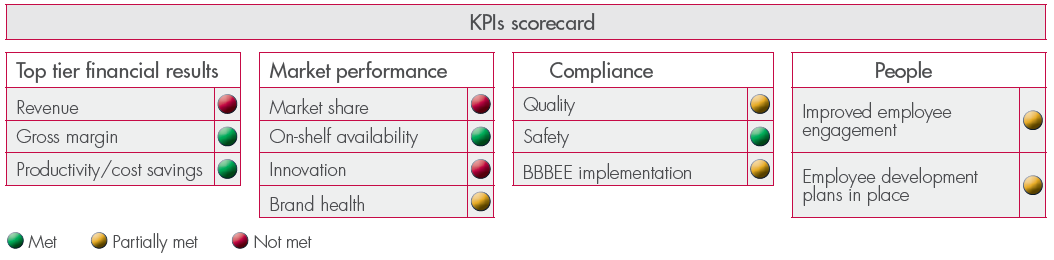
For the review period, in addition to the HEPS financial KPI, the following KPIs applied to the CEO and CFO. The level of achievement is reflected for each KPI:
Total remuneration of executive directors and prescribed officers
The total remuneration of executive directors and prescribed officers on a single-figure basis, as required by King IV and in line with guidance from the Institute of Directors and South African Reward Association is shown below.
Total remuneration of executive directors and prescribed officers for the financial year ended September 2017
| Name | Salary | Benefits | GP | Other | STI* | LTI | 2017 total |
|
| LC Mac Dougall** | 8 058 719 | 488 424 | 8 547 143 | – | – | 4 596 025 | 13 143 168 | |
|---|---|---|---|---|---|---|---|---|
| NP Doyle** | 5 211 772 | 943 704 | 6 155 476 | – | – | 5 334 903 | 11 490 379 | |
| CFH Vaux** | 4 531 406 | 398 030 | 4 929 436 | – | – | – | 4 929 436 | |
| AG Kirk** | 3 955 010 | 593 883 | 4 548 893 | – | 2 320 310 | 2 192 882 | 9 062 085 | |
| PW Spies*** | 2 343 743 | 490 568 | 2 834 311 | 1 740 154 | 1 782 738 | 1 586 233 | 7 943 436 |
| * | Value of STI includes the value of bonus deferrals, if any, given the LTI was allocated on 11 December 2017. |
| ** | Expected LTI value based on award as at 7 December 2016 at R395,97 per share. |
| *** | Expected LTI value based on award as at 5 September 2017 at R403,56 per share. |
| Other: sign-on bonus for PW Spies. | |
Total remuneration of executive directors and prescribed officers for the financial year ended September 2016
| Name | Salary | Benefits | GP | Other | STI* | LTI** | 2016 total |
|
| LC Mac Dougall*** | 3 053 378 | 215 745 | 3 269 123 | 20 000 000 | 256 250 | 7 119 518 | 30 644 891 | |
|---|---|---|---|---|---|---|---|---|
| NP Doyle | 4 716 246 | 923 254 | 5 639 500 | 10 000 000 | 417 993 | 4 402 954 | 20 460 447 | |
| CFH Vaux | 4 118 660 | 622 064 | 4 740 724 | – | 709 050 | – | 5 449 774 | |
| AG Kirk | 3 582 427 | 731 803 | 4 314 230 | 4 028 000 | 433 151 | 2 212 504 | 10 987 885 | |
| NG Brimacombe | 3 624 920 | 940 083 | 4 565 003 | – | – | 1 015 413 | 5 580 416 |
| * | Value of STI excludes the value of bonus deferrals, if any. |
| ** | Expected LTI value based on award as at 9 February 2016 at R291,71 per share. |
| *** | Expected LTI value based on award as at 5 September 2017 at R403,56 per share. |
| Other: sign-on bonus for LC Mac Dougall and retention payments for NP Doyle and AG Kirk. | |
2017 short-term incentive outcomes
The graphics below show the outcomes of the business multiplier component as well as the personal performance multiplier component relative to the targets for the respective executive directors and prescribed officers' schemes.
Executive directors
| Measure | Actual multiplier achieved |
Weight | Weighted multiplier % |
|
| HEPS | 0% | 100% | 0% | |
|---|---|---|---|---|
| Actual business multiplier for executive directors | 0% |

The individual outcomes for the executive directors are shown below.
| Name | GP* | On target % |
Actual business multiplier % |
Actual business multiplier % |
2017 STI |
2016 STI** |
|
| LC Mac Dougall | 8 610 000 | 50% | 0% | 100% | 0 | 512 500 | |
|---|---|---|---|---|---|---|---|
| NP Doyle | 6 150 000 | 50% | 0% | 130% | 0 | 835 985 | |
| CFH Vaux | 4 963 351 | 50% | 0% | 100% | 0 | 709 050 |
| * | Annual GP as at 30 September 2017. |
| ** | Includes the value of bonus deferrals. |
| Prescribed officers | |||
| Measure | Actual multiplier achieved |
Weight | Weighted multiplier % |
| EBIT | 130% | 70% | 91,1% |
|---|---|---|---|
| Working capital management | 50% | 20% | 10,0% |
| Sales volume growth | 0% | 10% | 0,0% |
| Actual business modifier for prescribed officers | 101,1% | ||
The individual outcomes for prescribed officers are shown below.
| Name | GP* | On target % |
Actual business multiplier % |
Actual personal multiplier % |
2017 STI** |
2016 STI** |
|
| AG Kirk | 4 590 107 | 50% | 101,1% | 100% | 2 320 310 | 646 494 | |
|---|---|---|---|---|---|---|---|
| PW Spies*** | 4 600 000 | 50% | 101,1% | 115% | 1 782 738 | N/A |
| * | Annual GP as at 30 September 2017. |
| ** | Includes the value of bonus deferrals. |
| *** | STI prorated as the start date was 1 February 2017. |
Short-term incentives for FY17
| Name | GP* | 2017 STI** |
% of GP |
|
| LC Mac Dougall | 8 610 000 | – | – | |
|---|---|---|---|---|
| NP Doyle | 6 150 000 | – | – | |
| CFH Vaux | 4 963 351 | – | – | |
| AG Kirk | 4 590 107 | 2 320 310 | 51% | |
| PW Spies*** | 4 600 000 | 1 782 738 | 39% |
| * | Annual GP as at 30 September 2017. |
| ** | Includes the value of bonus deferrals. |
| *** | STI prorated as the start date was 1 February 2017. |
Long-term incentives
Awards
The long-term incentive awards made during the year to executive directors and prescribed officers are set out below. The 10-day volume weighted average price at award date was R395,97 per share, on 7 December 2016 and R403,56 as at 5 September 2017.
| SARs | Bonus matching shares | Deferred bonus shares and company matching shares |
|||||||||||
| Name | PDT
multiplier |
GP | Award % |
Face value |
Number | STI*** | award % |
Face value |
Number | Match % |
Face value |
Number | |
| LC Mac Dougall* | 100% | 8 610 000 | 151% | 13 003 655 | 32 840 | 512 500 | 50% | 257 381 | 650 | 100% | 514 761 | 1 300 | |
|---|---|---|---|---|---|---|---|---|---|---|---|---|---|
| NP Doyle* | 150% | 6 150 000 | 145% | 13 375 867 | 33 780 | 835 985 | 50% | 629 592 | 1 590 | 100% | 839 456 | 2 120 | |
| CFH Vaux* | 100% | 4 963 351 | – | – | – | 709 050 | – | – | – | 100% | – | – | |
| PW Spies** | – | 4 600 000 | 110% | 5 287 443 | 13 102 | – | 50% | – | – | 100% | – | – | |
| AG Kirk* | 100% | 4 590 107 | 110% | 5 052 577 | 12 760 | 646 494 | 50% | 324 695 | 820 | 100% | 427 648 | 1 080 | |
| Expected value (based on fair value) | ||||
| Name | SARS | Bonus matching shares |
Deferred bonus shares and company matching shares |
|
| LC Mac Dougall* | 3 901 097 | 231 643 | 463 285 | |
|---|---|---|---|---|
| NP Doyle* | 4 012 760 | 566 633 | 755 510 | |
| CFH Vaux | – | – | – | |
| PW Spies** | 1 586 233 | – | – | |
| AG Kirk* | 1 515 773 | 292 226 | 384 883 | |
| * | Allocated on 7 December 2016 at a VWAP of R395,97. |
| ** | Allocated on 5 September 2017 at a VWAP of R403,56. |
| *** | STI in respect of the year ended 30 September 2016. |
Vesting
The outcome for awards due to vest in FY17, and whose performance conditions end by 30 September 2017, are shown below:
| LTI measures | |||
| LTI allocation | Total shareholder return |
Real HEPS growth |
Performance condition result (% vesting) |
| Performance vesting shares granted in February 2014. Vested in February 2017 | 
|
n/a | 300% |
| Phantom cash options granted in 2013 - third tranche* | n/a | 
|
- |
| Share appreciation rights granted in 2013 - third tranche | n/a |
|
- |
| Share appreciation rights granted in 2014 - second tranche | n/a | 
|
100% |
| Share appreciation rights granted in 2015 - first tranche | n/a |
|
27% |
| *Only 50% of which were subject to performance conditions. |
| Met |
Partially |
Not met |
Schedule of LTI awards
Unvested awards and cash flow from settling LTI awards for the CEO and CFO are tabulated below.
| Name and awards | Award date | Vesting date |
Opening number |
Granted during the year |
Grant price ZAR |
Forfeited during year |
| LC Mac Dougall | ||||||
| 2016 deferred bonus shares | 07/12/2016 | 07/12/2019 | – | 650 | – | – |
| 2016 company matching shares | 07/12/2016 | 07/12/2019 | – | 650 | – | – |
| 2016 bonus matching shares | 07/12/2016 | 07/12/2019 | – | 650 | – | – |
| 2016 performance shares | 26/05/2016 | 24/05/2019 | 8 160 | – | – | – |
| 2016 SARs | 24/05/2016 | 24/05/2019 | 12 000 | – | 341,68 | – |
| 24/05/2020 | 12 000 | – | 341,68 | – | ||
| 24/05/2021 | 12 000 | – | 341,68 | – | ||
| 2016 SARs | 07/12/2016 | 07/12/2019 | – | 10 946 | 395,97 | – |
| 07/12/2020 | – | 10 947 | 395,97 | – | ||
| 07/12/2021 | – | 10 947 | 395,97 | – | ||
| Total | 44 160 | 34 790 | – | |||
| NP Doyle | ||||||
| 2015 company matching shares | 03/12/2015 | 03/12/2018 | 2 688 | – | – | – |
| 2015 deferred bonus shares | 03/12/2015 | 03/12/2018 | 2 688 | – | – | – |
| 2016 company matching shares | 07/12/2016 | 07/12/2019 | – | 1 060 | – | – |
| 2016 deferred bonus shares | 07/12/2016 | 07/12/2019 | – | 1 060 | – | – |
| 2015 bonus matching shares | 04/02/2015 | 04/02/2018 | 2 320 | – | – | – |
| 2016 bonus matching shares | 09/02/2016 | 09/02/2019 | 1 330 | – | – | – |
| 2016 bonus matching shares | 07/12/2016 | 07/12/2019 | – | 1 590 | – | – |
| 2014 performance shares | 28/02/2014 | 28/02/2017 | 2 790 | – | – | – |
| 2015 performance shares | 04/02/2015 | 04/02/2018 | 2 490 | – | – | – |
| 2016 performance shares | 09/02/2016 | 09/02/2019 | 5 720 | – | – | – |
| 2012 Phantom Cash Share Options | 07/02/2012 | 07/02/2015 | 5 000 | – | 252,01 | – |
| 07/02/2016 | 5 000 | – | 252,01 | – | ||
| 07/02/2017 | 10 000 | – | 252,01 | (5 000) | ||
| 2013 Phantom Cash Share Options | 13/02/2013 | 13/02/2016 | 5 000 | – | 299,83 | – |
| 13/02/2017 | 10 000 | – | 299,83 | (5 000) | ||
| 13/02/2018 | 10 000 | – | 299,83 | – | ||
| 2014 SARs | 28/02/2014 | 28/02/2017 | 6 067 | – | 254,45 | – |
| 28/02/2018 | 6 067 | – | 254,45 | – | ||
| 28/02/2019 | 6 066 | – | 254,45 | – | ||
| 2015 SARs | 04/02/2015 | 04/02/2018 | 3 846 | – | 385,33 | – |
| 04/02/2019 | 3 847 | – | 385,33 | – | ||
| 04/02/2020 | 3 847 | – | 385,33 | – | ||
| 2016 SARs | 09/02/2016 | 09/02/2019 | 7 623 | – | 291,71 | – |
| 09/02/2020 | 7 623 | – | 291,71 | – | ||
| 09/02/2021 | 7 624 | – | 291,71 | – | ||
| 2016 SARs | 07/12/2016 | 07/12/2019 | – | 11 260 | 395,97 | – |
| 07/12/2020 | – | 11 260 | 395,97 | – | ||
| 07/12/2021 | – | 11 260 | 395,97 | – | ||
| Total | 117 636 | 37 490 | (10 000) |
| Name and awards | Performance condition achieved |
Settled during the year |
Closing number |
Cash received ZAR |
Value of shares acquired ZAR |
Closing fair value vesting ZAR |
| LC Mac Dougall | ||||||
| 2016 deferred bonus shares | – | – | 650 | – | – | 230 874 |
| 2016 company matching shares | – | – | 650 | – | – | 230 874 |
| 2016 bonus matching shares | – | – | 650 | – | – | 230 874 |
| 2016 performance shares | – | – | 8 160 | – | – | 5 209 752 |
| 2016 SARs | – | – | 12 000 | – | – | 1 175 280 |
| – | – | 12 000 | – | – | 1 270 080 | |
| – | – | 12 000 | – | – | 1 334 760 | |
| 2016 SARs | – | – | 10 946 | – | – | 894 945 |
| – | – | 10 947 | – | – | 966 182 | |
| – | – | 10 947 | – | – | 1 051 131 | |
| Total | – | – | 78 950 | – | – | 12 594 752 |
| NP Doyle | ||||||
| 2015 company matching shares | – | – | 2 688 | – | – | 981 846 |
| 2015 deferred bonus shares | – | – | 2 688 | – | – | 981 846 |
| 2016 company matching shares | – | – | 1 060 | – | – | 376 501 |
| 2016 deferred bonus shares | – | – | 1 060 | – | – | 376 501 |
| 2015 bonus matching shares | – | – | 2 320 | – | – | 867 054 |
| 2016 bonus matching shares | – | – | 1 330 | – | – | 483 309 |
| 2016 bonus matching shares | – | – | 1 590 | – | – | 564 752 |
| 2014 performance shares | 5 580 | (8 370) | – | 1 440 384 | 2 058 276 | – |
| 2015 performance shares | – | – | 2 490 | – | – | 567 820 |
| 2016 performance shares | – | – | 5 720 | – | – | 3 807 518 |
| 2012 Phantom Cash Share Options | – | – | 5 000 | – | – | 640 250 |
| – | – | 5 000 | – | – | 640 250 | |
| – | – | 5 000 | – | – | 640 250 | |
| 2013 Phantom Cash Share Options | – | – | 5 000 | – | – | 432 000 |
| – | – | 5 000 | – | – | 432 000 | |
| – | – | 10 000 | – | – | 864 000 | |
| 2014 SARs | – | – | 6 067 | – | – | 799 570 |
| – | – | 6 067 | – | – | 808 852 | |
| – | – | 6 066 | – | – | 849 786 | |
| 2015 SARs | – | – | 3 846 | – | – | 203 415 |
| – | – | 3 847 | – | – | 257 672 | |
| – | – | 3 847 | – | – | 295 603 | |
| 2016 SARs | – | – | 7 623 | – | – | 934 504 |
| – | – | 7 623 | – | – | 984 053 | |
| – | – | 7 624 | – | – | 1 021 331 | |
| 2016 SARs | – | – | 11 260 | – | – | 920 618 |
| – | – | 11 260 | – | – | 993 808 | |
| – | – | 11 260 | – | – | 1 081 185 | |
| Total | 5 580 | (8 370) | 142 336 | 1 440 384 | 2 058 276 | 21 806 294 |
A full analysis of the annual movement in phantom cash-settled options, performance shares, bonus matching, deferred bonus shares, company matching shares and share appreciation rights held by executive directors, prescribed officers and other members of the executive committee is set out in Annexure C of the annual financial statements.
Interests of directors and prescribed officers in BEE schemes
No executive directors or prescribed officers qualify to participate in either of the company's BEE schemes.
Non-executive directors' fees
Total emoluments to non-executive directors for the year ended 30 September 2017, inclusive of VAT from 1 June 2017, were:
| MO Ajukwu | SL Botha | MJ Bowman | K Hedderwick1 | M Makanjee | E Mashilwane2 | Dr KD Mokhele6 | |
| Board fees | 612 707 | 368 491 | 368 491 | 90 316 | 368 491 | 278 175 | 1 053 045 |
|---|---|---|---|---|---|---|---|
| Carozzi board meeting | – | – | – | – | – | – | – |
| Audit committee fees | – | – | – | – | – | 81 988 | 71 823 |
| Investment committee fees | – | – | 41 805 | – | – | – | 11 340 |
| Remuneration committee fees | – | 201 729 | – | – | 47 096 | – | – |
| Nominations committee fees | – | 7 560 | – | – | 7 560 | – | – |
| Social, ethics and transformation committee fees | – | – | – | – | 164 046 | – | – |
| Risk committee fees | 199 680 | – | 67 172 | – | – | – | 96 617 |
| Extraordinary fees | – | – | – | – | – | – | – |
| Ad hoc work/meetings | – | – | – | – | 25 200 | – | 47 880 |
| 812 387 | 577 780 | 477 468 | 90 316 | 612 393 | 360 163 | 1 280 705 |
| 1 | Appointed on 1 December 2016 and resigned on 14 February 2017. |
| 2 | Appointed on 1 December 2016. |
| 6 | Appointed as chairman on 21 February 2017. |
| BL Sibiya3 | RD Nisbet | MP Nyama | AC Parker4 | YGH Suleman | BS Tshabalala5 | |
| Board fees | 658 948 | 368 491 | 368 491 | 838 858 | 368 491 | 93 929 |
|---|---|---|---|---|---|---|
| Carozzi board meeting | – | – | – | 218 010 | – | – |
| Audit committee fees | – | 280 052 | – | – | 153 811 | – |
| Investment committee fees | – | 58 815 | – | – | 41 805 | – |
| Remuneration committee fees | – | – | 95 621 | – | 48 526 | – |
| Nominations committee fees | – | – | 7 560 | – | – | – |
| Social, ethics and transformation committee fees | – | – | 82 022 | – | – | – |
| Risk committee fees | – | 112 357 | – | – | 132 369 | – |
| Extraordinary fees | – | – | – | – | – | – |
| Ad hoc work/meetings | – | – | – | 22 680 | – | – |
| 658 948 | 819 715 | 553 694 | 1 079 548 | 745 002 | 93 929 |
| 3 | Resigned on 30 June 2017. |
| 4 | Resigned as chairman on 21 February 2017. |
| 5 | Appointed on 26 May 2017. |
Annual fees payable to non-executive directors for the period beginning 1 March 2017 were approved by shareholders on 21 February 2017.
Total emoluments to non-executive directors for the year ended 30 September 2016 were:
| MO Ajukwu | SL Botha | MJ Bowman | K Hedderwick | M Makanjee | E Mashilwane | Dr KD Mokhele | |
| Directors' fees | 352 664 | 352 664 | 352 664 | – | 352 664 | – | 352 664 |
|---|---|---|---|---|---|---|---|
| Carozzi board meeting | – | – | – | – | – | – | – |
| Audit committee fees | – | – | – | – | – | – | 138 947 |
| Investment committee fees | – | – | – | – | – | – | 3 780 |
| Remuneration committee fees | – | 194 995 | – | – | – | – | – |
| Nominations committee fees | – | 12 413 | – | – | 12 413 | – | – |
| Social, ethics and transformation committee fees | – | – | – | – | 152 351 | – | – |
| Risk committee fees | 86 641 | – | – | – | – | – | 186 077 |
| Extraordinary fees | – | – | – | – | – | – | – |
| Ad hoc work/meetings | 36 200 | 68 600 | 36 200 | – | 79 400 | – | 139 100 |
| 475 505 | 628 672 | 388 864 | # | 596 828 | # | 820 569 |
| # | Appointed during the 2017 financial year, thus not applicable for the year ended 30 September 2016. |
| BL Sibiya | RD Nisbet | MP Nyama | AC Parker | YGH Suleman | BS Tshabalala | |
| Directors' fees | 846 393 | 352 664 | 352 664 | 1 637 770 | 352 664 | – |
|---|---|---|---|---|---|---|
| Carozzi board meeting | – | – | – | 76 020 | – | – |
| Audit committee fees | – | 268 024 | – | – | 138 947 | – |
| Investment committee fees | – | 3 780 | – | – | 3 780 | – |
| Remuneration committee fees | – | – | 97 052 | – | 97 052 | – |
| Nominations committee fees | – | – | 12 413 | – | – | – |
| Social, ethics and transformation committee fees | – | – | 76 175 | – | – | – |
| Risk committee fees | – | 86 641 | – | – | – | – |
| Extraordinary fees | – | – | – | 36 200 | – | – |
| Ad hoc work/meetings | 36 200 | 139 100 | 57 800 | 32 400 | 171 500 | – |
| 882 593 | 850 209 | 596 103 | 1 782 390 | 763 943 | # |
Proposed non-executive directors' fees for 2018
The proposed fees from 1 March 2018, excluding VAT, to be approved at the AGM on 20 February 2018.
| Forum | Capacity | Current rate effective March 2017 |
Proposed rate resident board members – effective March 2018 |
Proposed fees for non-resident board members – effective March 2018 |
|||||
| Main board | Chairman | 1 744 825 | 1 849 515 | * | |||||
|---|---|---|---|---|---|---|---|---|---|
| Deputy chairman | 901 719 | * | * | ||||||
| Member | 375 717 | 398 260 | 915 998 | ||||||
| Audit | Chairman | 285 543 | 302 676 | * | |||||
| Member | 163 976 | 173 815 | * | ||||||
| Remuneration and nominations | Chairman | 208 463 | 220 971 | * | |||||
| Member | 94 191 | 99 842 | * | ||||||
| Risk | Chairman | 264 737 | 280 621 | * | |||||
| Member | 134 343 | 142 404 | 327 528 | ||||||
| Social, ethics and transformation | Chairman | 172 025 | 182 347 | * | |||||
| Member | 86 012 | 91 173 | * | ||||||
| Hourly fees | 3 931 | 4 167 | 9 584 | ||||||
| Extraordinary meetings | 19 765 | 20 951 | 48 187 |
| * Not applicable |
Non-binding advisory vote
Shareholders are requested to cast an advisory vote on the remuneration policy and implementation report in parts 2 and 3 of this report.