
Our key relationships
We understand that sustainable relationships with key stakeholders are essential to our long-term growth. Shareholders, employees, consumers, customers and suppliers are all part of the chain that creates value.
We also understand that we depend on broader society – not only stakeholders in our immediate value chain – to provide a conducive operating environment, and a consumer and talent base that we can reliably draw from in future.
As such, stakeholders in our broader socio-economic environment – law-makers, regulators, industry groups, the media and communities – all hold a stake in our licence to operate.
We develop key insights to inform our strategic choices for sustained growth through:
- A deep understanding of requirements for sustainable socio-economic development
- Considering the interests and expectations of material stakeholders
- Establishing relationships with stakeholders beyond our immediate value chain.
Stakeholder relations at Tiger Brands is, therefore, a strategic function. It is focused on constructive engagement to build positive reputational capital for the group as the principal mechanism underpinning our growth and sustainability (licence to trade).
We do this by acknowledging and understanding the role we play in society through multiple stakeholder lenses (the key issues and expectations our stakeholders have of us), using these expectations to inform our business strategy and decisions, and communicating these decisions back to our stakeholders. In this way, we build long-term value by establishing trust, good reputation and legitimacy.
Key elements of our stakeholder relations strategy include:
- Consistent approaches to engagement throughout the group
- Mechanism to anticipate risk and opportunities
- Coordinated framework for stakeholder management
- Leadership actively engaging with stakeholders
- Values-based engagement
- Stakeholder-focused as opposed to compliance-based engagement.
Our aim is to maintain our social licence to operate and protect the reputation of Tiger Brands as a trusted, strategic partner.
Stakeholder engagement survey
In the review period, we concluded a survey to develop a baseline understanding of how stakeholders perceive the group's engagement with them. This aligns with our strategic goal of increased stakeholder inclusivity, and meets the requirements of King IV.
The survey was used as a listening exercise to generate valuable insights that will inform and strengthen stakeholder engagement and ultimately relationships. Results will be used to refine our stakeholder engagement strategy and to inform and guide future planning, and proactively manage stakeholder-related risks by addressing their material issues and concerns.
Key results of the survey are summarised on the opposite page.
Key facts about the survey – conducted by external stakeholder management consultants
- Multiple methods of qualitative and quantitative data collection
- Target population included government (national and local)*, shop stewards, suppliers, shareholders, pressure groups*, community members, media, beneficiaries
- Stakeholders around ten Tiger Brands operations across South Africa were surveyed
- Final sample statistically significant at 70% of target population
*Poor response, with provincial government citing insufficient direct interaction with the group. Customers and employees are surveyed in separate initiatives (Our people)
Key results
Based on these results, we are developing and training relationship owners across the group, and developing specific plans to address particular issues, which we will report on in FY18.
| Performance metric | Score | Detail | |||||||||||||
| Quality of engagement | 72%
|
Government: national government 75%, local government 74%
Communities 74% 36% of stakeholders "know very little" about Tiger Brands as a JSE-listed company. Their relationship (mainly local government and community members) is with one of our operations |
|||||||||||||
| Relationship health (relational capital) | 70% | High: footprint communities 73%, beneficiaries of CSI projects and Tiger Brands Foundation 89%
Reasonable: national government 66%, shareholders 68%, local government 68%, suppliers 69% Low: media 58%, shop stewards 60% Stakeholders who scored Tiger Brands low cited engagement with the group as being too sporadic |
|||||||||||||
| Responsiveness on issues | 67% | Local government cited its experience of the quality of our engagement as generally good, but asked for improved responsiveness on issues it regards as important |
Plotting Tiger Brands' stakeholders on the exchange-communal continuum
- In exchange relationships, the company gives benefits to stakeholders but expects to almost immediately receive benefits of comparable value "in exchange". These relationships are conducive to commercial-type relationships.
- In communal relationships, the company's motivation to provide a benefit is the welfare of the stakeholder, or long-term greater good of the collective. Communal relationships are important for sustainability, social relevance and shared value.
How we fared
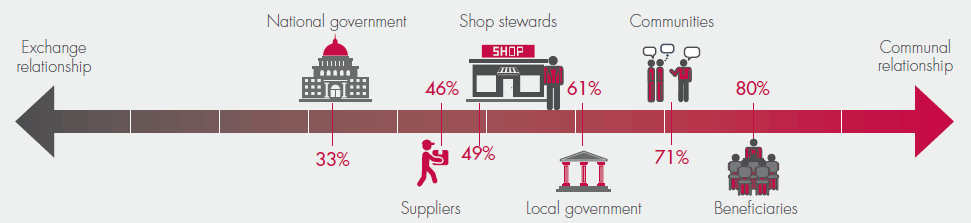
Key insights per stakeholder group
National government: While engagement was generally of high quality, we will focus on improving access to Tiger Brands' information. As part of developing a track record of communal relationships, we will enhance the degree of stakeholder inclusivity. |
Local government: Officials welcome the regional economic opportunity our activities support. As part of our more structured, continuous engagement in future, we will consider the real imperatives for sustainable socio-economic development and the negative impacts of our operations in certain instances, while ensuring we follow through on our commitments. |
Our footprint communities welcome their engagement with the group and are confident of our ability to make a positive contribution. We will ensure we improve accessibility at some operations, and respond more to real community needs, particularly in rural areas. |
The media believes Tiger Brands engages professionally and makes a positive contribution to food security, as do our peers. To build relationships based on satisfaction, trust and considering their legitimate interests, we are improving our rate of response and ensuring journalists have access to our leadership as required. |
||||||||


Our shareholders appreciate the high quality and transparency of their engagement with Tiger Brands. We are focused on improving this further by providing adequate disclosure on key issues while considering their feedback. |
We agree with shop stewards that work is still needed to achieve and maintain "preferred employer" status. Creating a great place to work is a strategic target, given intense competition for specific skills in our market. In considering the legitimate interests, priorities and realities of organised labour, we are ensuring that management communication across our sites is consistent and transparent. |
There is a high level of commitment and trust between the group and its suppliers. Given the scale of our supplier base, we are considering the different legitimate interests and engagement needs of different groups. This will include more continuous engagement, for example timely notification and effective handover when role players in Tiger Brands change. Together, we are focused on developing sustainable and mutually beneficial solutions, with inclusive growth opportunities. |


What are we doing with the information
Results were reviewed by the executive committee, social, ethics and transformation committee and the board. We have created a portfolio of dedicated managers to develop the strategy for stakeholder management, supported by relationship owners. Guided by metrics for each stakeholder group, we will develop an appropriate engagement plan for material stakeholders.
A key facet of our strategy to drive better engagement, resolve issues and co-create solutions for matters of mutual interest lies in developing relationship owners across the business. These are business leaders who have been identified and will be trained to manage and report on stakeholder health. This will bolster our relational value and provide additional governance and insight on issues before they become risks.
Our response - by stakeholder
National government |
 |
Quarterly executive engagements with key government ministries |
|||
Local government |
 |
Operating sites' relationship owners will implement engagement plans at local level |
|||
Footprint communities |
 |
Socio-economic development champions at each site will be the points of contact and engagement |
|||
Media |
 |
At least two media roundtable discussions with the executive team of Tiger Brands |
|||
Shareholders |
 |
Shareholder and investor engagement planned for 2018 includes individual and group meetings |
|||
Shop stewards |
 |
Regional engagements with union leadership planned for 2018 |
|||
Suppliers |
 |
Centralised management of key suppliers, with dedicated relationship owners |
Stakeholder issues in 2017
While the stakeholder survey becomes our benchmark for improving our engagements, we still need to address issues as they arise. Issues raised during the year are summarised below.
| Key issues in 2017 | Our response | Read more |
| Customers (retailers/wholesalers) | ||
|
|
Our customers and consumers |
| Employees | ||
|
|
Changing the way we work
Our people |
| Consumers | ||
|
|
Our customers and consumers
Consumer insights |
| Community | ||
|
|
Our communities
Consumer insights |
| Investors | ||
|
|
Strategic review
Changing the way we work |
| Government | ||
|
|
Transformation Our communities Our customers and consumers |
| Media | ||
|
|
|
| Suppliers | ||
|
|
Chief financial officer's review
Transformation Transformation |