
Our communities
Our success and our sustainability are directly linked to the well-being of our communities. They are the source of our most valuable asset - our employees - and support our businesses by buying our products.
Highlights
Committed R35 million (up from R23 million in FY16) to socio-economic development (SED) initiatives
First annual Tiger Brands SED partner workshop, hosting all our NGO partners across South Africa
Launch of the Tiger Brands household and community food garden initiative
Challenge
Gaps in the existing SED monitoring and evaluation framework
Key indicators
| 2017 Rm |
2016 Rm |
2015 Rm |
2014 Rm |
||||||
|---|---|---|---|---|---|---|---|---|---|
| Total SED spend | 35,0 | 23,0 | 24,2 | 24,0 | |||||
| Tiger Brands Foundation spend | 23,9 | * | 19,0 | * | 15,3 | 22,4 | |||
| Beneficiaries reached | 104 215 | 100 977 | 118 443 | 107 000 |
* For the foundation’s financial year to end-February.
Our approach
We honour our responsibility to contribute to the welfare of our communities through our socio-economic development (SED) strategy.
To ensure this strategy is integrated into our business objectives and focused on real – and changing – community needs, we critically reviewed our past approach to corporate social investment (CSI) to determine our future actions, illustrated here. We also incorporated insights from the 2017 stakeholder survey.
Tiger Brands socio-economic development strategy: 2017 and beyond
 |
Where we’ve come from | 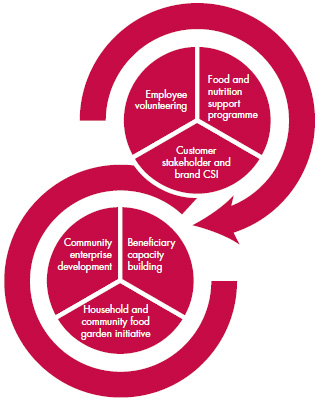 |
|
||
|
What has guided us | |
|
Our approach in action
While food security remains our overarching goal, our core SED programmes address the key goals of South Africa's national development plan (NDP) and UN Sustainable Development Goals.
Food and nutrition support programme
- We provide nutritionally balanced food parcels to the most in-need beneficiaries across South Africa through partnerships with food-focused NGOs and universities
- Through these partners, over 30 000 community members are reached monthly
- Supported communities include Soweto (Gauteng), Katlehong (Gauteng), Delmas (Mpumalanga), Plettenberg Bay (Western Cape), Stellenbosch (Western Cape), Ikageng (North West), Port Elizabeth (Eastern Cape), Potchefstroom (North West), Claremont (KwaZulu-Natal), Mohlakeng (Gauteng), Cape Town (Western Cape), Nwmitwa (Limpopo) and Braamfontein (Gauteng)
- Supported partners include four universities: Nelson Mandela University, Wits, Northwest University and University of the Western Cape.
CASE STUDY
| University nutrition support programme | |
|
For thousands of students across South Africa, meals are a daily challenge. In response, Tiger Brands launched the university nutrition support programme in 2017, partnering with tertiary institutions to provide much-needed nutritional support to struggling students. In June 2017, the University of the Western Cape (UWC) became our fourth partner. Almost 80% of students at UWC depend on some form of financial assistance, and an estimated 1 500 students are unsure about where their daily meals will come from. These students may be living on campus, in nearby community housing or travelling in daily from surrounding communities. The Tiger Brands programme forms part of UWC's new student support centre, and will be driven by the leaders of the student representative council (SRC), who plan to augment our food parcels with student-led food gardens. Tiger Brands has committed to providing nutrient-dense and fortified student food hampers to hundreds of students at UWC, Wits, Nelson Mandela University and North-West University. We are also providing support to establish and maintain food gardens at all campuses. |
Customer, stakeholder and brand initiatives
| Tiger Brands implements customer and brand-aligned initiatives with a meaningful social impact, including ad hoc stakeholder support during crises: | |
|
Beneficiary capacity building
| We focus on targeted community-based training in nutrition, food handling, health, food security and sustainability. Key initiatives during the year included: | |
|
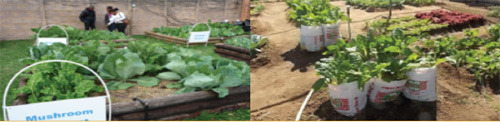
Community and household food-garden initiative
| Through partnerships with Food and Trees for Africa and Wits Siyakhana initiative, we provide training, support and mentorship to establish sustainable community and household food gardens |
|
||
|
Community enterprise development
 |
|
Employee volunteers
| We provide opportunities for our people to participate in social causes that are close to their hearts and in the communities in which they live and work. In the review period, these included: | |
|
FY17 snapshot
In the review period, we committed 1,5% of net profit after tax, or R35 million, to community development, achieving several milestones:
- Over 78 000 high-quality, nutrient dense and fortified food packages distributed (FY16: 13 200)
- 38 000 beneficiaries reached monthly via the Tiger Brands food and nutrition support programme (FY16: 41 000)
- Over 10 000 beneficiaries in crisis supported through our CSI and employee volunteerism programmes
- 25 000 learners received nutrition education material
- 194 community members trained in food gardening and community education.
| 2017 investments | Provinces | Nature of support | R000 |
| Food and nutrition support programme | Gauteng, Mpumalanga, Western Cape, KZN, Limpopo, Eastern Cape, North West | Food donations | 25 543 |
| Customer, stakeholder and brand CSI | All provinces | Food and supplies | 6 726 |
| Employee volunteerism | All provinces | Food and supplies | 85 |
| Beneficiary capacity building, household and community food garden initiative | All provinces | Capacity building, training, garden infrastructure and supplies | 1 400 |
| Site-specific community support | Western Cape | Training and supplies | 1 760 |
| Total | 35 514 |
Commitments for FY18
In the year ahead, we plan to accelerate the move from philanthropy to sustainable community investment. While we will continue to provide food packages, nutrition support is now backed by greater focus on creating food-secure communities with better health through:
- Nutrition education, food-handling training, health training and food security
- Training and mentorship on establishing and maintaining household and community food gardens
- Training, support and mentorship in identifying and establishing viable community enterprises concentrating on food security and the green economy
- Establishing a Tigers For Good network of champions across sites and operations
- Tracking the impact of initiatives by implementing a robust monitoring and evaluation system, supported by appropriate NGO partner training.
Tiger Brands Foundation
The Tiger Brands Foundation was established in 2010 to enhance our community impact and assist a broader range of underprivileged people in South Africa. It is managed by an independent board of trustees which establishes the criteria and procedures governing resource allocation.
Through the foundation, we develop partnerships with disadvantaged communities with whom we interact most.
Our operating model

The foundation implemented the first in-school breakfast feeding programme in 2011 in partnership with the Department of Basic Education's national school nutrition programme (NSNP). From six primary schools in Alexandra, this has expanded to over 90 schools in all provinces, providing the essential breakfast meal to over 63 600 learners. To date, over 51 million breakfasts have been served to our country's most vulnerable learners.
The programme is funded by a "trickle dividend" equal to 30% of dividends received from the foundation's 5% shareholding in Tiger Brands.
Practically, the foundation will build the capabilities to support its objectives. These include effective monitoring and evaluation (primarily by formally assessing social return on investment, and disclosing results in FY18), developing packaged and replicable solutions, and enhancing the capacity of key staff.
Flagship: Breakfast programme
WE’VE COME A LONG WAY SINCE 2011

* Approximately 2011 - 2017
The foundation partners with multiple stakeholders:
- The Department of Basic Education at national, provincial and local level
- Academic and research institutions (such as University of Johannesburg – Centre for Social Development in Africa)
- Beneficiary schools, parents and community leaders
- Community-based agencies (food delivery partners)
- Funders/donors investing in food-security and school-nutrition programmes
- Tiger Brands group, public and shareholders.
Enhancing capacity
The foundation introduced a food-handlers skills training programme accredited by the South African Qualifications Authority (SAQA) and welcomed by the Department of Basic Education. It was piloted in the Free State province with the support of the provincial education department, and aims to:
- Empower food handlers with appropriate knowledge about food preparation, safety and hygiene
- Extend the scope of SAQA-accredited training to give volunteer food handlers skills that will enhance their employability or opportunities for entrepreneurship after completing the nutrition programme
- Incorporate components of the national schools nutrition programme to ensure uniform food-preparation safety and hygiene standards.
Although food handlers are employed by the Department of Basic Education, they are paid a stipend by the foundation.
Commitments for FY18
- Given positive results from our public-private partnership model for in-school nutrition, we will expand this to more schools in South Africa
- We will continue to sponsor the first prize in the Department of Basic Education's annual NSNP awards for best school and best district. For the best school, this means R450 000 towards a school kitchen and adoption onto our in-school breakfast feeding programme for a minimum of three years. The best district will receive R80 000 towards equipment for the NSNP office
- Provide a stipend of R550 per month for food handlers
- The foundation will also donate at least four more school kitchens (for schools identified by the department) in FY18. Two of these will be built in partnership with a corporate funder.