Consumer Brands - food
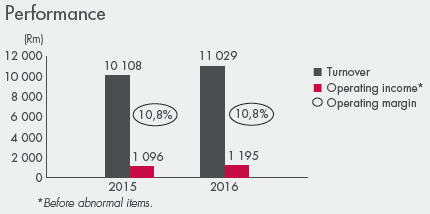
Turnover increased 9% to R11,0 billion and operating income was up 9% to R1,2 billion, despite aggressive competitor activity. The operating margin was maintained at 10,8%.
Salient features
- Groceries achieves margin of 9,9% while maintaining brand leadership in core categories
- KOO maintains leading position in top awards on page 29
- Improved manufacturing performance across all divisions
 Segment overview
This division houses many of the group’s iconic brands and includes Groceries, Snacks & Treats, Beverages, Value Added Meat Products and Out of Home.
Strategy
Entrench brand leadership and recover operating margin in specific categories through strategic pricing, improved operating performance, innovation, cost efficiency and enhanced manufacturing performance.
Performance
Turnover increased 9% to R11,0 billion, driven by 3% volume growth and 6% inflation. Operating income was up 9% to R1,2 billion, despite aggressive competitor activity and above-inflation increases in input costs. The operating margin was maintained at 10,8%.
|

 Visit our
HAPPY 90TH BIRTHDAY BLACK CAT – AND MANY MORE NUTTY YEARS AHEAD!
 Open up the world’s pantries and you will find one
product in almost all of them, peanut butter. Ask
a South African which brand they associate with
peanut butter and their answer is likely to be Black
Cat. In consumer research, Black Cat is mentioned
by 91% of people asked to name a peanut butter.
We are celebrating 90 years of peanut buttery goodness with Black Cat, the nutty spread that changed South African sandwiches forever.
- 1926 – Black Cat developed in South Africa by a company in Mokopane (formerly Potgietersrus) to quickly become a household staple through word-of-mouth support for its quality
- 1946 – Tiger Oats acquired Black Cat, investing in the brand through modern manufacturing techniques as well as extensive advertising and marketing campaigns
- 1967 – Professional golfer and local icon, Gary Player, endorsed Black Cat and appeared in many adverts
- 1973 – Tiger Oats sponsored the children’s radio programme The Adventures of Jet Jungle on Springbok Radio, heralding a new era for Black Cat and countering rising competition from private label brands
- 1980 – Does the name Felix Swart sound familiar? It should. Black Cat gave him supernatural strength in the popular TV programme Die Swart Kat.
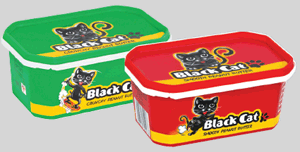
Black Cat quickly became a household staple in South Africa and remains the brand choice of peanut butter among parents to feed their children. Although Black Cat is a firm favourite for children, the target audience includes adults (young and old) too, making it the number one selling peanut butter and a firm favourite for healthier snacks.
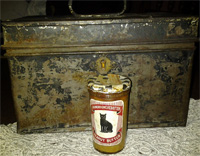
We remain ahead in continual innovation as well, such as plastic 600g tubs, and meeting health trends with our no-added sugar, no-added salt smooth and crunchy variants.
 Groceries
 continues its recovery and produced an improved
performance driven by its portfolio of consumer-preferred
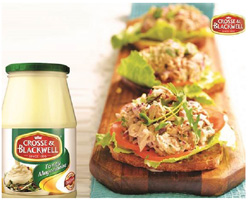
brands including KOO, All Gold, Crosse & Blackwell,
Black Cat and Mrs Ball’s. Turnover rose 10% to R4,7 billion
(2015: R4,3 billion) while operating income increased
by 13% to R466 million (2015: R411 million). As a result,
the operating margin improved from 9,6% to 9,9% in line
with guidance.
The division’s supply chain continues to focus on manufacturing excellence. The mayonnaise operation, which is now located in Boksburg (Gauteng), is now stable and performing to expectation after experiencing some initial challenges. Despite difficulties presented by the ongoing drought, the adverse impact on raw material availability was kept to a minimum. Although this was well managed, the drought and foreign currency volatility raised raw material and packaging costs significantly. We therefore implemented an appropriate pricing strategy, focused on price/volume management in a trading environment marked by aggressive competition and constrained consumer spending.
Innovation included the launch of successful flavour extensions to Mrs Ball’s, KOO’s expanded range of vegetable products and KOO Lite fruit products, as well as the domestic introduction of Benny stock flavouring.
Groceries continues to invest in its market-leading brands. The All Gold range was relaunched with a new brand advertising campaign. KOO continues to benefit from its current award-winning campaign, with the TV advert voted among Millward Brown’s Top 10 Best-liked Ads of 2015 (published July 2016). In addition, KOO was voted by consumers as South Africa’s favourite brand in the Sunday Times 2016 survey for a second consecutive year ahead of leading international brands.
Snacks & treats
This business is a market leader in sugar confectionery
through brands including Maynards, Beacon Allsorts,
MMMallows and Smoothies. It also markets chocolate slabs
(Beacon) where it enjoys the number 2 position, chocolate
bars (TV bar, Nosh, Nikki) as well as the snacking category
through Jungle.
During the review period, turnover grew 6% to R2,3 billion, reflecting slight volume share gains in a contracting market. Operating income of R316 million was maintained, despite significant input cost increases on major ingredients such as sugar, glucose, cocoa and nuts.
Good progress was made in 2016 on key factory issues that affected supply and customer service levels. We also made progress in product streamlining the portfolio by eliminating non-value-adding product lines. The category optimisation process that started this year will pave the way for greater innovation in FY17.
Building on the recent capacity investment in gums and jellies manufacturing, the business has invested in additional chocolate manufacturing capability to accelerate current momentum in chocolate slabs.
Beverages
With key brands including Oros, Energade, Rose’s and
Hall’s, the business recorded strong volume growth in the
period, driven by focused investment in core brands.
 Both turnover and operating income grew by 14% to
R1,3 billion (2015: R1,2 billion) and R157 million
(2015: R138 million), respectively. Despite significant
pressure on input costs, the operating margin
was maintained at 11,8% through various cost-saving
initiatives and mix management.
Investment continued during the year, building on the successful manufacturing architecture consolidation initiated in 2014. A state-of-the-art ready-to-drink production line was installed, paving the way for further innovation and productivity improvements.
Value-added meat products
The value-added meats category has moved from declining
growth in the previous year to a moderately positive
position, driven mainly by the polony segment. The
market-leading Enterprise brand has held up well against
this competition and has continued to gain share from other
major national brands.
Turnover increased by 6% to R2,2 billion (2015: R2,1 billion) and operating income by 8% to R158 million (2015: R146 million) despite significant cost increases in pork, driven indirectly by higher maize prices, particularly in the second half. The business achieved an operating margin of 7,1%.
The rate of innovation remains well above historical levels, further widening the gap against its main competitors.
During the year, the business acquired Hercules Cold Storage Proprietary Limited. Its core business is processed meats, focused on the economy segment. The facility will be converted into a Halaal-certified plant providing access to identified new channels, including the independently owned wholesale channel.
Out of home
Key drivers for the year included optimising product and
customer mix, with focus on higher-profit categories and
customers. The business grew volume by optimising the
entire Tiger Brands basket and focusing on combined
profitability. Improved service levels on key categories
contributed to an improved overall performance.
The food services market benefits when macro-economic conditions deteriorate and people trade down from fine dining to fast food.
For FY16, turnover increased 13% to R502 million (2015: R444 million) and operating income 14% to R98 million (2015: R86 million). Out of home sells all Tiger Brands’ products to food services customers such as caterers and restaurants, and is uniquely able to tailor solutions for these customers. This is a distinct competitive advantage in difficult trading conditions where customers face immense cost pressures.
Outlook
Trading conditions are expected to remain challenging in the year ahead, given widespread pressure on consumer spending, cost increases and aggressive competition. Accordingly, we will focus on increasing margins by driving cost savings and efficiencies and prioritising marketing efforts. In a highly competitive market, we will continue to focus on innovation to reinforce our core brands while optimising the price elasticity of our brands.