
Our customers and consumers
Highlights
Maintained leading market shares in core categories
New mobile platforms provide insights and improve efficiencies at store level
Challenge
Changing consumer behaviour and increasing competitive landscape
Our approach
Our customers are the retailers and wholesalers we distribute to in South Africa. We segment our major customers by channel (ie modern trade, general trade and pharmacy), by chain (ie major retailers, cash-and-carry shops) and by format (including hypermarkets, supermarkets and spazas – informal stores mostly in townships). To sustain strong customer relationships and a growth mindset, dedicated customer executives and shopper managers work in functional teams to serve each customer and their shoppers directly.

Our consumers are individuals who use our products: 95% of households in South Africa use our products daily, and our products are sold in over 33 countries across Africa.
Given that satisfied customers and consumers ensure the sustained and profitable growth of our company, we take our engagement with both groups of stakeholders seriously. In particular, consumers shape our business strategy and underpin our brand innovation and marketing strategy. This consumer-centric approach adds value to our company by offering a positive consumer experience that builds brand loyalty, the key to our continued success.
Consumer strategy
Our marketing strategy is driven by our focus on consumers – and how to satisfy their needs better in our specific product areas of the FMCG market. Key features of our strategy include:
- The renovation and innovation of our leading brands to maintain the number one or two position in our categories
- Investing in marketing support and innovation to drive our organic and new business growth plans
- Continually evaluating new or adjacent category entry opportunities, either through acquisition or innovation – particularly where we are able to drive expansion based on our leading brands
- Keeping abreast of key consumer trends and adapting our brand marketing strategies to better satisfy their needs
- Continually striving to encourage healthier eating by our consumers
- Given prevailing economic conditions, we provide greater value for money through a portfolio strategy premised on affordability.
In our international strategy, we aim to nurture and grow the businesses we currently own in the rest of Africa, and to strengthen our exports from South Africa by driving growth through focus and evolving the distributor model, determining optimal coverage and improving in-market visibility.
Customer strategy
Our operating landscape is undergoing significant changes that affect the way we go to market and in-store execution. Key changes to the retail landscape include:
- An increasingly crowded trading arena
- Shifting route to market, including independent channel growth
- Continued rise of the private-label brand
- Increasingly resilient independent trade
- Sub-channel development in retail
- Focus on margin
- The increasing role of data and technology
- Retailers operating for less
- Targeted collaboration/joint business planning
- Modern trade expanding into the rest of Africa
As a result of these factors and building on our progress to date, our strategy is based on five priorities:
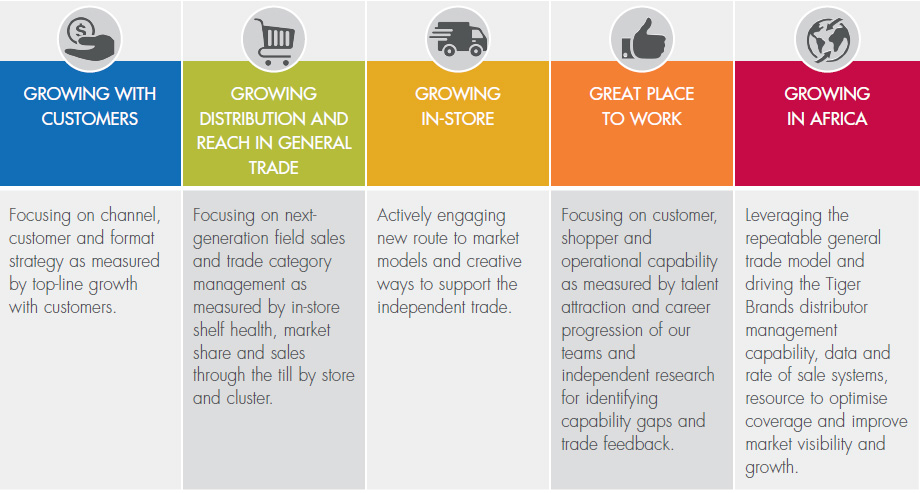
Underpinning these priorities are four strategic enablers:
- Harmonising customer operations in the field across all categories
- Customer IT and insight system
- Joint business planning
- Building a growth culture in customer teams.
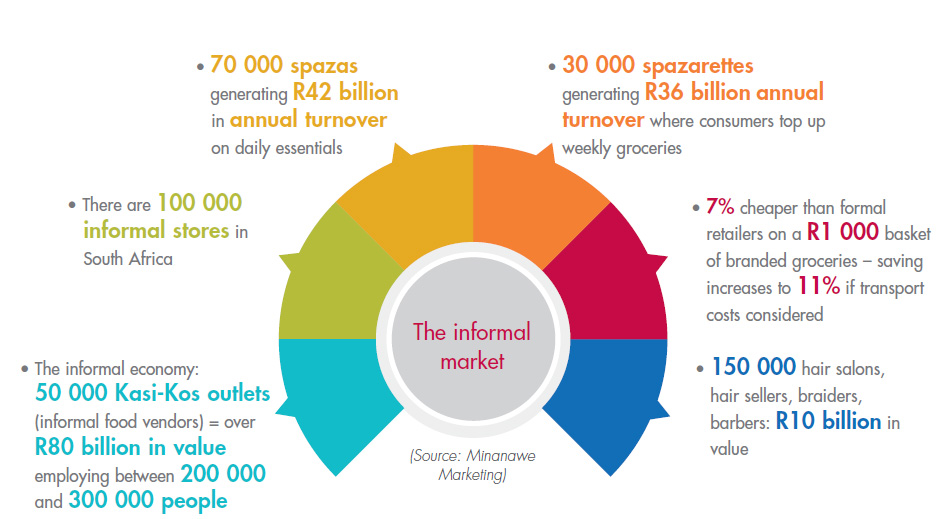
Our performance is tracked against three key metrics: customer growth, market share and service levels, including on-shelf availability, promotional and pricing activity. We set service level targets, which are agreed with customers and consistently perform within this range. We are strengthening our ability to track on-shelf availability and have set a target of a 50 basis point improvement on a basket of strategic products.
2016 overview
Customer and consumer engagement
Tiger Brands engages with customers in South Africa and our other operating countries using a number of channels. We talk to our customers about category strategy, value chain efficiencies, trading terms, as well as pricing and promotional activities. These engagements take place on regular call cycles as per the industry standard and as requested by trade customers. Complaints are handled directly by the sales and/or manufacturing unit.
Our consumer services division manages feedback and complaints. Our in-house consumer services centre is the primary channel for this feedback and addresses all complaints and queries on any of our products. Staffed by Tiger Brands employees, the call centre aims to answer all calls within 30 seconds. We have systems for managing all types of complaints, including food and health safety. These are elevated to the appropriate management levels and prioritised. For all consumer complaints, company feedback is given after an investigation and independent analysis when necessary. When consumer complaints are reported through the customer, we follow up directly with the consumer. Incidents that require a recall of the product or further quality checks are reported immediately to the respective quality managers.
Consumer insights
We value consumer insights and invest in ongoing research surveys such as the brand health tracker and Nielsen market share research:
- Brand health gauges the degree of brand recognition, consumers’ likelihood of choosing our products and how well we satisfy the needs of the market. We track brands across 21 categories and, in most of these, the health of our brand is far above our nearest competitor. In nearly all categories, we have widened the gap in recent years
- Nielsen research tracks product market share by value and volume, distribution, pricing and product movement.
In addition, consumer research enables us to identify consumer needs and preferences for current and new products and innovation. This enables us to harness consumer insights that inform the marketing mix accordingly. Typical consumer research projects conducted within our business include:
- Product testing: testing the “likeability” and evaluating the performance of actual products with consumers
- Concept testing: testing a product idea or proposition with consumers to gauge appeal and potential
- Use and attitude studies: profiling the consumer to understand patterns of use and attitudes to products and brands
- Volumetric/simulated test market studies: volumetric modelling (forecasting) used to aid innovation by simulating real-world consumer purchasing behaviour
- Immersions: spending time with consumers in their homes to better understand how products are used and their role in daily lives
- Pricing elasticity: determining the minimum, maximum and optimal selling price for a product to generate a favourable return
We use these insights to improve category understanding, pinpoint consumer needs, develop productive market segmentation models and identify potential market opportunities. They are vital in enabling us to continually refresh our brands, position our pricing, innovate and develop our marketing strategies. In 2016, key trends from our research included the role of foreign traders in the independent trade, the importance of growing in-store, the need for strong category management tools and the ability to track promotional investments. These trends have been incorporated into our customer strategy, which is above.
Tiger Brands commits significant investment to researching and understanding changing consumer needs. Research and development (R&D) for renovating existing products or designing new products is based on this understanding and insight. Our investment in R&D and new product development ensures we remain abreast of new technological developments that are used to better satisfy consumer needs.
Consumer nutrition and food safety
As a leading manufacturer, we are aware of the significant impact Tiger Brands has on the nutrition and thus health of its consumers. We monitor advances in nutrition and broader health issues, including World Health Organization (WHO) and South African Department of Health public health concerns.
We are dedicated to helping consumers make better food choices so that healthy living becomes easier. In 2009, we were the first South African company to voluntarily initiate the Eat Well, Live Well system that includes the guideline daily amount (GDA) table on all Tiger Brands’ products. The GDA notes the five nutrients that have an impact on non-communicable and lifestyle diseases, such as heart disease, type 2 diabetes, obesity and some cancers. The GDA table allows the consumer to balance high-risk nutrients for the day, and thus make better food choices. The Eat Well, Live Well system has its own icon – this is only featured on products that constitute better food choices for overall health – and website, where consumers can learn about the system and incorporate healthy eating into their lifestyle (www.ewlw.co.za). Consumers also have access to our nutritionist for further information or assistance.
With malnutrition affecting a significant proportion of the populations we serve, we understand the important responsibility that comes with manufacturing staple foods like bread and maize meal, particularly to people in lower-income categories.
In line with South African regulations, we fortify staple foods such as wheat flour (for bread manufacture) and maize meal with key vitamins and minerals. These include vitamin A, B1, B2, B3, B6, B9 (folic acid), iron and zinc.
In addition, we voluntarily enrich other products including breakfast cereals such as Morvite, certain Jungle cereals and Ace Instant with micronutrients that fulfil a specific consumer need. Products are specifically developed to target certain requirements, for example Jungle Energy bars are enriched with B vitamins that assist in releasing energy from food consumed.
After the South African minister of health regulated the maximum levels of sodium in certain food categories, manufacturers had to reduce salt by June 2016. Tiger Brands supports the efforts of government to improve the health of South Africans and we worked hard to achieve compliance on our affected categories (bread, breakfast cereals, processed meats, savoury snacks, instant noodles and stock concentrates). We will work as hard to meet the 2019 deadline for an even lower sodium level, reflecting our commitment to improving the nutrition of our products.
In February 2016, the South African minister of finance announced a tax on sugar-sweetened beverages to be implemented in April 2017. The policy paper on the proposed tax was published for comment on 8 July 2016, stating that the tax would address obesity in South Africa. Although the policy paper noted a few models of taxation that were considered, it recommended a model where every gram of sugar in a sweetened beverage would be taxed at 2,29 cents and determined from the product label.
Comments on the policy paper were submitted to National Treasury. Tiger Brands also aligns to the stance of BevSA, our industry body, that a tax would have far-reaching socio-economic repercussions without a substantial effect in reducing obesity. As such, the tax should be withdrawn and existing collaborative efforts to address obesity between the Department of Health and industry should continue.
National Treasury is conducting a socio-economic study. The outcome of this study and consultation requests are awaited by industry, including Tiger Brands.
 Tiger Brands introduced its Eat Well, Live Well system
in 2009 to encourage consumers to eat healthier,
balanced meals. Products carrying this logo conform
to strict nutritional criteria, which are annually and
independently reviewed by the Nutrition Information
Centre of the University of Stellenbosch.
The quick-reference Eat Well, Live Well logo and concise GDA information enables consumers to instantly recognise the healthiest options for their meals.
Currently, products such as Tastic Rice, Jungle Oats and some Albany bread variants carry the logo after conforming to the strict Eat Well, Live Well criteria. Our nutritionist works closely with product managers to help them formulate new and existing products in line with the criteria.
For more information on Eat Well, Live Well
 Visit our website for additional information |
Consumer regulatory compliance and industry participation
Tiger Brands ensures a high standard of compliance to consumer legislation and codes. We comply with the Consumer Protection Act, Foodstuffs, Cosmetics and Disinfectants Act and other laws that ensure consumer protection. Areas of compliance refer to aspects of product labelling, pricing policies, product liability and safety, returns policies, marketing, standard terms and conditions and promotional competitions.
In terms of Consumer Protection Act requirements, we have made the required changes across our business to ensure compliance. These included revising processes for running promotional competitions. We have also conducted training to ensure our personnel are familiar with both the provisions and applications of the act. This included training staff at our existing consumer services unit, which addresses consumer complaints.
In addition, we subscribe to the consumer goods and services industry code, which is enforced by the consumer goods services ombudsman, and adhere to the Advertising Standards Authority code that ensures responsible advertising to consumers.
Tiger Brands is a member of the Marketing Association of South Africa and our group marketing executive serves actively on the board of this industry body. The association primarily focuses on:
- Regulatory matters
- Education and transformation of marketing skills in South Africa
- Media research
- Advertising self-regulation through the Advertising Standards Authority.
Tiger Brands complies to current labelling regulations and continuously engages with government authorities through industry associations on new or amended labelling regulations.
Generally accepted food manufacturing standards are rigorously applied and food safety at all facilities is regularly audited by independent assurance providers.
Responsible selling
Tiger Brands is dedicated to responsible advertising and marketing and committed to upholding the Advertising Standards Authority code on advertising. We fully comply with all regulatory requirements on marketing and labelling for foods, beverages, personal and home care and baby products.
All aspects of responsible selling skills are addressed in our business units and supported by secretarial and legal services. In addition, the Tiger Brands Customer School of Mastery, an internal training programme, covers all key competencies and skills in a market and customer-related curriculum.
Commitments for FY17
The retail landscape has changed significantly in recent years due to poor economic growth. As a result, we have had to adapt our approach and engage differently with our customers and consumers.
Consumers want additional value from supermarket purchases and we have to ensure that our products, many of which are the preferred consumer choice, are available at all points of purchase at a price that represents value to shoppers. This requires a strong focus on cost efficiency throughout our value chain, appropriate promotional activity in-store, and affordable pricing.
As we seek to empower our consumers to make better decisions about their nutritional habits, we aim to form strategic relationships with public sector and non-profit partners. Together, we hope to educate children and consumers on healthy eating habits through effective use of the Eat Well, Live Well system and GDA table.