Our communities
Highlight
Allocated R23 million (over 1% of net profit after tax) to socio-economic development initiatives
Key indicators
| Rm | 2016 | 2015 |
2014 | 2013 |
|||||
|---|---|---|---|---|---|---|---|---|---|
| Total CSI spend | 23,0 | 24,2 | 24,0 | 22,9 | |||||
| Tiger Brands Foundation spend | 19,0 | ** | 15,3 | 22,4 | 12,2 | ||||
| Beneficiaries reached | 100 977 | 118 443 | 107 000 | * |
| * | 2013 beneficiary data not available. |
| ** | For the foundation’s financial year (1 March 2015 to 29 February 2016). |
Our approach
Our success as a group is inextricably linked with the well-being of our communities. They are not only the source of our most valuable asset – our employees – but also sustain our businesses by buying our products. It is therefore our responsibility to contribute to their welfare. We honour this commitment through our corporate social investment (CSI).
Our CSI approach is rooted in the belief that Tiger Brands can add value to people’s lives and reflected by our investments in surrounding communities. Through socio-economic upliftment, we believe we build a sustainable legacy, and help to weave a constructive social fabric in each country where we operate.
Tiger Brands contributed food parcels to 15 non-profit organisations (NPOs), community-based organisations and beneficiary organisations. We also support requests for ad hoc donations or specific requests from organisations in crisis. This includes partnering with the Department of Agriculture, Forestry and Fisheries on a major drought-relief initiative which will provide support via boreholes, water, fodder and food parcels to identified villages and towns.
We also partnered with our customer, Shoprite, in a separate drought-relief programme, distributing 2 200 food parcels to destitute communities in Greytown, KwaZulu-Natal, while Shoprite provided water. This coincided with national water week.
Our core CSI programmes address some of the key goals of South Africa’s national development plan (NDP) and the United Nations Sustainability Development Goals by contributing to the fight against food and nutrition insecurity through key focus areas:
- Food security: nutritional support programme
- Sustainability: green environment (carbon footprint, packaging recycling).
We encourage employee involvement in community-related initiatives that benefit the vulnerable, including orphans, children, youth, women, people infected with HIV/Aids, the disabled and the disadvantaged.
Our CSI strategy is executed through established policies and procedures, overseen by the social, ethics and transformation committee. We regularly review beneficiary organisations to ensure the most effective impact on our communities.
2016 overview
The group committed over 1% of net profit after tax, or R23 million, to community development in 2016, achieving several milestones:
- Over 13 200 food parcels distributed
- 41 000 beneficiaries reached via the Tiger Brands nutrition support programme.
2016 CSI investments
| Project type | Geographical presence | Impact | R000 |
| NGOs providing social support to communities | Gauteng, Western Cape, Eastern Cape, KwaZulu-Natal, Mpumalanga, Limpopo | Food provision and cash donation | 18 347 |
| Humanitarian support/ad hoc donation | All provinces | Food provision and cash donation | 2 767 |
| Goodwill building | Western Cape | Capacity building | 250 |
| Cause-related marketing | Gauteng | Cash donation | 845 |
| Employee volunteerism | All provinces | Supplies donation | 502 |
| School holiday food distribution | Gauteng, Western Cape, Eastern Cape, KwaZulu-Natal, Mpumalanga, North West | Food provision | 382 |
| Total | 23 093 |
Food security
Food security is a natural fit with Tiger Brands, as much of our business stems from the sale of food. We are therefore keenly aware of the critical role our products play in supporting the well-being of the population in sub-Saharan Africa.
Our valuable partnerships with NGOs and other community organisations are critical to achieving our goals in terms of our beneficiaries. Key beneficiaries of FY16 are summarised below.
Buhle Farmers Academy
Buhle Farmers Academy was established in 2000 to provide practical skills training to farmers on crop, livestock, vegetable, poultry production and farm management. Its purpose is to support and empower new farmers to start profitable farming activities. The academy also provides post-training support to assist farmers in setting up and expanding their farms.
It enrols over 500 students per annum, with some 5 000 students trained over the past 16 years.
Tiger Brands has supported farmer development through this academy since 2009 by supplying dry foodstuffs for students’ meals. Buhle Farmers has been able to invest the equivalent value into subsidising students who cannot afford the full cost of training.
Love to Give Stellenbosch
Love to Give’s primary focus is nutrition. It aims to fight malnutrition, prevent stunted growth and address obesity by giving children in need a nutritious meal that enables them to concentrate and learn better in school. It works with other NGOs in Kayamandi, Stellenbosch, on after-school care programmes, providing food that ensures good attendance and productivity on the programmes for almost 2 100 young beneficiaries who are all black.
Nelson Mandela Metropolitan University (NMMU) community project
In 2008, NMMU and Tiger Brands collaborated to ensure needy students and communities received vital nutrition. NMMU provides meals to over 680 students to ensure they have the nutritional support to complete their studies and enter the world of work. This way, with Tiger Brands’ support, NMMU endeavours to break the cycle of unemployment and poverty.
The NMMU community project also uses our products to support surrounding communities with food, including 60 orphans from Sinethemba Children’s Home and Laphumilanga HIV/Aids home-based care centre for children affected by the disease. It also provides 100 daily meals to the community through a soup kitchen in Malabar, while Noxolo Preschool benefits from food products for 40 learners daily.
Cotlands
Early childhood development (ECD) is a critical focus area in the national development plan and Cotlands specialises in the delivery of a holistic model on non-centre-based ECD. This includes education, nutritional support, health and psychosocial intervention and support.
Commitments for FY17
Building on a new strategy developed in FY16, the CSI team will focus on the tiered approach by investing in:
- Annual projects aligned to CSI strategy
- Employee volunteerism
- Brand-related CSI
- Site and operations-related CSI.
The Tiger Brands Great South African Student
Chef Cookout |
|
Tiger Brands proudly partnered with the Nelson Mandela Foundation to sponsor the first Great South African Cookbook – a celebration of South African cuisine from top local chefs, cooks and food artisans. In addition to the sponsorship, we facilitated a national competition among culinary students at technical and vocational education and training colleges. |
Tiger Brands Foundation
The Tiger Brands Foundation owns an effective 5% of Tiger Brands Limited and was established in 2010 to enhance our community impact and assist a broader range of underprivileged people in South African society. It enables the group to develop partnerships with those disadvantaged communities with which we interact most. It is managed by an independent board of trustees that establishes the criteria and procedures governing resource allocation.
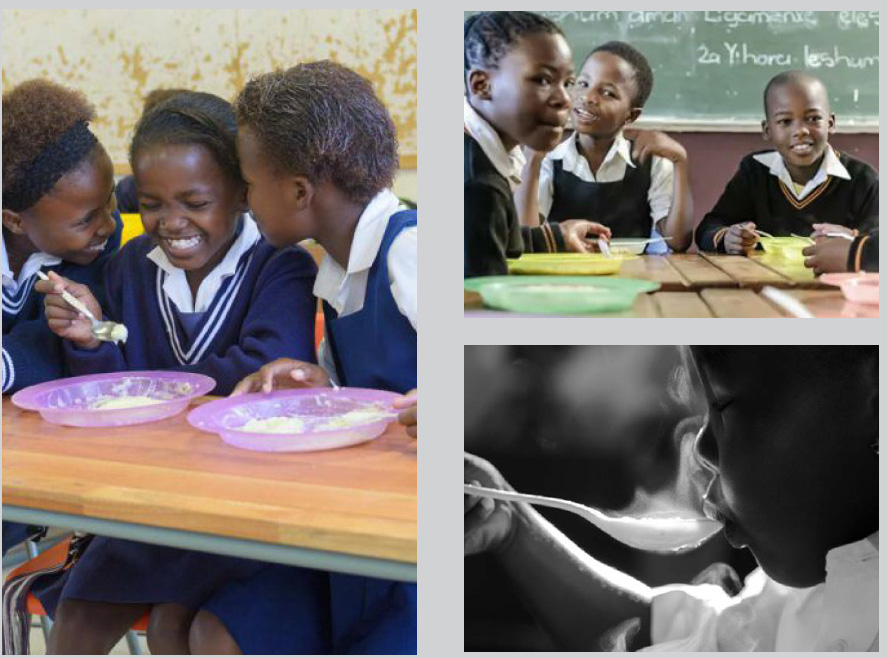
The foundation implemented the first in-school breakfast feeding programme in 2011 in partnership with the Department of Basic Education’s national school nutrition programme. From six primary schools in Alexandra, this has expanded to 89 schools in all provinces, providing the essential breakfast meal to almost 60 000 learners. To date, over 40 million breakfasts have been served to our country’s most vulnerable learners.
| Tiger Brands Foundation snapshot |
|
|
The in-school breakfast feeding programme is funded by a “trickle dividend” equal to 30% of dividends received from the foundation’s shareholding in Tiger Brands. Given the success of the current feeding programme, the foundation expanded its activities to significantly more schools across the country earlier this year.
In 2016, the Tiger Brands Foundation adopted a new strategy for 2022, aimed at becoming a highly effective, impactful and recognised industry leader in vulnerable child nutrition and wellness, with a sustainable financial position. To reach this goal, we will focus on:
- Financial sustainability
- Continued direct impact
- Targeted advocacy
- Strategic partnerships
- Positive reputation.
Practically, the foundation will build the necessary capabilities to support its objectives. These include specifying, measuring and managing its impact through effective monitoring and evaluation, developing packaged and replicable solutions and enhancing the capacity of key staff.
From January 2016, the foundation has added 24 schools (translating to roughly 20 000 beneficiaries). It also provided infrastructural support by donating two school kitchens. Ongoing training includes support for the senior management teams of schools where the breakfast programme has been implemented.
Since inception, the programme has demonstrated the significant difference an effective public-private partnership can make to learners via an in-school feeding programme. The breakfast menus were specifically developed by an independent nutritionist to offer optimum nutrition to learners, in turn improving attendance, class participation and performance while supporting physical development. This was confirmed in recent research conducted by the Centre for Social Development in Africa: the 2015 study indicated that the combination of our feeding programme and the lunch meal from the Department of Basic Education has contributed to a reduced occurrence of wasting or stunting and obesity in learners and improved learner performance (see case study on page 68).
The foundation fulfils its mission by partnering with multiple stakeholders, including:
- The Department of Basic Education at national, provincial and local level
- Academic and research institutions (such as University of Johannesburg – Centre for Social Development in Africa)
- Beneficiary schools, parents and community leaders
- Community-based agencies (food delivery partners)
- Funders/donors wishing to invest in food security and school nutrition programmes
- Tiger Brands, the public and shareholders.
The programme has also been instrumental in supporting 310 jobs for food handlers who prepare breakfasts provided by the foundation. Although food handlers are employed by the Department of Basic Education, they are offered a stipend by the foundation.
Commitments for FY17
- Given the positive results from our public-private partnership model for in-school nutrition, we will continue to expand this initiative to more schools in South Africa
- In line with this commitment, Tiger Brands Foundation will continue sponsoring the first prize in the Department of Basic Education’s annual NSNP awards in the categories best school and best district. For the best school, this means a donation of R450 000 towards a school kitchen and adoption onto our in-school breakfast feeding programme for a minimum of three years. The best district will receive a donation of R80 000 towards office equipment for the NSNP office
- The foundation will also donate at least one more school kitchen (for a school identified by the department) in FY17.
ADDING VALUE TO LIFE
In South Africa, around one-third of 18 million children (0 to 18) have inadequate or severely inadequate access to food. The worst cases were found in the North West, Northern Cape and Eastern Cape provinces, with the Eastern Cape recording the worst prevalence of food insecurity at 39% – that translates into two of every five children facing hunger.
Recognising the long-term impact on physical and mental development, ability to learn and, ultimately, the economically active population, the government has implemented several programmes, including the National School Nutrition Programme or NSNP. The Tiger Brands Foundation joined this initiative in 2011 with the in-school breakfast programme.
In 2015, the Centre for Social Development in Africa evaluated the combined impact on learners who receive breakfast (Tiger Brands programme) and lunch (NSNP) at school daily in the Lady Frere district of the Eastern Cape. As background, over 50% of households in this district live in poverty, while 36% experience hunger – making services such as government grants and nutritional initiatives especially important.
The results were unequivocal:
- Very low levels of children being underweight (a cause of stunting)
- Dramatic reduction in the rate of overweight and obese learners (at some 11% versus combined national rate of 28%)
- Learner performance improved by 10%
- Highest zero absenteeism rate at schools providing breakfast.
Childhood obesity is strongly associated with adult obesity and non-communicable (lifestyle) diseases such as type II diabetes and heart disease. The study indicated that the protective effects of the NSNP and breakfast programme may therefore translate into longer-term economic benefits from a healthier population, more economically productive and less burden on the healthcare system.