
Risk management report
Effective risk management is fundamental to the business activities of Tiger Brands. By identifying and proactively addressing risks and opportunities, the group aims to generate sustained value for stakeholders while protecting its business operations, reputation and the well-being of its employees.
Tiger Brands recognises that risk in business is a complex and diverse concept and that there are many parts of the organisation working at managing risk exposures. Our intention is that these parts will work together in a consistent and integrated manner to manage and reduce risk appropriately. Ultimately, the function of risk management is to assist Tiger Brands in achieving its objectives and to ensure a safer, healthier work environment for employees while preserving assets and earnings for the benefit of stakeholders.
During the review period, our risk reporting process was revised to consolidate similar risks into broader categories that amplify the impact:
- Intensifying competition now relates to innovation, the relationship with retailers and our response to a changing competitive landscape
- The risk of inadequate human resource management is now a consolidation of management’s ability to further mitigate against labour unrest, develop key talent and attract the appropriate resources to deliver against the group’s strategy
- Maintaining cost competitiveness is addressed through appropriate procurement strategies as well as securing raw material supply
- Business continuity is a consolidation of IT systems failure, catastrophic loss to manufacturing facilities and the availability of water and electricity.
Risk velocity, which is the time taken for Tiger Brands to feel the impact of a risk after it materialises, has been introduced into the risk assessment process as an additional indicator for management to consider during risk management and mitigation.
Tiger Brands is currently reviewing its strategy. While risk management is integral to this process, the work-in-progress nature of the strategic review precludes linking specific risks to strategic objectives in this report. In future reports, we will be able to disclose this detail, with metrics and targets for key risks.
Approach
Tiger Brands effectively identifies, manages and reports on risk across the organisation. Risk management activities are embedded in daily operations through processes, resources and structures. The group has adopted an enterprise-wide approach, meaning that every identified material risk is included in a structured and systematic process of risk management.
Risk appetite and tolerance
Risk appetite – the level of risk management is prepared to absorb before mitigating actions are implemented – has been determined by setting exposure limits at three tiers:
- Tier 1: any calculated risk exposure that requires no further management mitigation, ie does not present a catastrophic threat to Tiger Brands
- Tier 2: a threshold zone where any risk exposure that exceeds our risk appetite, but remains within the risk tolerance, may be acceptable but management must make a conscious decision about risk tolerance versus risk mitigation
- Tier 3: All risk exposure above our risk tolerance will be considered a significant risk and must be supported by a comprehensive mitigation plan and timeline for implementation.
Exposure limits are determined after assessing residual risk. The risk appetite and tolerance of the group is set by the risk and sustainability committee and approved by the board.
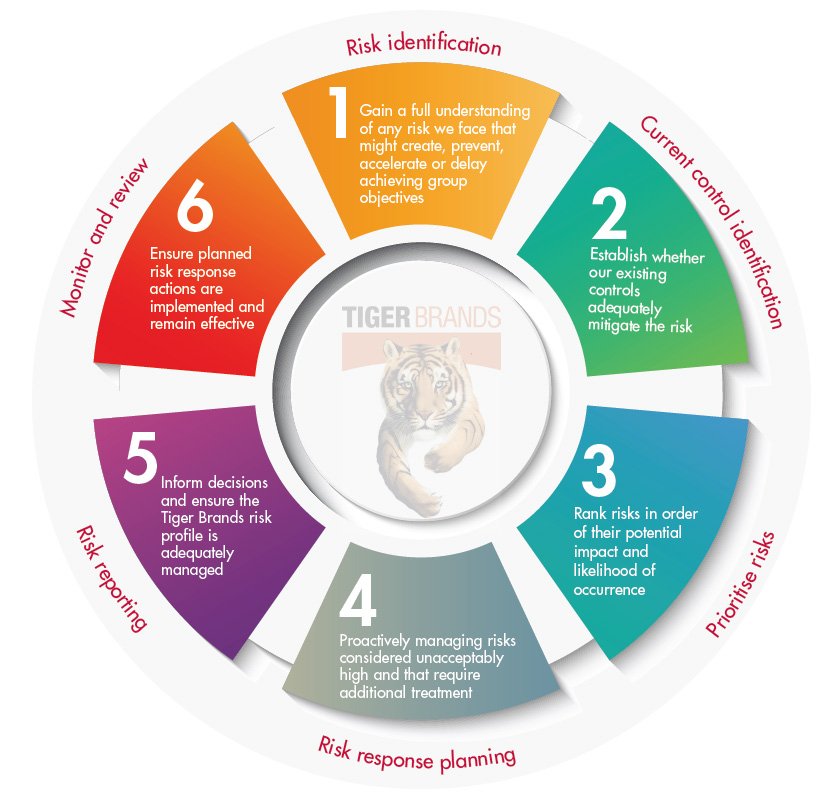 |
This process complements existing risk management processes and aims to ensure Tiger Brands effectively identifies, manages and reports on risk across all operations and all territories. The underlying reporting structure starts at site level and rolls up into the relevant business unit. After that, divisional consolidation among business units culminates in risk reporting at group level.
Governance
The board of directors is ultimately responsible for oversight of the group’s risk management processes. The risk and sustainability committee assists the board by ensuring that the risk management process complies with the relevant standards and governance requirements in all the group’s operating territories. Divisional and business unit risk registers are updated quarterly and the risk and sustainability committee meets three times in the year.
Senior management in each division and business unit is responsible for managing risks in its area. Oversight of risk management at divisional level rests with the relevant executive committees.
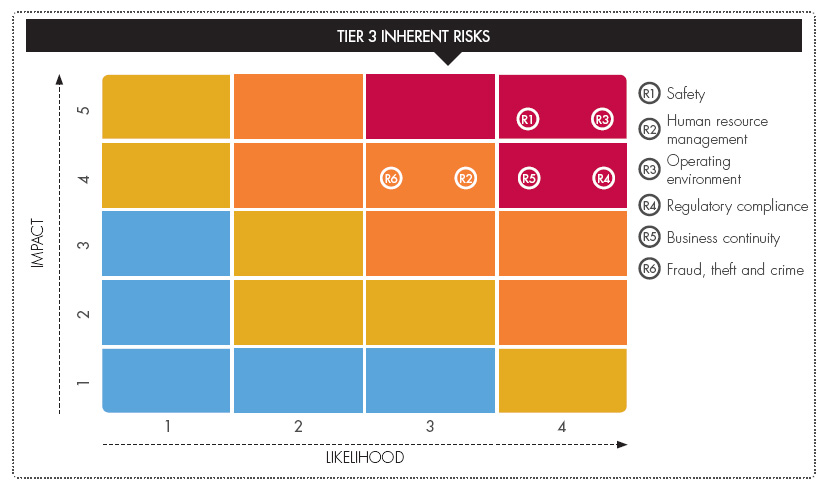
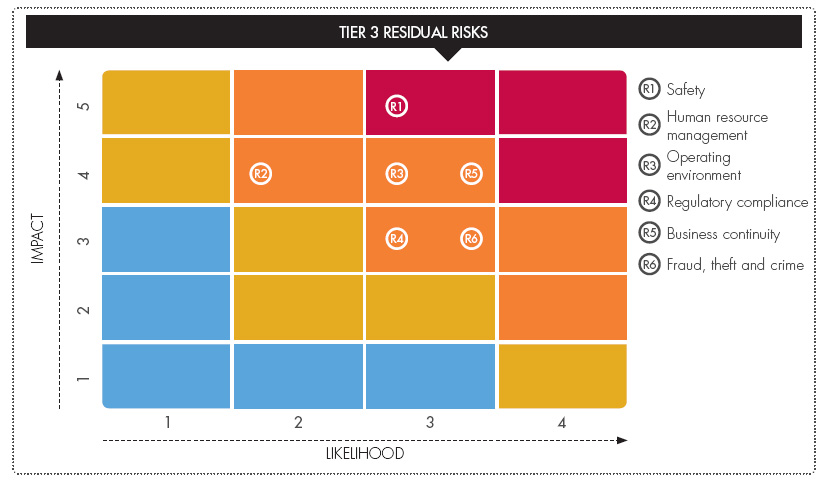
To prioritise risks, each risk is evaluated in terms of likelihood and impact on an inherent (actual impact) and residual (after mitigating action) basis. The heat maps below reflect the significant inherent and residual risks for Tiger Brands.
 |
 |
Significant risks
Significant risks are determined by analysing business unit risks, divisional risks and group risks. The score for each risk is determined by multiplying the likelihood of the risk occurring to the impact of the risk to Tiger Brands. A risk is regarded as significant when its score exceeds the risk tolerance set by the board. The following risks are regarded as significant to Tiger Brands:
Safety
Maintaining a safe working environment is non-negotiable as this supports our commitment to ensuring that the safety of our employees is a priority. Safety procedures aligned to the global OHSAS 18001 standard are embedded across all our manufacturing facilities, with restricted access controls at all production facilities. The nature of certain businesses increases the risk of safety to employees. Robust plans are in place to manage and further mitigate the risk to employee safety in the long term. The results of annual independent safety audits are used to inform the improvement plan for each site. Our health and safety performance for the review period is on pages 60 to 62.
Human resource management
Employees are at the centre of Tiger Brands’ success, and our ability to effectively manage human capital is integral to the sustainability of our business. Failing to develop a high-performance culture by setting clear expectations, defining employees’ roles, creating a trusting environment, and encouraging individual growth and development will have a detrimental effect on the group’s performance in a dynamic environment. An enterprise-wide talent review is under way and employees with high potential are being identified by business unit and function. In addition, a management trainee scheme is being implemented to ensure the future supply of talent and more holistic and richer personal development plans for employees are in place. The group people strategy has been amended to address human resource-related risks on pages 56 to 59.
Operating environment
As outlined on pages 26 and 27, the operating environment remains challenging. In addition, volatility in the South African rand against major foreign currencies will impact raw material pricing and therefore input costs, which may not always be recovered through price increases. This risk is managed under various strategies. Tiger Brands has a centralised procurement model to capitalise on economies of scale and efficiently manage the procurement of price-sensitive raw materials. Evaluating brand and product mix leads the decision-making process of all customer and marketing teams to ensure consumer needs based on prevailing trends and behaviour are continually addressed. Product innovation is another important driver for every brand and appropriate funding has been allocated to achieve this objective.
Regulatory compliance
Tiger Brands is committed to complying with all legislative and regulatory requirements. In South Africa, we are complying with new salt legislation (reducing the salt content in several foodstuffs) by making appropriate changes to internal processes. We will take a similar approach if the proposed sugar tax is legislated. Ongoing training programmes raise awareness about compliance and ensure guidance is continuously available to all staff. We have also established a governance forum to facilitate the process of adapting to the legal environment through policy implementation. This forum is attended by senior management from across the business, information technology, group legal and internal audit.
Business continuity
Loss of life, reputational damage and business performance can all be compromised by a catastrophic event or unplanned disruption. To manage this risk holistically and systematically, a formal business continuity management process is being piloted at our largest groceries manufacturing site, and will be rolled out across the group in FY17. Presently, we manage this risk with appropriate group insurance cover, reviewed annually, and disaster recovery plans that include replicating core business applications and services. Maintenance and support services agreements are in place with key vendors.
Risk, control and environmental audits are performed by an external specialist annually. The results of this review are used to improve business continuity planning and disaster recovery processes. Comprehensive preventative maintenance plans are in place and regularly reviewed at all manufacturing sites to ensure a continuous supply of product to consumers. Power-generating capacity has been installed to cover key manufacturing processes where applicable, and exposure to the loss of power generation at all facilities is regularly reviewed both at site level and head office from a centralised perspective. Our energy and carbon emissions strategies are set out on pages 74 to 79.
Fraud, theft and crime
Fraud, theft and crime are realities of doing business. Following previous incidents, our internal controls have been reviewed and significantly improved to continuously guard against incidents of fraud and crime through employee awareness campaigns, strict access control enforcement at all our facilities, and working with the local police to assist in investigating syndicated crime. In addition, an anti-bribery and corruption policy has been implemented and employees are required to acknowledge compliance annually. The Tiger Brands ethics line is available to all employees, suppliers and customers to confidentially report unethical business practices without fear or victimisation. The ethics committee independently validates the effective finalisation of all reports. Fraud risk registers have been documented for each business unit. Key controls to mitigate fraud risks are identified, and where controls are assessed as inadequate, they have been improved. We have also invested in technology to manage and remediate access control violations.