
Transformation
Highlight
Retain level 3 status for 2017
Challenge
Allocation of resources
In South Africa, we promote social transformation in the interest of nation building, most notably by advancing broad-based black economic empowerment (BBBEE) initiatives. Compliance with BBBEE and employment equity legislation is a business imperative and our BBBEE data and reporting is independently assured.
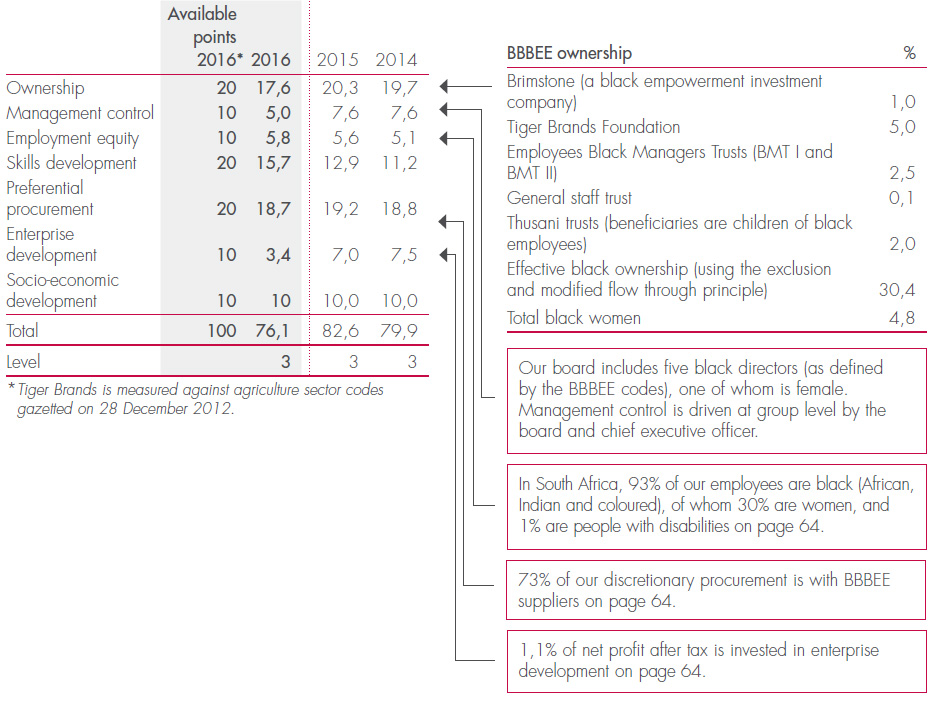
To the extent that the revised BBBEE codes of good practice have not been adopted by the agriculture sector, which is the sector against which Tiger Brands is measured, the group has retained its level 3 rating for the year, as shown below. In anticipation of the revised codes, we have proactively revised our strategy which aims to optimise associated investment while maximising the economic empowerment benefit by concentrating on skills development, enterprise and supplier development.
Tiger Brands BBBEE scorecard
Tiger Brands’ workforce profile
| Outside of South Africa | |||||||||||||||||||||||
| African | Indian | Coloured | White | Disabled | Permanent | Temporary | Total | Permanent | Temporary | Total staff |
|||||||||||||
| 2016 | 8 437 | 720 | 1 120 | 831 | 72 | 11 109 | 3 689 | 14 798 | 2 012 | 4 664 | 21 474 | ||||||||||||
| 2015 | 7 648 | 698 | 1 189 | 844 | 53 | 10 379 | 4 222 | 14 601 | 3 841 | 2 149 | 20 591 | ||||||||||||
| 2014 | 6 536 | 726 | 1 153 | 838 | 69 | 9 253 | 4 537 | 13 790 | 3 673 | 1 671 | 19 134 | ||||||||||||
| 2013 | 6 178 | 739 | 1 192 | 881 | 68 | 8 990 | 1 500 | 10 490 | 3 770 | 788 | 15 048 | ||||||||||||
| 2012 | 6 260 | 777 | 1 027 | 938 | 76 | 9 002 | 1 079 | 10 081 | 1 876 | 782 | 12 739 | ||||||||||||
International employees are accounted for only where Tiger Brands is the majority shareholder.
The increase in permanent employees is largely due to the conversion of temporary contractors to permanent employees. We remain committed to growing our black management talent pool. We realise that employment equity is a long-term challenge and we are investing in junior and middle management levels to develop a pipeline of future black leaders at senior and executive level.
Preferential procurement
In our supply chain, we monitor environmental, social and governance performance through a questionnaire distributed annually to our highest-risk suppliers. The results are collaboratively reviewed by the procurement and safety, health and environment teams. Our revised procurement policy has been updated to include preferential procurement commitments. As part of our execution strategy for FY17, our preferential procurement policy will be reviewed and updated in line with the new BBBEE codes.
Tiger Brands procured agricultural commodities, ingredients, packaging, consumables and services totalling R13,2 billion from BBBEE suppliers in 2016 (2015: R16,5 billion). This represents 73% of our discretionary procurement.
Preferential procurement is embedded in our sourcing process in South Africa, and developing and supporting BBBEE suppliers remains a key element of our procurement strategy.
Compliance under the revised BBBEE codes is expected to be a longer-term process as suppliers come to terms with new targets and implement the required steps to improve their scorecard levels. Our procurement team is working closely with suppliers to understand their scorecard trajectories and inform our sourcing strategies.
We remain focused on supporting small and medium black-owned businesses, especially in our core spend. As detailed below, we regard this as a business imperative that will contribute to a vibrant and competitive supply landscape in South Africa in the longer term. Our five-year BBBEE strategy outlines a roadmap to deliver this goal and forms part of our performance targets for FY17.
Enterprise development
We have projects in place across our value chain, focusing on growing small businesses that we can support over the longer term. While financial support of R24,0 million (2015: R39,4 million) is a cornerstone of our contribution, the sustainability of these initiatives is driven by the specialist support of our staff to mentor and develop skills where required. As example, we mentor farmers producing tomatoes for the group in Limpopo. While this is not a formal programme, it is part of the farm extension service we provide to farmers from which they benefit.
Our annual investment in enterprise development equates to 1,1% of FY16 net profit after tax, spread over most of our businesses. Albany’s owner-driver scheme is at present the main contributor (at R17,6 million), although the revised codes may affect the status of this scheme. The balance comprises donations and loans to organisations that presently supply Tiger Brands.
As part of our strategy to comply with the revised codes, we are increasing our investment in enterprise development to meet requirements within the next two years. While the scope of our investment is broad, the first phases will focus on emerging farmers to play a greater role in our supply chains. As examples, we will spend over R9 million to fund formal technical support and mentoring for tomato farmers in Nwanedi, pea farmers in Marble Hall and small white bean farmers. The bulk of this will be with farmers in Nwanedi to help them increase their yields by up to 30% in the next 12 months. These farmers will be exposed to world-class farming techniques, and enjoy increased revenue from higher yields. As part of this initiative, market leaders in soil preparation and fertiliser technology will join the mentoring group. This programme is expected to generate increased employment opportunities in the next four years.
To support this initiative, we signed a memorandum of understanding with the Department of Agriculture, Forestry and Fisheries in 2015.
Practically, supporting emerging farmers is a complex issue. We have approached this by drawing on in-depth research that aligns our supply needs with the availability of emerging farmers who require support. We provide technical support, firm offtake agreements and financial loans (totalling around R15 million for the first 18 months). Once the project is established, we will assess what other opportunities exist to support the farmers through entrepreneurial business training.