
Environment
ISO 14001 certification retained
Lifecycle assessment
Challenges
Significant capital expenditure to improve efficiency and flexibility of manufacturing architecture
Water scarcity and drought have a direct impact on the agriculture industry on which our business depends and on our manufacturing processes
Environmental sustainability
| Absolute use | Intensity (per ton) | ||||||||||||
| Measure | FY15 | FY16 | Improvement | Measure | FY15 | FY16 | Improvement | ||||||
|---|---|---|---|---|---|---|---|---|---|---|---|---|---|
| Energy – kWh | 325 523 087 | 316 659 244 |  (2,72%) |
Energy – kWh | 122,34 | 127,96 |  4,59% |
||||||
| Water – kℓ | 5 155 728 | 5 115 464 | (0,78%) |
Water – kℓ | 2,46 | 2,32 | (5,69%) |
||||||
| Packaging – ton | 1 209 649 | 1 060 154 | (12,36%) |
Packaging – ton | 0,46 | 0,43 | (6,52%) |
||||||
| Waste – ton | 14 608 | 12 498 | (14,44%) |
Waste – ton | 0,0055 | 0,0051 | (7,27%) |
| FY15 | FY16 | ||||||||
|---|---|---|---|---|---|---|---|---|---|
| Production output – ton | 2 660 727 | Production output – ton | 2 474 705 | ||||||
| Carbon emissions – CO2e | 587 047,84 | 0,22 | Carbon emissions – CO2e | 588 382,18 | 0,24 |
Sustainability vision
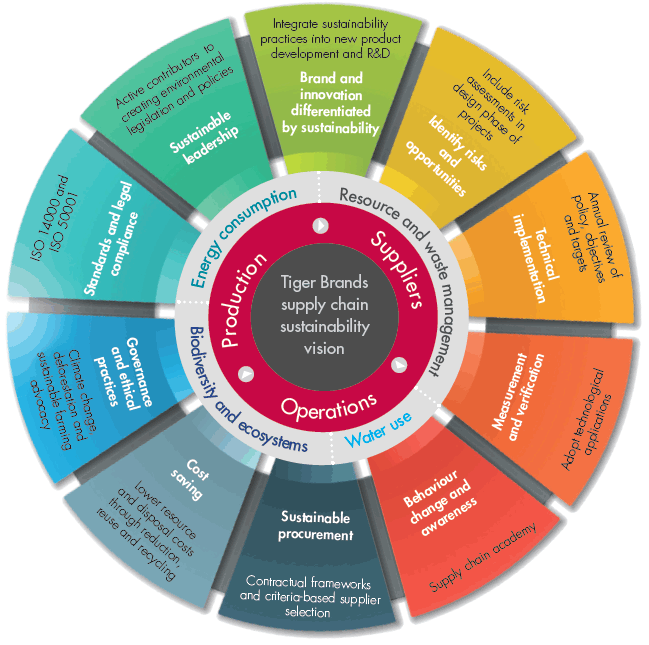 |
|
Our approach
Sustainable manufacturing
Tiger Brands is committed to operating as an
environmentally responsible company and our operations
adhere to all relevant environmental regulations. Managing
operations in an environmentally and socially responsible
way – sustainable manufacturing – is a business imperative.
As a manufacturing company, we rely on energy and water
for production, and water quality in particular is vital to
product quality and consumer safety.
We envision sustainable manufacturing as minimising the business risks inherent in any manufacturing operation while maximising the opportunities that arise from improving our processes and products.
Collaborating and engaging with stakeholders
The desire to contribute to a more sustainable world requires
understanding, collaboration and action at many levels by
governments, companies, brands and customers. This drive
also comes from consumers themselves, who want to
understand the environmental impacts of their choices. In
addition to our initiatives to reduce and manage our
environmental impacts, we have intensified our participation
in industry forums to help shape sustainable consumption
standards, tools and best practices.
Each year, Tiger Brands voluntarily discloses its performance under the CDP for carbon emissions and water management. This global standard allows us to benchmark our performance against international peers and learn from best practices.
In addition, the group is a signatory to We Mean Business, committing to three categories flagged by CDP as most relevant to our business:
- Adopt a science-based emissions reduction target
- Responsible corporate engagement on climate policy
- Disclose climate change information in mainstream reports as a fiduciary duty.
We are also working with South Africa’s Council for Scientific and Industrial Research (CSIR) on assessments by the National Cleaner Production Centre to enhance manufacturing industry competitiveness through resource efficiency and cleaner production.
Tiger Brands is a member of the National Business Initiative, Manufacturing Circle, Business Leadership South Africa, Consumer Goods Council of South Africa, South African Agricultural Processors Association, South African Fruit and Vegetable Export Council, South African Fruit Juice Association and Business Unity South Africa. Through these bodies, we support engagements with government on a variety of issues including environmental legislation and sustainability.
In line with our desire for self-regulation, Tiger Brands is a founding member of the Multilayer Packaging Forum, which is developing recycling initiatives for multilayer packaging.
Finally, we engage with government departments that have a bearing on the business and upcoming legislative changes through facilitated discussion forums such as the World Wildlife Fund for Nature (WWF) and manufacturing industry debates.
Environmental management
At board level, the risk and sustainability committee provides strategic guidance and leadership on climate change and environmental issues and oversees the implementation and revision of the environmental policy. Operational execution of the strategy and management of the environmental system rests with the group manufacturing excellence department.
Our environmental policy was approved two years ago. In it, we commit to identifying environmental and climate change risks, taking action to address weaknesses, forging strong relationships with relevant stakeholders, developing and implementing a sustainability strategy, striving for continuous improvement, and reporting to the board through relevant committees. We also commit to set targets, and monitor, measure and report on our environmental scorecard against key performance indicators. The policy is available on the Tiger Brands intranet and website and communicated internally to relevant stakeholder forums. Our manufacturing and distribution operations conduct policy training for all relevant employees.
Our environmental strategy is focused on improving environmental performance in key areas, shown below, and forms the framework for addressing identified priorities in our current organisational and external environment. By improving our environmental and social sustainability performance, we will generate economic benefits for stakeholders.
Our environmental control system covers:
- Policies and procedures
- Responsibilities and accountabilities for environmental management
- Reporting
- Environmental legal compliance
- Waste, water, energy, pollution, recycling, climate change management
- Continuous improvement
- Monitoring and performance measurement of systems.
Related training is conducted site by site after changes to the policy and procedures. In addition, training is part of each site’s induction programme, highlighting the requirements and responsibilities, and informing employees how to access policies and documents.
Environmental sustainability – continuous improvement
| CONTINUOUS IMPROVEMENT | |
Products
|
Offices and plants
|
Management systems
|
Communication
|
Environmental targets
Our performance is shown above. FY16 was the last year of the three-year rolling environmental sustainability targets. These targets were based on the following measures:
| Target | |||
|---|---|---|---|
| Water | Reduce water consumption and water discharges per ton of product produced by 15% | ||
| Energy | Improve energy efficiency by 15% | ||
| Packaging | Reduce packaging use by 9% | ||
| Waste | Reduce waste for disposal by 12% | ||
| Carbon emissions | Ultimately, eliminate emissions and GHG as far as practically possible |
Environmental targets FY17 to FY20
 |
Energy Improve efficiency by 15% per year |
 |
Waste Reduce waste for disposal by 10% per annum |
|
|
Water* Reduce water consumption and discharges per ton of product produced by 15% |
|
Packaging Reduce packaging use by 10% per year |
|
| Carbon emissions reduction remains a key business deliverable and a scientific target will be developed for the organisation with the assistance of National Business Initiative. | ||||
* In the short term, Gauteng municipalities have mandated an immediate 15% month-on-month reduction in water consumption due to water shortages.
While our primary focus is on the five most material aspects of our environmental strategy (water, energy, packaging, waste and carbon emissions), our manufacturing operations also test air emissions from boilers, ventilation areas, disposed dust, noise, carbon monoxide and carbon dioxide levels in line with legislation.
Our primary certification process in our manufacturing operations is the stringent global ISO 14001 standards. At year end, 95% of South African sites were certified.
Subsequently, ISO 14001 has been amended in line with Annex SL, which is the new high-level structure for ISO management system standards. The transition deadline to meet the new standard is September 2018, and appropriate plans are being considered and implemented.
As we pursue our key targets, we measure indicators as two categories:
- Primary measure indicators: readily available measures to track current performance
- Secondary measure indicators: targets or activities that relate to a gap analysis or benchmark. These may be used to improve primary measure indicators.
Our manufacturing sites submit monthly performance data on these environmental scorecard indicators. They also provide air emissions testing reports from boilers, ventilation areas, dust, noise, carbon monoxide and carbon dioxide levels.
2016 overview
Our environmental performance in 2016 was a mix of challenges and successes. We significantly improved our use of packaging and waste, while the energy efficiency and carbon intensity of our operations was constant.
Legislative developments
During the review period, we began preparing for
unanticipated legislative changes in South Africa:
- Department of Minerals and Energy: companies have to submit five-year energy reduction plans
- Department of Environmental Affairs: notification that companies will need to submit a five-year pollution prevention plan for approval by the minister. While this regulation has not yet been legislated, we are proactively developing a draft plan given the proposed three-month window between promulgation and submission to the minister. This change in legislation will also require companies to submit annual progress reports on their approved plans.
Water
Global water scarcity is expected to increase substantially in
coming decades. In South Africa, this trend is likely to affect
the availability, cost and quality of water – a critical input in
our manufacturing processes. We use water to process
products and as a key ingredient in many products themselves. In addition, given that most of our products are
for human consumption, water quality in turn affects the
quality and safety of these products.
South Africa is classified as a water-stressed region, which elevates water management to both a risk and critical success factor for Tiger Brands. We have several initiatives under way to improve our direct use of water, including the possible use of recycled and grey water at some facilities and water-saving schemes that have reduced the volume of municipal water used each year.
Most of our water comes from municipal sources, and we monitor consumption, water availability and reliability by river basin and water management area source. We also interact with the government, Department of Trade and Industry, municipalities and water boards. This enables the group to influence legislation, build partnerships in the industry and to learn from organisations using sustainable best practices that we can apply to internal processes.
We recognise our responsibility to promote responsible water use throughout our operations, and to encourage our suppliers to do the same. We have focused on enhancing agricultural water efficiency programmes with suppliers, specifically for water-intensive crops, such as tomatoes, beans, fruits and sugarcane.
In 2016, Tiger Brands again participated in the CDP’s water disclosure programme. Our response – and further detail on our approach to water stewardship – is available on our website.
We are committed to using water efficiently across our operations and ensuring our operations do not compromise local communities’ right to water. We conduct water resource reviews across existing and new factory sites and focus our interventions in priority watersheds.
Water management initiatives |
|
Online water metering
Water reuse
|
Packaging
Packaging plays a vital role in delivering products to our
consumers in a way that preserves the integrity of the
product and protects consumers’ health and safety.
Over recent years, the cost of raw materials has escalated significantly. This has affected the costs of packaging and motivated more efficient and sustainable packaging management. Extraction, location and processing can also contribute significantly to carbon emissions and the overall footprint of a product. Where possible, by lightweighting our packaging (a complex research process to ensure that lighter materials will achieve the same product protection goals), we are significantly reducing carbon emissions and costs, while directly improving the lifecycle assessment of products (see page 79).
Waste
Waste management is important to Tiger Brands because,
when done successfully, it can reduce input costs, lower
the cost of waste disposal and improve our standing as
a good corporate citizen. In our operations, most waste is
generated either in our manufacturing processes or as
a by-product of these processes.
Globally, waste management practices differ between developed and developing nations, urban and rural areas, and residential and industrial producers. Consequently, while our standards are influenced by the South African regulatory environment, we always consider local conditions and that regulatory environment when applying our standards.
Our ambition is to send zero waste to landfill and to build a culture of waste segregation. To achieve these goals, we are focused on reducing, reusing and recycling waste generated in our production processes. When all reasonable options have been exhausted to realise this, we ensure that any remaining wastes are disposed of responsibly. We do not currently produce any hazardous waste.
Energy and carbon emissions
Energy is at the core of any manufacturing process, and
reducing the energy intensity of our operations is a critical
element of our response to climate change. In addition,
South Africa faces a period of energy shortage, and smart
energy management is now strategically important.
Tiger Brands has identified the climate change risks with the greatest potential to affect the company and consolidated these into our top risks for mitigation and action as part of our internal risk processes (see the risk management section starting on page 102). Among these climate change-linked risks are the availability of water, an essential input for the agricultural sector on which we rely, and in our manufacturing operations.
The diverse sources of GHG emissions include:
- Direct emissions from sources owned or controlled by the group (scope 1)
- Indirect emissions from generating electricity, heating and cooling, or steam generated off-site but purchased by the group (scope 2)
- Indirect emissions (not included in scope 2) from sources not owned or directly controlled by the group but related to our activities (scope 3).
As part of raising awareness in our operations, last year we appointed champions in manufacturing units with the highest impact on carbon emissions and water use.
We also enrolled engineering managers, site services (utilities) managers and technical/artisan employees in national cleaner production training offered by the CSIR. This includes courses on energy management systems, and system optimisation for fans, compressed air and steam. Attendees have now launched focused optimisation projects at their individual business units.
In addition, we participate in the National Cleaner Production Centre programme aimed at introducing cleaner production processes through partnerships, advocacy, technology transfers, tools and capacity building. Multiple assessments were conducted across a number of manufacturing facilities during the year and recommendations are being implemented.
Measuring energy consumption alone is not an accurate measure of improvement because, as the group grows, our consumption requirements and patterns change. To ensure improvements and GHG reductions, we focus on energy and emissions intensity, which shows the reduction in the ratio of energy consumed or emissions produced per ton of product produced. If we are successful, despite a growing business, our intensity levels should decline.
The group’s scope 1, 2 and 3 emissions for the year are shown below. The data covers our South African manufacturing sites, in line with our strategy to initially focus on these operations and extend the programme to international operations in the rest of Africa over the next three to five years.
| 2016 | Change (%) | 2015 | Change (%) | 2014 | |||||||
|---|---|---|---|---|---|---|---|---|---|---|---|
| Direct GHG emissions (scope 1) | 253 909 | (1,7) | 258 392 | (0,17) | 258 834 | ||||||
| Electricity indirect GHG emissions (scope 2) | 326 159 | 1,5 | 321 439 | 11,4 | 288 515 | ||||||
| Other indirect GHG emissions (scope 3)* | 31 519 | 343 | 7 099 | 2 599 | 263 | ||||||
| CO2e (tons) | 588 382 | 0,2 | 587 047 | 7,2 | 547 611 | ||||||
| Carbon intensity (tons CO2e/ton of product produced) | 0,24 | 0,02 | 0,22 | – | 0,22 |
LIFECYCLE ASSESSMENT
The lifecycle assessment (LCA) evaluates the environmental impacts of all stages of a product’s life from cradle to grave (ie from raw material extraction through materials processing, manufacture, distribution, use, repair and maintenance, and disposal or recycling). They help prevent a narrow outlook on environmental concerns by:
- Compiling an inventory of relevant energy and material inputs and environmental releases
- Evaluating potential impacts of identified inputs and releases
- Interpreting the results to help make a more informed decision.
In FY15, we completed LCAs for KOO Baked Beans and All Gold Tomato Sauce (750mℓ and squeeze bottle). As a result, we have changed glass packaging where possible, and sourced and trialled an alternative can – all of which reduces the amount of input materials required.
In the review period, two further LCAs were commissioned:
- The cocoa LCA report was finalised. This study found that soil erosion due to lack of crop rotation, fertilisation and pesticides were the key environmental sustainability focus areas. The LCA was not focused on the chocolate production process and this would be the next focus area for identifying any internal GHG emission reduction opportunities
- A bread LCA review using existing data from the industry is under way and expected to be finalised in FY17.
We have participated in the carbon disclosure project (run
by CDP) annually since 2010. Our response – and further
detail on our carbon approach and performance – is
available on our website.  Visit our website
Carbon tax
Given the imminent introduction of carbon tax, we continue
to engage extensively with external parties to establish
holistic, practical and affordable solutions on how to reduce
our carbon emissions. With the published framework, and
proposed carbon tax at R120 per ton of CO2e above the
suggested thresholds, the expected impact to the business
is substantial.
To ensure we are adequately prepared, we are considering:
- The extent of our potential liability, taking into account proposed tax-free thresholds
- The effect on suppliers that may be directly liable to pay the carbon tax and seek to pass on these costs.
In addition to addressing our own emissions, we are encouraging suppliers to improve the fuel efficiency of their operations and reduce their GHG emissions.
Other emissions
We are committed to exceeding legislative requirements
on air emissions and will continue to find practical and
cost-effective solutions to reduce or eliminate all forms
of air emissions.
From every test and analysis conducted on atmospheric air quality, our manufacturing operations receive a detailed report and must develop appropriate plans for any indicated deviations.
Tiger Brands prides itself on accurate impartial emissions testing at our manufacturing facilities – our service providers also compile atmospheric emissions reports under the requirements of the Air Quality Act, as well as our specifications. To the business, the aim of air quality management is to protect public health and the environment from the damaging effects of air pollution, and to eliminate or minimise human exposure to hazardous pollutants.
In terms of our environmental control system, boiler stack emissions are measured at all business units that operate boilers, although only two of our boilers fall under amended legislation (November 2013, controlled emitters). We measure sulphur dioxide, nitrous oxide, carbon dioxide and particulate matter (soot) to ensure legal compliance. Independent annual performance audits are conducted at all business units to monitor compliance levels.
Commitments for FY17
In 2016, we continued to work with our suppliers on lifecycle assessments to reduce the environmental impact of our products. In particular, we will be looking at the overall impact of cocoa, a key ingredient for our snacks & treats businesses.
Furthermore, we will partner with our small and medium suppliers to help them align with ISO 14001. This will include third-party packaging and ingredients suppliers. At the same time, we hope to sustain and build on our own ISO 14001 certifications.