
Health and safety
Highlight
13% year-on-year reduction in lost-time injuries
Challenge
Eliminating recurring behaviour-based incidents
To integrate our approach and raise awareness across the group, we launched the Tiger Brands health and safety forum in November 2015. Participants included risk managers and safety officers from all our manufacturing units, as well as external health and safety experts who shared best practice standards.
Supported by an analysis of lost-time injuries reported by our manufacturing units in FY15, participants agreed that our business units are dealing with multiple and repetitive behaviour-based incidents. Eliminating these has been escalated to our highest priority.
Against this focus, key outcomes of the inaugural forum included:
- Sign-off of the health and safety strategic plan
- Framework defined
- Non-negotiable FY16 standards for each manufacturing unit
- Training plans for manufacturing employees
- FY16 lost-time injury targets reviewed and ratified.
 Behavioural safety through visible leadership (predict and prevent) |
|
Achieving safety excellence
|
The safety of our workers, visitors to our operations and the public is key to our long-term success. We believe a safe and healthy workplace is both the fundamental right of every person and a business imperative.
As such, our group health and safety policy stipulates our responsibility for maintaining productive workplaces across the company by minimising the risk of accidents, injury and exposure to health hazards for our own people, associates and contractors.
Our policies and standards for managing safety, the environment and quality are defined in operating requirements throughout the group. Our manufacturing facilities follow the requirements and principles of the internationally recognised Occupational Health and Safety Assessment Series (OHSAS) 18001 standard as the framework of an occupational health and safety management system.
The group chief executive officer is ultimately responsible for the safety of employees. He reports to the risk and sustainability committee as well as the audit committee on these matters. Health and safety committees, led by supply chain executives and site management, are responsible for implementing health and safety measures at manufacturing sites.
The Tiger Brands environmental, health and safety risk management programme has been implemented at all business units. Rigorous operational controls manage known risks and align with international best practice. An accredited independent risk management company assesses implementation and adherence, and provides third-party verification. Any non-conformance is identified and assessed, and risk mitigation and corrective actions are implemented. In addition, compliance audits on applicable laws and regulations as well as the group’s occupational health and safety requirements are conducted biannually at each manufacturing operation.
Training
To meet the milestones in our strategic plan, key employees are being trained and coached on the job to build on the required levels of safety expertise. The programmes are facilitated by an external specialist, and focused on developing careers in the safety, health and environment (SHE) field. Appropriate programmes have been agreed for employees, supervisors, SHE coordinators and safety officers, management, internal audit, and SHE practitioners.
To supplement formal training, we have implemented self-auditing and peer-auditing processes to drive the safety programme.
Our safety programmes include training at induction and periodic refresher training for employees and contractors. In addition, on-the-job risk assessments are regularly performed to identify safety risks.
With a renewed focus on these safety programmes and initiatives, injury rates declined over the reporting period.
Safety performance
| Key performance indicators | Target | 2016 | 2015 |
2014 | 2013 |
2012 | ||||||
|---|---|---|---|---|---|---|---|---|---|---|---|---|
| Fatalities | 0 | 5 | 2 | 1 | 2 | 0 | ||||||
| Lost-time injury frequency rate (LTIFR) | 0,78* | 0,36 | 0,36 | 0,74 | 0,67 | 0,78 |
| * | The group target is the average of the Grains, Consumer Brands – including Food, Home, Personal and Baby care and International divisions, and considers individual site targets set at an 8,5% to 11% improvement on actual performance in the reporting period. |
 Route to market security remains a focus area for our
industry. In FY16, we recorded four fatalities in Gauteng
and the Western Cape. We extend our sincere
condolences to the family and friends of Herman
Mokaleng, Michael Mbesi, Bafana Amos Mtsweni and
Mduduzi Joseph Ntuli and their colleagues at Albany
Bakeries. Tiger Brands is working with other industry
players and provincial authorities to share best practice,
and build sustainable solutions in areas including route risk
management, driver training, vehicle inspection and
maintenance.
In our Ethiopian operation, Legesse Kassahun was accidentally electrocuted while conducting routine maintenance on a packing line. The appropriate remedial steps were taken and we offer our heartfelt condolences to his family and colleagues.
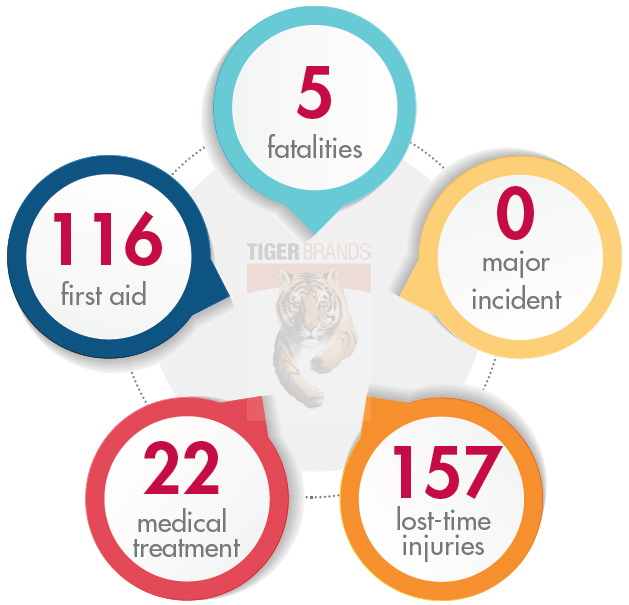
As shown on the right, first aid and lost-time injuries account for a significant portion of the total recorded during the year. Accordingly, we continue to deliver safety toolbox talks in multidisciplinary team meetings, conduct safety-critical equipment inspections and deliver process safety-related training to raise awareness on injuries recorded and share lessons learned. No operation recorded an unplanned shutdown due to health and safety issues in 2016.
Depending on the nature of each plant, our manufacturing sites have annual LTIFR improvement targets ranging from 8,5% to 11%. The group LTIFR target is 0,33 for FY17. In FY16, 31% of our manufacturing sites achieved zero LTIFR, while 42% beat their targets (FY15: 18% and 63% respectively).
Activities to improve health and safety
Health and safety is a priority for all managers and executives. Key initiatives introduced in FY16 include:
- Developing a workplace health improvement plan for implementation next year
- Further integration of safety into business processes, understanding that safety should be a core business and strategic value
- Extensively improving management commitment and leadership and employee participation as these are key to safety management
- Safety skills development programmes and role-based competence matrixes are being defined and launched for our business units.
Employee wellness
Our employee wellness support programme offers a 24-hour telephonic counselling service, and face-to-face professional counselling. Users can access psychologists, social workers, dieticians, biokineticists, and financial and legal advisers.
Two years ago, we invested almost R8 million in on-site clinic services. These include occupational health support, as well as limited primary healthcare, free to all permanent and temporary employees on site. Our clinic in Ashton (Western Cape, South Africa) is also open to the community. Contracted services include an HIV/Aids management programme and a free advisory and counselling service for all permanent and temporary employees.
We also offer all South African employees voluntary membership to our in-house medical scheme that offers cost-effective comprehensive health cover.
We have a comprehensive HIV/Aids framework that includes support for HIV-positive employees. In 2016, 372 employees were voluntarily counselled and tested (2015: 331) and 95% of employees who tested positive have enrolled in the programme. Our recorded prevalence 5 rate in South Africa is 1,6% (2015: 1,8%).