
Remuneration report
Report from the remuneration committee chairperson
Our vision
To be the most admired, branded, FMCG company in emerging markets.
Achieving our vision depends, in large part, on our people. Together, they are our most sustainable source of competitive advantage in a volatile and technology-driven economy.
Accordingly, the purpose of our reward philosophy, strategy, policy and practices is to:
- Contribute to attracting, retaining and engaging high-performing employees
- Inspire and motivate people to outperform against our business strategy, goals and targets
- Drive, reward and recognise performance excellence and innovation by significantly differentiating reward for top performers, ie pay for performance.
We have adjusted our remuneration report this year to align with the best practice recommendations of integrated reporting and structured the report in two sections. Part 1 deals with why and how we pay our executive directors and prescribed officers, while part 2 details the various financial components of remuneration.
This report should be considered against the overview of company performance in 2016 on pages 34 to 37 to provide the context to remuneration outcomes set out later.
The war for talent is at an all-time high and, led by our new CEO, we have reviewed all our pay offerings in a benchmark exercise against the top 100 JSE listed organisations. This has resulted in a fit-for-purpose model to ensure we continue to deliver on our shareholder value proposition and only reward in terms of our differentiated pay-for-performance framework.
While this review confirmed that our reward structure is in line with best practice, we have made certain adjustments to both our short-term and long-term incentives to simplify, focus and align these with our business and people strategy. In line with leading practice, we have also adopted a minimum shareholding policy for our executives, with our top team undertaking to build up their personal shareholdings in the company to target levels.
Santie Botha
Chairperson
22 November 2016
Part 1: Remuneration policy
Remuneration policy
The remuneration policy, to be approved by shareholders in a non-binding advisory vote at the annual general meeting on 21 February 2017, is set out below.
Governance and the remuneration committee
The remuneration policy is reviewed annually by the remuneration and nominations committee to ensure that the design of directors’ remuneration reflects best practice and is competitive. The policy also needs to ensure that payment is aligned with the company’s growth objectives and financial performance for the review period. The committee’s membership, responsibilities and meetings held in the year appear in the corporate governance section on pages 85 and 86.
Remuneration policy
Objective
The Tiger Brands remuneration policy aims to ensure the group attracts and retains key and critical talent required to deliver its business goals and results.
The policy, in conjunction with the remuneration philosophy and strategy, is based on the following key principles:
- Remuneration should support our vision by attracting and retaining the right talent
- It should directly correlate with the growth plans and financial performance of our businesses and the group
- It should be reviewed and benchmarked annually through professional in-country service providers to ensure we remain competitive in diverse markets: never applying percentiles rigidly but considering industry type, skills scarcity, performance and legislative structures and requirements
- Remuneration must support the group’s strategy, and be consistent with its culture of fairness and equity
- It should motivate, drive deeper engagement and allow for differentiation in rewarding high performers
- Individual contributions based on role and responsibilities should have a direct bearing on levels of remuneration
- Variable remuneration (short and long-term incentives) practices should be tested periodically through external service providers to ensure these support our objective of reward for achieving short-term and long-term growth, and retaining talent. The remuneration committee actively participates in this process.
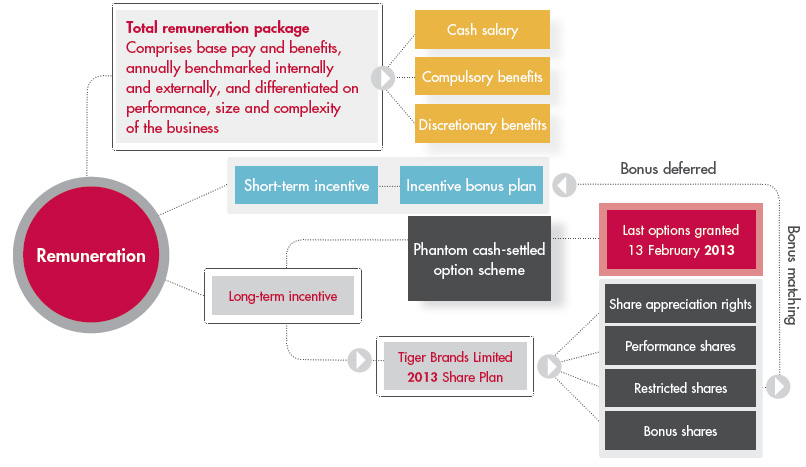
Remuneration mix, recognition and rewardElements of executive management and prescribed officers’ remuneration |
 |
| Short-term incentive (STI) scheme | |
| The incentive bonus plan | |
| Purpose and link to key remuneration principles | The STI drives achieving short-term performance targets which correlate to the growth plans and financial performance of our businesses and the group. This is one of our key remuneration principles. By incorporating personal performance through the personal multiplier, the STI is consistent with our culture of fairness and equity, allowing for differentiation in rewarding high performers. |
| Performance measures | The target for the STI comprises a financial component and a number of strategic components. In 2016, the STI scheme for the Tiger Brands executive committee carried a 70% weighting for the financial component and a 30% weighting for the strategic component. The financial performance component is based on growth in profits, as measured by headline earnings per share (HEPS) from continuing operations. Measures and targets are set and reviewed annually by the remuneration committee. In 2016, the strategic element of the bonus focused on the following areas (weighting in brackets):
Performance against individual targets and objectives is also considered in the final bonus determination. |
| On-target and maximum value of cash incentive (annual or subject to deferral) | All participants are able to earn an annual STI of up to 112,5% of their total remuneration package, rising progressively from 50% to 112,5% for performance above the on-target level, achieving all strategic objectives and attaining the maximum personal multiplier for exceptional performance. The maximum STI is paid only when the company achieves stretch business performance targets, all strategic targets are achieved and the maximum personal multiplier is attained. |
| Operation | The following formula is applied to determine the final result: STI formula financial = TRP x on-target % x BM (0% – 150%) x PM (0% – 150%) x 70% Where: |
| Voluntary deferral and matching | Executives and prescribed officers may defer a portion (25%, 33% or 50%) of their STI payment into restricted shares under the Tiger Brands Limited 2013 Share Plan, which are then matched by the company in a 1:1 ratio. All restricted shares will vest after three years. We believe these deferrals demonstrate commitment to the company’s long-term success and an appropriate alignment with shareholders’ interests. We therefore support our executives and prescribed officers’ efforts to increase their shareholding in the company through this process. Further detail on restricted shares appears in part 2 (long-term incentive scheme) below. |
| Changes for FY17 |
|
BEE schemes
Three members of the Tiger Brands executive committee also participate in one or both of the company’s black manager empowerment schemes.
The Tiger Brands Black Managers Trust (BMT I) was established in 2005 as part of the company’s phase I staff empowerment transaction. In terms of this, allocating participation rights to black managers entitles them to receive the underlying Tiger Brands shares (and shares in Adcock Ingram on a one-for-one basis) – after making the required capital contributions to BMT I – at any time after the specified lock-in period, ie from 1 January 2015. However, for all shares allocated after 31 July 2010, the lock-in date varies depending on the date of allocation.
The Tiger Brands Black Managers Trust II (BMT II) was established as part of our phase II empowerment transaction implemented in 2009. In terms of this, allocating participation rights to black managers entitles them to receive a specified number of Tiger Brands shares from 31 December 2017 (after Tiger Brands has exercised its right to repurchase a certain number of shares from BMT II under an agreed repurchase formula).
Retirement benefits
During the year, the group contributed on behalf of executive directors to an umbrella retirement scheme operated by Investment Solutions. This is a defined contribution retirement plan, with the company contributing 13,2% (2015: 15,7%) of gross pensionable remuneration. The cost of these contributions is a component of directors’ TRPs. The two prescribed officers are also members of this umbrella retirement scheme.
In addition, seven other members of the executive committee participated in this umbrella retirement scheme. The two remaining members of the executive committee belong to the Tiger Brands Management Provident Fund, a defined contribution plan. The company contributed on average 16,4% (2015: 16,5%) of gross pensionable remuneration to the provident fund for retirement funding.
Details of contributions in the review period on behalf of executive directors, prescribed officers and other members of the executive committee appear in Annexure C of the annual financial statements.
Other benefits
Executive directors, prescribed officers and other members of the executive committee enjoy various benefits, including medical aid cover, permanent health insurance, death-in-service and funeral cover, as well as a travel allowance, where applicable.
The total value of other benefits paid is set out in Annexure C of the annual financial statements.
Executive service contracts
Executive directors, prescribed officers and other members of the executive committee are not employed on fixed-term contracts and have standard employment agreements with current notice periods of either one or three months. The current retirement age is 63, although a retirement age of 65 applies to three members.
Contractual entitlements on terminating employment include, for those who leave due to retirement or retrenchment, a pro rata short-term incentive payment, subject to the extent of achieving the relevant financial and strategic performance targets at the end of the period and the necessary individual performance agreement being in place at the date of exit. This pro rata incentive payment is subject to the employee being in service for a minimum of three months in that financial year. No pro rata bonus is paid for employees who leave for other reasons.
The termination rules for options issued under the Tiger Brands Limited 2013 Share Plan are below.
External board appointments
Tiger Brands encourages members of the executive committee to consider accepting appropriate opportunities to serve as non-executive directors on the main board or committees of external companies. We believe this policy encourages our executives to broaden their skills base and experience. Under our formal policy, an executive member is limited to one substantive outside directorship. The chairman of Tiger Brands, as chairman of the nominations committee, and the chairman of the remuneration committee, are required to authorise these appointments based on a recommendation from the chief executive officer. Directors’ fees paid to executive members by outside companies under this policy may be retained by the individual. Tiger Brands currently has no executive committee members serving as non-executive directors on the main boards of external companies.
Vesting of SARs and full-value shares on terminating employment – Tiger Brands 2013 Share Plan
If an individual’s employment is terminated, vesting of any outstanding (unvested) share options or full-value shares under the LTIP depends on the reasons for termination. The group’s termination rules are aligned with recommendations in King III. In summary, the principles applied for units awarded under the LTIP include:
| Type of termination | Definition/treatment |
| No-fault termination | No-fault termination is defined as terminating the employment of a participant by the company or applicable employer company by reason of:
Under the circumstances above, if employment is terminated on a no-fault basis then, depending on the nature of the unit (ie whether it is a share appreciation right, performance share or restricted share) and reasons for termination, a participant may retain all units or only a pro rata portion. Accelerated vesting and settlement of retained units may apply in certain circumstances. |
| Fault termination |
|
Non-executive directors
Appointment and contractual arrangements
Non-executive directors are appointed to the board of Tiger Brands in line with the policy and procedures for appointments which are formal, transparent and a matter for the board as a whole, assisted by the nominations committee. In terms of the company’s memorandum of incorporation, no directors have fixed-term appointments. Executive directors are subject to standard terms and conditions of employment and are required to retire from the board by rotation on the same basis as non-executive directors. Any director appointed to fill a vacant position during the year must be subject to election at the first annual general meeting following the appointment. Directors are subject to retirement every three years.
There are no contractual arrangements for compensation due to loss of office. Non-executive directors do not receive short-term incentives or participate in any long-term incentive plan.
Fees and approval process
Non-executive directors are paid a retainer that reflects their overall contribution and input to the company, and not just their attendance at board and committee meetings. The chairman and deputy chairman do not receive any additional remuneration for participating in committees of the board. Consistent non-attendance at meetings will be appropriately handled as part of the company’s board evaluation process.
In addition to standard fees, non-executive directors are currently paid R19 005 for each special meeting of the board and R3 780 per hour for any additional work they undertake, provided that payment for this work is approved by the remuneration and nominations committees and chief executive officer.
In determining fees payable to non-executive directors, market benchmarks for similar-sized companies are considered in a benchmarking exercise every two years. Fees payable to non-executive directors are considered by the board and approved by shareholders at the annual general meeting. Fee proposals are prepared by the executive committee for consideration by the remuneration and nominations committees, after which a final recommendation is made to the board for its consideration before being presented to shareholders for approval. Non-executive directors who perform services outside the scope of their ordinary duties may receive additional remuneration, with a reasonable maximum fixed by a disinterested quorum of directors.
Shareholder approval will be sought for increasing non-executive directors’ fees, including fees paid for attending special board meetings and additional work undertaken. Details of the proposed increases appear in the notice of AGM of shareholders to be held on 21 February 2017.
Details of non-executive directors’ fees paid in the review period appear in part 2 on below.
Non-binding advisory vote
The remuneration policy, as set out above, will be subject to approval by shareholders, by way of a non-binding advisory vote at the AGM of the company to be held on 21 February 2017.
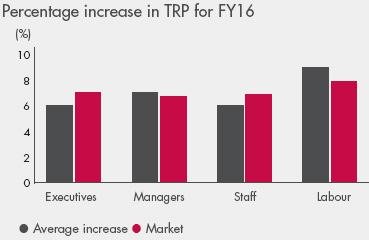 Part 2: Implementation of policies for the review period
Summary of remuneration activities/decisions during the year
- Appointment of the new CEO, with a special LTIP allocation and sign-on bonus awarded
- Retention bonuses were awarded to certain members of the executive team to ensure stability as we began the process of appointing a new CEO
- Retention share allocations were made to certain key employees considered critical to the business
- Review of the current short-term and long-term incentive schemes, with new proposals summarised in this remuneration report.
Short-term incentive for exco FY2016
| STI December 2016 |
Percentage of TRP |
||||
| LC Mac Dougall | 512 500 | 6,25 | |||
| NP Doyle | 835 985 | 13,59 | |||
| AG Kirk | 646 494 | 15,00 | |||
| CFH Vaux | 709 050 | 15,00 | |||
| NG Brimacombe | 340 158 | 7,50 |
Directors’ emoluments and share scheme allocations are detailed in Annexure C of the annual financial statements.
Non-executive directors’ fees
Total emoluments to non-executive directors for the year ended 30 September 2016 were:
| R000 | Board | Invest- ment |
Audit | Risk and sustain- ability |
Remuneration and nominations |
Social, ethics and trans- formation |
Special meetings |
Total | |
| AC Parker – chairman | 1 638 | – | – | – | – | – | 145 | 1 783 | |
| MO Ajukwu | 353 | – | – | 87 | – | – | 36 | 476 | |
| SL Botha | 342 | – | – | – | 218 | – | 69 | 629 | |
| MJ Bowman | 353 | – | – | – | – | – | 36 | 389 | |
| M Makanjee | 353 | – | – | – | 12 | 152 | 79 | 596 | |
| Dr KDK Mokhele | 353 | 4 | 139 | 186 | – | – | 139 | 821 | |
| RD Nisbet | 353 | 4 | 268 | – | – | 87 | 139 | 851 | |
| MP Nyama | 353 | – | – | – | 109 | 76 | 58 | 596 | |
| BL Sibiya – deputy chairman | 846 | – | – | – | – | – | 36 | 882 | |
| YGH Suleman | 353 | 4 | 139 | – | 97 | – | 172 | 765 | |
| Total | 5 297 | 12 | 546 | 273 | 436 | 315 | 909 | 7 788 |
Annual fees payable to non-executive directors for the period beginning 1 March 2016 were approved by shareholders on 16 February 2016.
A market review of non-executive directors’ remuneration was undertaken in 2015 and this formed the basis for increases effective from 1 March 2016.
Interests of executive directors and prescribed officers in share capital
Executive directors and prescribed officers do not hold any interest in the share capital of the company.
Interests of directors and prescribed officers in BEE schemes
No executive directors or prescribed officers qualify for participation in either of the company’s BEE schemes.
Outstanding LTI awards held by executive directors, prescribed officers and other members of the executive committee
A full analysis of the annual movement in phantom cash-settled options, performance shares, restricted shares and share appreciation rights held by executive directors, prescribed officers and other members of the executive committee is set out on pages 170 to 174 per Annexure C to the notes of the annual financial statements.