
Chief financial officer's review
The group’s results for the year ended 30 September 2015 reflect a solid performance in the domestic business, but were impacted by poor results from certain of the Exports and International businesses and the significant impairments arising from the TBCG decision.
Salient features
| Operating margins | |||||||
| 2015 | 2014 | Change % | 2015 | 2014 | |||
| Turnover | 31 558 | 30 072 | 5 | ||||
|---|---|---|---|---|---|---|---|
| Operating income before IFRS 2 charges | 3 683 | 3 661 | 1 | 11,7% | 12,2% | ||
| Domestic | 3 595 | 3 252 | 11 | 15,2% | 14,5% | ||
| Exports and International | 527 | 691 | (24) | 11,4% | 15,1% | ||
| Nigeria | (439) | (282) | (56) | (13,3%) | (9,0%) | ||
| Operating cash flow | 3 605 | 4 193 | (14) | ||||
| Headline earnings per share – continuing operations | 1 786 | 1 804 | (1) | ||||
 The group recorded a solid performance driven by its core South African businesses. However, this was partially offset by underperformance in certain of the Exports and International operations.
Domestic operations
In an increasingly competitive domestic and demand constrained environment, volumes were maintained and turnover grew by 6%. Operating income for the domestic businesses increased by 11% to R3,6 billion with the domestic operating margins improving from 14,5% to 15,2%, demonstrating the resilience and strength of the group’s brands under challenging trading conditions. The results also reflect the execution of the group’s strategic intent, particularly with regard to increased innovation, higher marketing investment and ongoing cost management. Particularly pleasing was the improved performance of the Groceries, Home and Personal Care businesses, which recorded improved margins and double digit profit growth. The Grains business also achieved a solid result, regaining its market leading position in the bread category, while improving overall margins.
Exports and International
The results also reflect continued progress from Chococam and Langeberg & Ashton Foods (L&AF) but were significantly impacted by the irregularities in Haco and the failure of a key distributor in Mozambique during the fourth quarter who has subsequently been replaced. The Haco issue, disclosed at the interim, which consisted of pre-invoicing of R106 million in the previous year, as well as other accounting misstatements, had a negative impact on the current year’s operating profit of R50 million. Appropriate disciplinary action has been taken against the former Haco management team and the business is being monitored even more closely from the centre.
Nigeria
Following the sharp drop in the price of crude oil and the resultant devaluation of the naira, the macro-economic environment in Nigeria deteriorated significantly during the review period. Tiger Branded Consumer Goods plc (TBCG) (formerly Dangote Flour Mills (DFM)) achieved strong volume growth, improved efficiencies and new product launches. However, these operational improvements did not translate into an improved bottom line performance as the increased cost inflation due to the naira devaluation could not be immediately recovered in pricing. In addition, the business experienced significant trading disruptions during the third quarter due to fuel shortage and labour stoppages. The TBCG’s results also include a R134 million foreign exchange loss in respect of its working capital borrowings used to fund wheat purchases.
As disclosed in the chairman’s report, with effect from mid-November 2015, the board of Tiger Brands decided not to extend any further financial support to TBCG and consequently from this date, the business will be reflected as a discontinued operation in Tiger Brands’ results. Tiger Brands reached agreement with Dangote Industries Limited (DIL) on 11 December 2015 to sell its 65,7% shareholding interest for a nominal sum of US$1 and to forgive its shareholder loans to TBCG of R0,7 billion. In addition, Tiger Brands will assume responsibility for debt of R0,4 billion guaranteed on behalf of TBCG in return for DIL providing an immediate cash injection of R0,7 billion into TBCG. The transaction is subject to the fulfilment of certain conditions precedent, including approval of the Exchange Control Division of the South African Reserve Bank and the Securities and Exchange Commission of Nigeria.
The investment in TBCG and related exposures have been fully provided against as at 30 September 2015 and consequently, no further loss will be incurred on disposal. Given the losses that have been sustained by TBCG since its acquisition by Tiger Brands, the transaction will have a positive impact on Tiger Brands’ earnings in the future.
Income statement
Group turnover increased by 5% to R31,6 billion (2014: R30,1 billion), underpinned by 1% volume growth and pricing inflation of 4%. Operating income of R3,7 billion was up 3% on the prior year after accounting for a R29 million IFRS 2 share option charge (2014: R105 million) and the foreign exchange losses in TBCG of R134 million.
Profit before tax decreased by 20% to R2,1 billion (2014: R2,7 billion) after accounting for net financing costs of R397 million, income from associate companies of R603 million and abnormal charges of R1,7 billion. These included a R1,4 billion impairment charge relating to the group’s residual investment in TBCG. Goodwill and intangible assets relating to the group’s investment in Deli Foods of R250 million was also impaired during the year, primarily as a result of the naira devaluation and increased cost of capital in Nigeria.
Income from associates of R603 million was up 1% on the prior year. Oceana delivered another solid set of results, contributing R309 million to the group’s earnings, reflecting a 10% increase on the prior year. The group’s share of earnings from Empresas Carozzí increased by 4% to R207 million, while UAC Foods and National Foods Holdings recorded weaker earnings, with their contribution to group earnings down 25% and 26% to R33 million and R54 million respectively. (The performance of the associate companies is set out on page 49.)
Net financing costs of R397 million were in line with the prior year, despite higher domestic borrowing rates and the increased level of debt in TBCG.
The group’s income tax expense of R1,2 billion (2014: R832 million) represents an effective tax rate of 37,3% (2014: 28,1%) based on total profits before abnormal items and associate income. The lower tax rate in the prior year was primarily due to special investment allowances claimed on qualifying capital projects completed during the year, as well as a prior year deferred tax adjustment. The current year tax rate was negatively impacted by the non-recognition of deferred tax in respect of losses and other timing differences arising in TBCG during the current year as well as the derecognition of the balance of TBCG’s net deferred tax asset brought forward from 2014. Excluding the impact of the above tax adjustments relating to TBCG, as well as the release in 2015 of surplus tax provisions, the group tax rate for the year was 29,3%.
After accounting for minority shareholders’ share of after-tax losses in TBCG and Haco, non-controlling interests amounted to R785 million (2014: R127 million).
Profit attributable to ordinary shareholders from continuing operations decreased by 13% to R1,7 billion (2014: R2,0 billion) while earnings per share from continuing operations decreased by 14% to 1 068 cents (2014: 1 243 cents).
Headline earnings per share from continuing operations decreased by 1% to 1 786 cents (2014: 1 804 cents), including the effect of the TBCG deferred tax asset impairment. In the prior year, TBCG disposed of its packaging subsidiary, Dangote Agrosacks, which was consequently disclosed as a discontinued operation. Headline earnings per share from total operations decreased by 2% to 1 786 cents (2014: 1 816 cents).
Adjusted headline earnings per share from continuing operations, excluding the TBCG deferred tax asset impairment, increased by 6% to 1 920 cents (2014: 1 804 cents).
Cash flow
The group generated operating cash flows of R3,6 billion which were deployed in funding capital expenditure of R882 million, dividends of R1,6 billion and tax payments of R1,2 billion. The group’s working capital requirements increased due to the normalisation of stock levels in Groceries following the prior year’s production disruptions in baked beans and the timing of raw material procurement in a number of businesses just before the year end. Oceana acquired the entire issued share capital of Daybrook Fisheries, based in Louisiana in the United States. The acquisition was partly funded by a rights issue, with Tiger Brands’ participation amounting to R525 million.
Capital expenditure
The group continues to manage its capital expenditure prudently, focusing on return on capital while ensuring adequate investment in maintaining and replacing assets to sustain optimal operational efficiency and capability, and build capacity for growth.
During the year, the net book value of the group’s investment in property, plant and equipment decreased to R4,6 billion (2014: R5,9 billion). Capital expenditure of R882 million exceeded the total depreciation charge of R662 million. In addition, the group impaired TBCG and other assets with a carrying value of R1,4 billion as outlined above.
Balance sheet
The group maintains a strong balance sheet, with ordinary shareholder funds of R13,8 billion (2014: R13,2 billion) after accounting for attributable profits of R1,7 billion in 2015 and dividend payments to shareholders of R1,6 billion (net of dividends retained for treasury and empowerment shares).
The group’s return on average net assets of 26,4% increased from 24,6% in the prior year, primarily due to the improved domestic performance and the impairment of the TBCG investment.
Tiger Brands’ net debt increased from R3,5 billion in 2014 to R3,8 billion at year end. The net debt to EBITDA ratio increased to 0,9 times (2014: 0,8 times), remaining well within the group’s covenant limit of 2,5 times.
Outlook
The weak rand and currency devaluation across the continent are likely to exert significant upward pressure on input costs over the coming year. Given the ongoing pressure on consumers due to low economic growth and job security concerns, it may not be possible to fully recover these higher costs through price increases. To maintain the strength of our brands, we will continue to invest in marketing support and drive innovation while mitigating the pressure on margins through ongoing cost-savings initiatives.
It will also be necessary to continue to invest in our manufacturing facilities to ensure the capacity to support our long-term growth ambitions. Three strategic projects have been identified for 2016 to upgrade facilities and drive capacity expansion. In addition, projects carried over from the 2015 financial year, and the group’s normal replacement capital expenditure will result in significantly increased capital expenditure in the 2016 year, which is forecast at R1,7 billion.
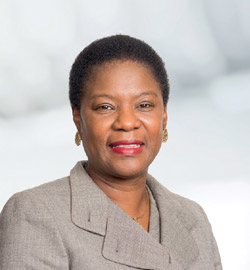
Funke Ighodaro
Chief financial officer