
SUSTAINABLE FUTURE
SUSTAINABLE COMPANY, COMMUNITY AND PLANET
 |
To optimise our societal-value proposition and enhance social and natural capital, we will deliver on our strategic commitments to: enable consumer health and nutrition; enhance livelihoods; and significantly reduce our environmental impact. These are underpinned by our strategic anchors relating to: robust food safety and food quality; occupational health, safety and security; ethical supply chain practices; and transparency, stakeholder responsiveness and partnerships. |
Performance summary 2019 |
Additional detail on our sustainability strategy and performance is available in our sustainable development report. |
ENABLING CONSUMERS TO IMPROVE THEIR HEALTH AND NUTRITION |
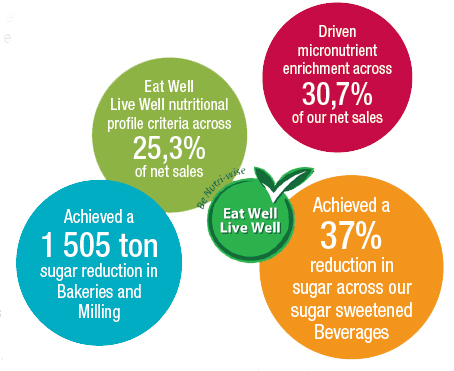
We will enable consumers to improve their health and well-being by providing affordable good nutrition. We are reviewing and updating our nutritional standards for our products to meet or exceed globally recognised guidelines, and we are developing more nutritious, affordable food products, including through the fortification of new and existing products. We are committed to leveraging our brand and marketing activities to promote consumer nutrition and health awareness and to inspire positive behaviour change, and to playing a leadership role in modern food labelling practices.
We have made some valuable progress on these commitments.
As part of the Tiger Brands Foundation’s in-school breakfast programme, this year we donated five school kitchens in vulnerable communities, with three of these schools winning top honours at the National School Nutrition Programme (NSNP) run by the Department of Basic Education. During the year we sponsored three new schools on our in-school breakfast programme, bringing the total up to 101 schools on the programme across all provinces. Since its launch, we have served more than 78 million breakfasts to the country’s most vulnerable learners, and creating over 390 jobs as food handlers, monitors and regional coordinators. Independent studies undertaken to assess the social return on investment (SROI) of the in-school breakfast programme in Limpopo and the Northern Cape have shown significant positive benefits.9 9 These studies are available at www.thetigerbrandsfoundation.com |

IMPROVING THE LIVELIHOODS OF THOUSANDS OF PEOPLE |
|
We are committed to improving the livelihoods of thousands of people by providing opportunities across our value chain for inclusive economic participation. We will continue to create sustainable livelihood opportunities by providing financial and non-financial support to black-owned and black women-owned enterprises and smallholder farmers, through our supplier and farmer development programmes, and our preferential procurement policies. In addition, we will continue on an annual basis to contribute at least 1,5% of net profit after tax towards socio-economic development activities that promote sustainable thriving communities. 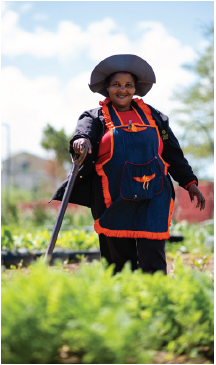
This year, we set up a “market access accelerator” to support those black-owned
enterprises that need intensive business development assistance by providing support
to enable them to access Tiger Brands’ supply chain opportunities, build their products
or services offerings, and assist in ensuring compliance. The accelerator has already
successfully supported seven black-owned enterprises to secure logistics opportunities
and trained more than In line with our recently revised socio-economic development strategy, we invested R28,5 million on community development, achieving several milestones including: distributing over 89 000 high-quality, nutrient dense and fortified food packages; reaching 30 000 direct and indirect beneficiaries each month through the Tiger Brands food and nutrition support programme; training 396 community members in food gardening and community skills development. |

SIGNIFICANTLY REDUCING OUR ENVIRONMENTAL IMPACT |
We will significantly reduce our environmental impact by implementing innovative solutions that optimise energy and water consumption in our operations, reduce the negative impacts of packaging, and minimise waste, effluent and emissions. We are exploring opportunities to develop innovative product offerings that are “good for you” and “kind to the environment”, implementing circular economy initiatives that stimulate sustainable economic opportunities, and leveraging our brand and marketing activities to inspire positive behaviour change in consumers.
This year we made valuable progress in reducing the environmental impact of our operations, focusing on the most material issues: improving energy and water efficiency, reducing greenhouse gas emissions, and striving for zero waste to landfill operations. As a result of various energy efficiency measures, we achieved a 6,5% reduction in total carbon emissions year-on-year, with emissions intensity down from 0,23 ton in FY18 to 0,21 ton CO2-equivalent per ton of product this year. We undertook baseline work on energy management, and next year we will be working on defining the ISO 50001 implementation and certification roadmap for our 10 most energy-intensive facilities. All of our coal fired boilers above 10MW were upgraded and grit arrestors installed to reduce particulate emissions below the legislated requirements. We conducted water efficiency assessments in multiple operations, contributing to a 7,2% reduction in total water use, and a slight improvement in water intensity. We completed a mapping of our waste streams across the business units, and we have engaged with the National Cleaner Production Centre to support our circular economy activities and identify opportunities for industrial symbiosis. All our manufacturing operations that went through their surveillance and recertification audits for ISO 14001 have successfully retained their certification. (Further details are in our online sustainable development report.) |

ROBUST FOOD SAFETY AND FOOD QUALITY SYSTEMS |

We are committed to energising the quality agenda, raising the bar and offering superior products. We are determined to develop a quality capability that differentiates Tiger Brands from our competitors, supported by trained and talented people integrated across functions, a robust and integrated set of processes and tools, and a culture and passion for quality that permeates across the organisation. This year, we invested in driving the quality agenda across the company. Quarterly self-assessments and gap closeouts were completed across our operations, and we achieved external certification (FSSC 22000/HACCP) for all our manufacturing sites. Supplier quality assurance processes are now in place for all new raw material and packaging suppliers, and we successfully delivered an online self-assessment module and incident management tool against the Global Food Safety Initiative (GFSI) for reporting and managing quality data. We completed HACCP training for all high-risk sites, provided basic microbiology and sampling training for relevant factory teams, and made progress with quality onboarding and awareness training across our operations. Through our various quality initiatives, this year we have seen a 18% reduction in consumer complaints, a 35% reduction in marketplace incidents, and zero public recalls. During 2020, we will build on this renewed focus on quality, defining and implementing a centralised hygiene and quality verification schedule for manufacturing units, and we will continue to drive selfassessments to deliver a step-change improvement in performance. We will deploy European Hygienic Engineering and Design guidelines as a manufacturing hygiene standard, deploy testing protocols at our operations, and develop and implement metrics and processes for supplier performance measureme |
OCCUPATIONAL HEALTH, SAFETY AND SECURITY |
|
Ensuring zero injuries and delivering strong behavioural safety, health and security performance through visible, felt leadership is a top priority. We have a holistic health and safety programme with clear roadmaps and deliverables, supported by a behavioural safety programme that drives leadership accountability and responsibility, as well as by effective auditing to ensure that process safety management is implemented properly. A brief performance review is provided below. Safety performanceThis year, tragically, one employee was killed in a work-related incident. In April 2019, Mr Aubrey Tornado Skosana, a driver at Albany Pretoria, died following a multi-collision vehicle accident while on a delivery. The Albany drivers have all subsequently been provided with additional training on defensive driving, with an online training programme delivered to all Bakery drivers and van assistants on route-to-market alertness. The family has been given support and counselling. Regrettably, there was an increase in the group’s lost-time injury frequency rate (LTIFR) to 0,38. For all reported incidents, we undertake a thorough root cause analysis. The findings inform the implementation of appropriate preventative measures, and are used to improve the operational safety culture. Disciplinary action is metered where appropriate. We are in the process of rolling out behaviour-based safety to all our manufacturing facilities and ensuring safety visual management standardisation in all operations. Occupational health (OH)This year we focused on driving the implementation of a revised OH strategy and improving the reporting of OH KPIs and incapacity cases. We have run ongoing operational OH awareness campaigns and interventions with the support of external OH service providers, developed and standardised our occupational hygiene surveys, and conducted health risk assessments. We have commenced a process of rationalising the health service providers across the group to deliver a consistent, cost-effective and standardised approach, and ensure that mobile healthcare service providers are available at relevant sites. Where necessary, we have contracted occupational health nurses, and are upgrading medical clinics’ infrastructure and equipment. 
Security managementWe have maintained a major focus on managing the concerning number of violent route-to-market incidents. All delivery routes are risk assessed, and tailored response measures developed. We have also improved security at our facilities, informed by site security risk assessments using a methodical security management system to review and ensure the availability of appropriate physical security measures and access controls. Training awareness is provided, and appropriate incident management, reporting and investigations undertaken. This year, we enhanced security personnel and controls at Bakeries and site security, revised the firearms policy and cash management guidelines, and commenced the process of rationalising security service providers across the group. |
TRANSPARENCY, STAKEHOLDER RESPONSIVENESS AND PARTNERSHIPS |

Recognising the importance of transparency and partnerships we are committed to playing an active role in industry forums to help shape sustainable consumption standards, tools and best practices. We are a member of industry bodies such as the National Business Initiative (NBI), Manufacturing Circle, Business Leadership South Africa, Consumer Goods Council of South Africa (CGSA), South African Agricultural Processors Association (SAAPA), South African Fruit and Vegetable Export Council (SAFVEC) and the South African Fruit Juice Association (SAFJA). We play an active role on various sustainability initiatives with these organisations, including for example on the UN SDGs, responsible labelling and marketing, and plastics packaging. We are working with South Africa’s Council for Scientific and Industrial Research (CSIR) on assessments to enhance manufacturing industry competitiveness through resource efficiency and cleaner production, and we partner with various academic bodies and NGOs. Each year, we voluntarily disclose our performance on carbon emissions and water management as part of the global CDP initiative. We are also signatories to the “We Mean Business” initiative, through which we have committed to adopting a science-based emissions reduction target, promoting responsible corporate engagement on climate policy, and reporting climate change information in mainstream reports as a fiduciary duty. |