The board of Tiger Brands has ultimate responsibility for
overseeing the group’s risk management processes. The
board is assisted by the risk and sustainability committee
who are responsible for ensuring that the risk management
process complies with relevant standards and governance
requirements. Senior management in each division and
business unit is responsible for managing risks in their
respective areas. Oversight of risk management at
divisional level rests with the relevant executive
committees. Divisional and business unit risk registers are
updated quarterly and reviewed on an annual basis at the
group executive committee risk workshop. The risk and
sustainability committee meets three times a year.
Risk appetite refers to the level of risk that Tiger Brands’
management is prepared to absorb before mitigating
actions are implemented; risk tolerance refers to the
company’s strategic capacity to accept or absorb the
risk. The operational risk committee will assess the risk
management evaluation criteria on an annual basis.
Any changes to the evaluation criteria, including the risk
appetite and tolerance are recommended for adoption
by the risk and sustainability committee.
The group executive committee determines the risk
appetite, tolerance evaluation criteria and velocity (the time
taken to feel the impact of a risk after it materialises) and is presented to the risk and sustainability committee for
recommendation to the board. The board reviews and
approves this annually, ensuring that the company
effectively identifies, manages and reports on risk across
all operations and all territories. The underlying reporting
structure starts at site level and rolls up into the relevant
business unit and division, culminating in risk reporting at a
group level.
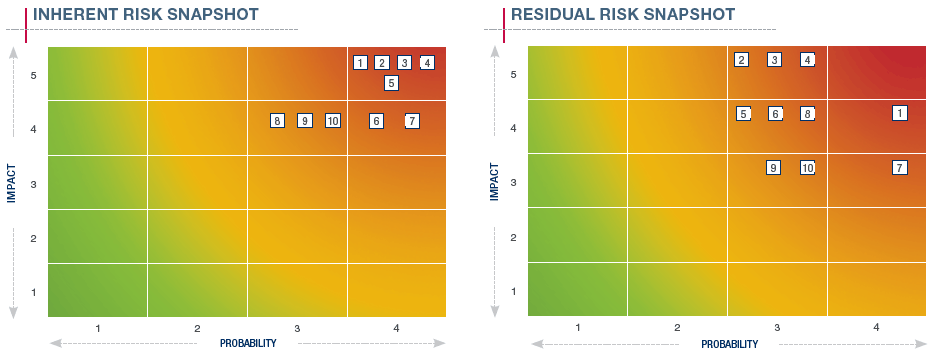
Each risk is evaluated in terms of its likelihood and impact,
both on an inherent (actual impact) and residual (after
mitigating action) basis. The current group residual risk
tolerance score is set at nine, as highlighted in the heat
maps below that reflect the scoring of our top 10 risks.
The group risk profile is reviewed quarterly and may be
revised after considering changes to the local and regional
macro-economic environment, recent political and
legislative developments, socio-economic challenges and
technological advancements. Through our combined
assurance model, the risk and sustainability committee
evaluates and approves the level of assurance provided
for all group risks.
The following heat maps reflect the top 10 inherent and
residual risks for Tiger Brands in the 2019 financial year,
identified as having the most material implications for
Tiger Brands and its employees.
The following table briefly reviews the implications and mitigation measures for each of the top 10 risks.
| MATERIAL RISKS |
|
IMPLICATIONS FOR VALUE |
|
MITIGATING ACTIONS |
|
|
|
|
|
|
|
- Weakened consumer demand off the back of
lower economic growth negatively impacts
volumes, and heightened consumer focus on
shopping on promotion, negatively impacts
profitability.
- Similarly, the rising cost of utilities, labour, general
input costs and regulatory requirements, is
increasing the cost base at a higher rate than
inflation, weighing on margins.
|
|
- Driving growth through customer strategies focused
on winning at the point of purchase.
- Creation of a health and nutrition strategy.
- Being efficient by unlocking costs and cash through
incremental supply chain savings and driving
continuous improvement efficiencies, fuelling growth
and continuing to build an advantaged and agile
supply chain.
- A people strategy focused on talent, leadership
and creating a great place to work.
- A sustainability strategy is aimed at health and
nutrition, enhanced livelihoods and environmental
stewardship.
|
| 2. |
Albany route-
to-market |
|
|
Increasing levels of violent crime against drivers
in the bakery route-to-market can result in:
- employee and service provider loss of life
- distribution disruptions
- reputational and brand damage
- potential loss of market share.
|
|
- All delivery routes are risk assessed, and tailored
response measures developed.
- Security assessment reports have been compiled for
all facilities to address security-related improvement
opportunities.
- Rationalisation of security service providers.
- Exploring technological solutions for more effective
security provision at a reduced cost.
|
| 3. |
Food safety
and product
quality |
|
|
Challenges with food safety and product quality
can have significant implications in terms of:
- loss of life
- reputational and brand damage
- loss of market share
- disruptions to production
- expensive product recall
- potential litigation.
|
|
- Revised good manufacturing practice (GMP)
standards and food safety system certification
standard (FSSC 22000) implemented across the
group, supported by standardised quality selfassessments
for all our manufacturing sites, training
of quality teams, and a robust supplier quality
management process.
- Manufacturing, group legal and regulatory
compliance functions collaborate to ensure products
comply with regulatory standards and meet
consumer preferences.
- Entrenched partnership with Stellenbosch University
to remain at the forefront of scientific trends; through
the Centre for Food Safety.
- Adoption of European Hygienic Engineering and
Design Guidelines (EHEDG) in terms of
manufacturing hygiene standards.
|
| 4. |
Occupational
health and
safety |
|
|
Occupational health and safety incidents can
result in:
- loss of life of employees and service providers
- reputational and brand damage
- regulatory non-compliance costs
- loss of market share.
|
|
- Robust safety programme implemented across the
group, supported by self-audits, annual independent
audits, and behavioural safety and awareness
initiatives, reinforced with disciplinary action.
- Safety improvement targets signed off annually
for each division and manufacturing site.
- Standardised occupational health and hygiene
programme and fitness to work standards have been
operationalised at all manufacturing sites.
- An external support model is being evaluated to
further strengthen compliance to occupational health
and safety.
|
| 5. |
Cybercrime
and information
security |
|
|
Increasing interconnectivity, globalisation and
“commercialisation” of cybercrime are driving
greater frequency and severity of cyber incidents,
including data breaches.
- This can compromise the confidentiality, integrity
and availability of information and technology
resources, leading to disclosure of commercially
sensitive information, intellectual property and/or
disruption to operations.
- In addition to non-compliance risks, the release
of any personal information also has negative
reputational and brand implications.
|
|
- Various external security specialist providers are
utilised to ensure that we enhance our security
posture.
- Penetration testing is part of the standard project
lifecycle approach.
- The new Cyber Security Bill has been drafted and is
out for public comment. The conditions and impact
of the Bill need to be assessed against our current
processes and controls.
- IT policies have been established to support the
group’s approach to managing information security.
- The cybersecurity landscape is monitored with a
view to implementing the latest security practices
and revising existing controls to safeguard the group
against cybercrime and maintaining cyber resilience.
|
| 6. |
Business
continuity
vulnerabilities |
|
|
Disruption at our facilities – for example, following
a significant technical breakdown, floods or fire,
political or labour unrest, and/or interruption of
IT services, energy or water supply – can lead to:
- interruptions in production, resulting in lost sales,
and reduced market share and reputation
- damage to plant and equipment
- increased production costs.
|
|
- Business continuity plans are in place for all
high-priority packaging and raw materials across
the business; a formal management process for the
group’s manufacturing facilities is in place. This
includes IT business continuity and annual technical
testing of the IT disaster recovery environment.
- A network upgrade project is currently under way
to implement secondary network links at all Tiger
Brands sites.
- Annual external risk, control and environmental
audits inform improved business-continuity planning
and disaster-recovery processes.
- Appropriate insurance cover is reviewed annually,
and disaster-recovery plans are in place.
|
| 7. |
Data and
information
risk |
|
|
- Suboptimal information management could lead
to inconsistent data quality, compromising
decisions and contributing to privacy/identity
management and information security risks.
- Increased regulation is placing additional demand
on system capabilities and IT teams and presents
implications in terms of compliance and potential
non-compliance costs.
|
|
- A holistic data and information strategy is being
developed in FY20 to manage this risk across the
organisation.
- Advanced information capabilities are being
explored in a prioritised manner in order to ensure
that Tiger Brands is able to take advantage of the
upcoming data science and engineering capabilities
which will result in proactive decision-making,
efficient operations and lead to competitive
advantage.
|
| 8. |
Attract and
retain critical
skills |
|
|
- A loss of critical skills can negatively impact our
ability to deliver our strategy and maintain
business viability and profitability.
- An inability to ensure sufficient level of diversity in
the executive team and across the employee base
also undermines our effectiveness and has
reputational implications.
|
|
Comprehensive people strategy is in place to attract,
develop, reward and retain talent, with provision for:
- performance management and incentive structures
aligning performance to group objectives
- proactive talent mapping and engagement plans
by role and function to drive talent acquisition
- skills development and leadership initiatives
- robust induction and onboarding programme.
|
| 9. |
Fraud, theft,
crime and
corruption |
|
|
- Instances of fraud, theft, crime and corruption can
result in loss of life, financial loss, reduced profit
margin and negative impact on reputation.
|
|
- Internal controls are in place and are reviewed to
guard against fraud and crime through employee
awareness, strict access control, and working with
local police in investigating syndicated crime.
- Each business completes quarterly selfassessments,
independently assessed by internal
audit.
- Tiger Brands’ ethics line is available to employees,
suppliers and customers to confidentially report
unethical business practice; the ethics committee
validates the close out of all ethics reports.
|
| 10. |
Ageing
infrastructure |
|
|
- Ageing plant and equipment has implications in
terms of increased maintenance costs, inefficient
operations and variable production quality, and
cost of product recall and replacement.
|
|
- Replacement and maintenance capital expenditure
is implemented annually; this year R1,1 billion was
disbursed in capital expenditure, with R1,5 billion
planned for FY20.
- A total productive maintenance system is in place to
maintain and improve the integrity of production
systems; a maintenance management system is in
place at all sites across the group to ensure proper
and consistent application of maintenance planning
and scheduling.
|