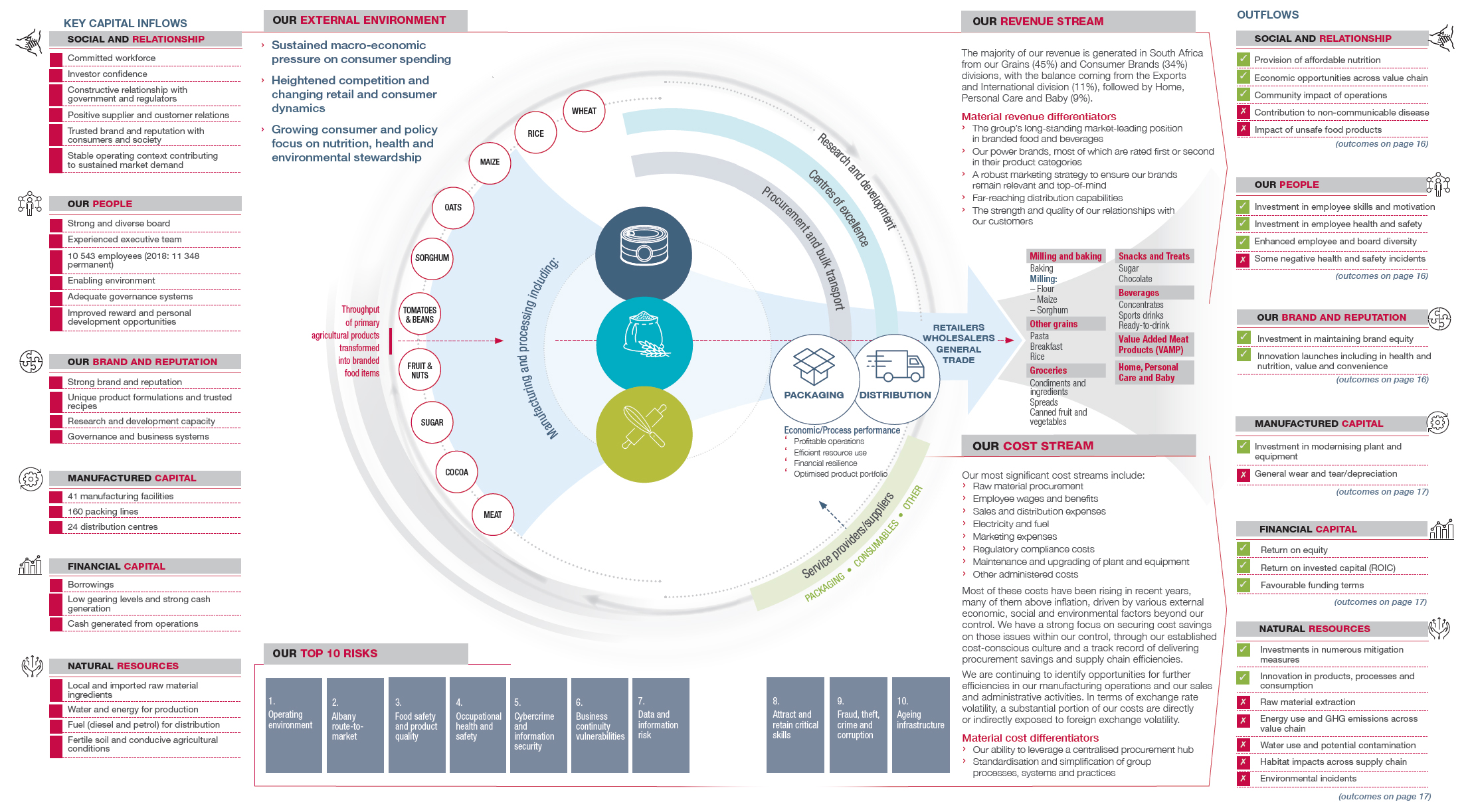
Our business model
Tiger Brands creates value and delivers on its purpose by producing, marketing and
distributing everyday branded food, home and personal care products, predominantly
in South Africa with a growing market presence across Africa.
Our core target consumers are middle-income consumers, the largest and fastest
growing segment. Our core category is food with immediate adjacencies
in beverages, snacks and treats.
 Material inputs
| Committed workforce |
| Investor confidence |
| Constructive relationship with government and regulators |
| Positive supplier and customer relations |
| Trusted brands and reputation with consumers and society |
| Stable operating context contributing to sustained market demand |
Our actions to sustain value
- Strong drive on people strategy
(see Great people), and on developing
positive employee relations
- Regular investor communication
- Structured engagement with
regulators, continued focus on
compliance and ensuring a societal
contribution
- Active engagement with suppliers and
customers (retailers and wholesalers)
- Product and process innovation
including on health, convenience and
value
- Delivering societal value through
our core business, supported by
Tiger Brands Foundation
|
|
Outcomes
of our activities
Generally positive relations across
key stakeholder group
 |
18% reduction in consumer complaints and 35% reduction in marketplace incidents |
|
31% of net sales fortified with micronutrient enrichment |
|
R14,3 billion BBBEE supplier spend |
|
R12,3 million spend to support black farmers and small businesses |
Continuing concerns in certain areas
 |
Concerns around the company’s ability to recover cost push in a challenging consumer environment |
|
Listeria class action lawsuit |
|
Labour unrest (Groceries and Bakeries) |
|
|
Capital trade-offs
- Our success as a business
depends ultimately on the quality
of our relationships with key
stakeholders. These stakeholders have different and sometimes
conflicting priority interests; balancing these
competing interests requires
trade-offs as we prioritise certain
investments over others.
- Investing in social and relationship
capital also often requires short to
medium-term financial capital
inputs, but generally generates
positive return across most capitals
over the longer term.
|
 Material inputs
| Strong and diverse board |
| Experienced executive team |
| 10 543 employees (2018: 11 348) |
| Enabling environment |
| Adequate governance systems |
| Improved reward and personal development opportunities |
Our actions to sustain value
Three-pillar people strategy focusing
on building a diverse talent base,
developing leadership capacity, and
creating a great place to work
- Sustained focus on promoting
diversity and employment equity
- Appropriate succession plans in
place
|
|
Outcomes
of our activities
Generally improved employee skills
and motivation
|
40% of leadership appointments were internal |
|
Recognised as a Top Employer 2019 |
|
Management trainee programme
ranked second in SA Graduate and
Employee Association |
|
R4,2 billion on wages and benefits |
|
R127 million invested in skills
development |
Board diversity:
|
62% black and 38% female |
Employee diversity:
|
93% black and 30% female |
|
Industrial action at some of our operations |
|
One fatality (2018: one) |
|
0,38 lost-time injury frequency rate (2018: 0.27) |
|
|
Capital trade-offs
- As labour is one of our most
significant costs, there has been a
strong drive to identify
opportunities for further labour
efficiencies and productivity gains
across our operations. While
reducing labour costs has benefits
in terms of financial capital, it has
potentially significant negative
implications in human and social
capital.
- Investing, attracting, retaining and
developing executive talent is a
material cost, depleting financial
capital in the short term, but
resulting in returns in most capital
stocks in the longer term.
|
 Material inputs
| Strong brand and reputation |
| Unique product formulations and trusted recipes |
| Research and development capacity |
| Governance and business systems |
Our actions to sustain value
- Strong focus on ensuring a clear
purpose and strong personality
behind our master brands
- More diversified marketing spend
across different media
- Investment in innovation and R&D,
including in health and wellness
|
|
Outcomes
of our activities
Sustained brand presence
|
100% penetration in South Africa, with every household having at least one Tiger Brands product |
|
Category leader in over 50% of the categories we operate in from a brand equity perspective |
|
Brands compete head-on with the leading brand in almost a third of categories |
|
We can disrupt categories, being a challenger in over 15% remaining categories |
Innovation launches, including:
|
Health and nutrition: Albany BoB Genius, Ace+Fibre, Jungle Plus+ |
|
Value: Tastic variants; Benny seasoning; Morvite strip pack |
|
Convenience: Purity pouches |
|
Other: 100% durum pasta; new Oros flavours |
|
|
Capital trade-offs
- Tiger Brands’ legacy is built on the
strength of our brands and the
quality of our products, which in
turn depends on our proprietary
product recipes, our capacity to
innovate in response to changing
consumer preferences, our robust
food quality and safety systems,
and our innovative marketing and
consumer engagement.
Maintaining our leadership in these
areas is key to long-term growth,
but often has short-term cost
implications.
|
 Material inputs
| 41 manufacturing facilities |
| 160 packing lines |
| 24 distribution centres |
Our actions to sustain value
- R1,1 billion capital expenditure in
manufacturing and distribution
capability and technology
|
|
Outcomes
of our activities
Generally positive relations across
key stakeholder group
|
Investment in Oats Mill, Beverages |
|
97% on-shelf availability |
Some challenges remain
|
Supply chain difficulties at Groceries impacted profitability |
|
Higher conversion costs at Snacks and Treats |
|
|
Capital trade-offs
- Investing in plant and equipment is
beneficial for longer-term growth
but can impair short-term financial
performance.
- The modernising of facilities may
also lead to job losses, negatively
impacting social and human
capital; any job losses generally
contribute to reduced consumer
spend and undermine market
growth.
|
 Material inputs
| Borrowings |
| Low gearing and strong cash generation |
| Cash generated from operations |
Our actions to sustain value
- Strategy supported by focused
execution
- Continued drive on operational
efficiency
- Prudent approach to capex
approvals
- Operating model embedded
through revitalised ways of
working
- Strong corporate governance
structures
- Deliberate working capital
management
|
|
Outcomes
of our activities
Generally positive relations across
key stakeholder group
|
21,6% return on net assets (RONA) (2018: 26,6%) |
|
Net interest paid R10,6 million (2018: R41,8 million) |
|
R3,5 billion cash generated from operations (2018: R3,3 billion) |
|
Savings of R616 million |
|
Working capital cents per R1 turnover 21,4 (2018: 21,6) |
|
Total dividend per share declared: 1 061 cents (1 080 cents) |
|
14,1% return on equity (2018: 16,7%) |
|
ROIC 14,2% > weighted average cost of capital (WACC) 12,5% (2018: ROIC 17,3% > WACC 12,5%) |
|
|
Capital trade-offs
- Ensuring sustainable growth in
financial capital often involves
making significant capital
investments in the short term.
- Our strategic direction informs the
allocation of capital to balance the
short-term interests of certain
stakeholders with long-term
growth objectives.
|
 Material inputs
| Local and imported raw material ingredients for our products |
| Water for production facilities,
comprising municipal supply and own
borehole sources |
| Energy to fuel our manufacturing,
primarily Eskom electricity |
| Fuel (diesel and petrol) for distribution |
| Fertile soil and conducive agricultural conditions |
Our actions to sustain value
- Continued energy and water
efficiency measures, with
supporting mitigating plans to
ensure continuity of production
- Investment in innovations to
optimise packaging and reduce
waste
- Partnerships in place to reduce
food waste and packaging waste
|
|
Our actions to sustain value
Some progress in mitigating impacts
|
Absolute water use down 7,2%; water intensity down 5,4% |
|
Total carbon emissions down 6,5% year-on-year |
|
Absolute energy use down 8,5%; energy intensity down 5,0% |
|
Achieved a 10% reduction in body
plate thickness by light-weighting
aerosol and food cans |
|
|
Capital trade-offs
- Natural capital is a critical input
for all of our activities. Generating
value across all the other capitals
often involves some negative
impact on natural capital.
- We strive to minimise these
impacts across our value chain,
by investing in mitigating
measures in our processes,
products and packaging.
|