
Strategic review

Noel Doyle, Chief financial officer
Salient features*
Revenue declined by 9% to |
Group operating income** decreased 28% to |
Group operating margin** down 310 basis points |
|||||
Heps down 26% to |
Dividend unchanged at 1 080 |
Dividend cover reduced to 1.75x based on |
* From continuing operations.
** Before IFRS 2 charges, impairments and abnormal items.

Overview
South Africa slipped into a technical recession during the second quarter of 2018 and the rand weakened significantly, adding to the pressure on consumer spending. At the same time, input costs started to increase considerably. Despite this cost push, the market was characterised by manufacturer restraint on pricing in an attempt to minimise consumer inflation and maximise volumes. The group's VAMP divisionhad a material impact on the results after suspending operations for the entire second half of the financial year.
Analysis of financial performance
The following review of the group's financial performance should be read together with the annual financial statements (www.tigerbrands.com).
Income statement
The increase in VAT and further increases in the cost of transport and essential services weakened consumer demand in all categories except maize, where increased supply and price deflation stimulated demand. Domestic revenue fell 9%, with volumes down 5% and price deflation of 4%. Suspending operations at VAMP contributed 4% to the volume decline. The balance of the volume decline reflected a worse-than-expected performance in Groceries and Home & Personal Care. This was partially offset by volume and market-share growth in Grains. Disappointingly, the positive volume performance in Grains was not reflected in operating income due to category deflation and increases in the cost of essential services, pressuring margins. This resulted in domestic operating income declining by 28% to R3,0 billion (2017: R4,2 billion).
Total revenue for the Exports and International businesses declined 10% to R3,8 billion, while operating income reduced by 32% to R270 million. This result was influenced by a positive performance from our African exports, which grew revenue and profit. The Deciduous Fruit business had a disappointing year. Fruit quality and availability were affected by the prolonged drought in the Western Cape, with lower fruit yields and declining volumes resulting in an operating loss for the year.
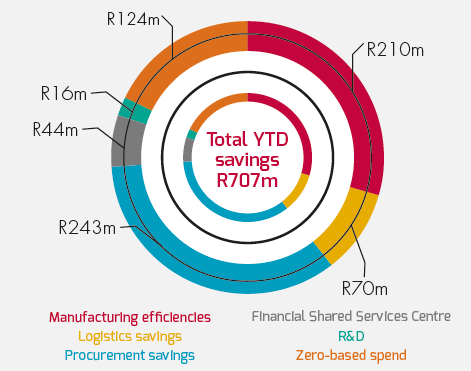
Savings in procurement and ongoing supply chain efficiencies yield record savings |
Cumulative procurement savings (Rm) |
|||
 |
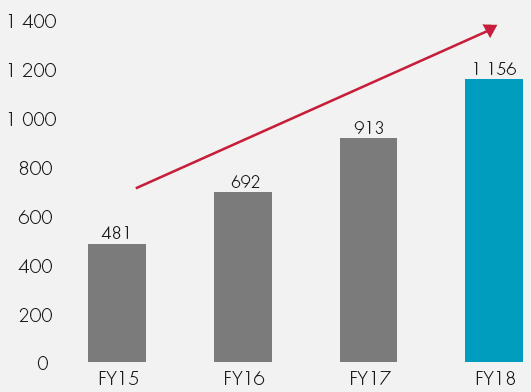 |
The impact of volume declines and pricing pressures on the group's gross margins was partially offset by another year of record savings in procurement and ongoing supply-chain efficiencies totalling R707 million (2017: R505 million). Gross margins declinedby 90 basis points (bps) to 32,5% from 33,4%.
During the year, asset impairments of R262 million (2017: R560 million) were accounted for after a detailed evaluation of intangible assets in the Personal Care division, a review of the carrying value of Deli Foods' operating assets in view of its loss-making position, as well as the impact of the Listeria outbreak on Hercules, the Pretoria-based VAMP facility.
Abnormal losses of R422 million in the current year include the significant impact of the VAMP product recall of R380 million (net of insurance recoveries).
Income from associates increased 37% to R731 million (2017: R533 million), with all associates reporting improved performances in local currency, and particularly strong performances from Oceana and Carozzí. Oceana benefited from a once-off deferred tax adjustment after the US federal corporate tax rate was reduced from 35% to 21%, effective 1 January 2018. Tiger Brands' equity accounted share of this benefit was R79 million for the year.
Net financing costs of R34 million benefited from a reduction in net interest costs of R125 million, due to lower average debt levels. A net foreign exchange gain of R21 million was realised, compared to a loss of R30 million in the previous year, due to the weakening of the rand in the latter part of this year.
The effective tax rate before abnormal items, impairments and income from associates increased to 30,2% from 28,9%, largely due to the non-recurrence of investment allowances claimed on qualifying capital projects in 2017.
Headline earnings per share (HEPS) from continuing operations declined 26% to 1 587 cents (2017: 2 155 cents), while earnings per share (EPS) from continuing operations decreased 21% to 1 451 cents (2017: 1 848 cents).
HEPS from total operations decreased 26% to 1 589 cents (2017: 2 161 cents). EPS from total operations reduced by 24% to 1 458 cents (2017: 1 915 cents). Excluding VAMP's trading results and product-recall costs from the current and prior year, HEPS from continuing operations declined by 11% to 1 881 cents (2017: 2 109 cents). Similarly, EPS from continuing operations declined 2% to 1 760 cents (2017: 1 802 cents).
HEPS impacted by VAMP and challenging trading conditions

* WANOS – Weighted average number of shares.
Segmental performance
The increasingly competitive environment resulted in ongoing volume pressure, with the domestic business reporting revenue declines of 9% while operating income declined by 28%. The Exports and International business delivered a mixed result, with improved performances from Exports and Chococam offset by Deciduous Fruit and Deli Foods. Total revenue for the Exports and International businesses declined by 10% while operating income reduced by 32%.
Suspension of VAMP and challenging trading environment affect overall performance
| Grains | Consumer Brands Food(ex VAMP) | HPCB | Exports and International | Group* (ex VAMP) |
VAMP | Group* | |||||||||||||||
| Volume | ▲ | 3% | ▼ | 3% | ▼ | 14% | ▼ | 8% | ▼ | 2% | ▼ | 53% | ▼ | 6% | |||||||
| Revenue | R12,8bn | R8,7bn | R2,2bn | R3,8bn | R27,4bn | R1,1bn | R28,5bn | ||||||||||||||
| ▼ | 4% | ▼ | 3% | ▼ | 16% | ▼ | 10% | ▼ | 6% | ▼ | 52% | ▼ | 9% | ||||||||
| Operating income** | R1,9bn | R1,1bn | R0,3bn | R0,3bn | R3,6bn | (R0,3bn) | R3,3bn | ||||||||||||||
| ▼ | 20% | ▼ | 8% | ▼ | 45% | ▼ | 32% | ▼ | 21% | ▼ | 342% | ▼ | 28% | ||||||||
| Operating margin** | ▼ | 14,8% | ▼ | 12,5% | ▼ | 15,3% | ▼ | 7,2% | ▼ | 13,0% | ▼ | (23,7%) | ▼ | 11,7 |
* From continuing operations.
** Before IFRS 2 charges, impairments and abnormal items.
Detailed segmental disclosures appear on KPIs of the annual financial statements in the report and operational review
Statement of financial position
Cash generated from operations decreased by 46% to R3,3 billion. Working capital was predominantly impacted by strategic raw-material purchases coupled with higher inventory holdings, reflecting forecasting challenges due to constrained consumer demand. Capital expenditure disbursed during the year totalled R720 million, of which almost 15% related to efficiency optimisation and improved compliance.
Final dividend
Taking into account the company's strong balance sheet and once-off impact of suspending operations at VAMP, including costs of the product recall, a gross final cash dividend of 702 cents per share has been declared for the year ended 30 September 2018. This, together with the interim dividend of 378 cents per share, brings the total dividend for the year to 1 080 cents, unchanged from last year.
Shareholders are referred to the accompanying dividend announcement on Declaration of final dividend number 148 for further details.
Dividend policy
In recognition of the company's low gearing levels and strong cash-generating capabilities, the board has decided to change the company's dividend policy, from 2x cover (based on HEPS) to 1,75x for the foreseeable future, in the absence of any significant corporate activity.
Balance sheet strength supports lower dividend cover
| FY18 | FY17 | ||
| Cash generated from operations (Rm) | 3 284 | 6 134 | |
|---|---|---|---|
| Net cash (Rm) | 590 | 431 | |
| RONA (%) | 27 | 35 | |
| Net interest cover | 59x | 25x | |
| Working capital per R1 of turnover | 21,7 | 19,9 |
Outlook
The economic outlook for 2019 remains challenging, with no signs of a significant recovery in economic growth or consumer confidence.
We remain committed to the growth of our power brands, with a relentless focus on creating a cost-conscious culture and developing a great place to work for all our employees, which will result in superior returns and a beneficial outcome for all our stakeholders.
Acknowledgements
Thank you to our local and international shareholders for your continued investment in our group and to members of the broader investment community for their interest and engagement. I also thank my colleagues in the finance department who constantly strive to ensure the group achieves best-practice standards in reporting and disclosure.
Noel Doyle
Chief financial officer
21 November 2018