Health and nutrition
Enabling consumers to improve their health and well-being
The responsibility of the food sector in driving health and nutrition has been highlighted by various recent studies that suggest that unhealthy diets pose a greater risk to human health than alcohol, drug and tobacco use combined. This is seen to be particularly true in South Africa, which faces the double burden of malnutrition, characterised by the coexistence of undernutrition, along with obesity and diet-related non-communicable diseases.
To address this challenge we are committed to enabling consumers to improve their health and well-being by providing good nutrition. We are reviewing and updating our nutritional standards for our products to meet or exceed globally recognised guidelines, and we are developing more nutritious, affordable food products, including through the fortification of new and existing products. We are committed to leveraging our brand and marketing activities to promote consumer nutrition and health awareness and to inspire positive behaviour change, and to playing a leadership role in modern food labelling practices.
Providing more nutritious, affordable products
Developing nutritional standards that meet or exceed globally recognised nutritional guidelines
With malnutrition affecting a significant proportion of the populations we serve, we understand the important responsibility that comes with manufacturing great quality staple foods like bread and maize meal, particularly to people in lower-income categories. We are reviewing and updating our nutritional standards for our products to meet or exceed globally recognised guidelines. To accelerate Tiger Brands' transformation and be recognised as a thought leader on health and nutrition in Africa, we have revived the Eat Well Live Well Nutrition Standards to create visibility on the nutritional profile and value of our products.
Developing more nutritious, affordable products
During FY20 we will establish the baseline and set a target for more nutritious products as a percentage of our total portfolio. We have been working hard to combine the health and convenience trend with increased affordability and value.
Tiger Brands reduced salt levels since 2016 in affected food categories: bread, breakfast cereals, processed meats, savoury snacks, instant noodles and stock concentrates, to comply with South African regulations. These regulations targeted a further reduction for June 2019 across the affected categories, and we are 100% compliant with the further reduction.
In addition to ensure full compliance with the regulated targets for sodium reduction, we achieved a 37% reduction in sugar across our sugar sweetened beverages, and a 1 505 ton reduction in Bakeries and Milling.
Product and process innovation lies at the heart of our growth agenda. We have a robust innovation pipeline that was launched in the second half of FY19. Our rice brand Tastic recently launched an affordable brown rice to reflect consumer desire for an increasing focus on health and nutrition. We evolved our bread brand Albany to create the Albany "Best of Both Genius", which is a specialty bread with added nutrients made for children, providing benefits such as boosting the immune system while supporting growth and brain development, we have also added a new fibre variant to Ace maize meal, which has more than 25% of a person's recommended daily fibre intake to promote digestive well-being.
Fortification of new and existing products: In line with South African regulations, we fortify staple foods such as brown bread and white bread wheat flour as well as maize meal. These are fortified with key vitamins and minerals, including vitamins A, B1, B2, B3, B6, B9 (folic acid), iron and zinc. Under pending regulatory changes, the amounts of these vitamins and minerals and the type of compound for iron has been amended to better meet micronutrient deficiencies. In addition, fortification will be extended to cake flour for the benefit of consumers. Once the new regulations are published, we will change the fortification for affected products to ensure compliance.
We voluntarily enrich other products including breakfast cereals such as Morvite, certain Jungle cereals and Ace Instant with micronutrients that would otherwise be consumed in inadequate amounts in South African diets. Products are specifically developed to target certain requirements, for example Jungle Oatso Easy cereals are enriched with some B vitamins that assist in releasing energy from the foods we eat, while Morvite has been specifically developed with micronutrients that assist in supporting the immune function.
Leveraging our brand and marketing to inspire positive behaviour change
Consumer nutrition: As a leading manufacturer, we are aware of the significant impact Tiger Brands has on the nutrition, health and well-being of consumers. We monitor advances in nutrition and broader health issues, including World Health Organisation (WHO) and South African Department of Health public health concerns.
Guideline daily amounts and Eat Well Live Well: We are dedicated to helping consumers make better food choices so that healthy living becomes easier. In 2009, we were the first South African company to voluntarily initiate the Eat Well Live Well (EWLW) system that includes the guideline daily amount (GDA) table on a number of Tiger Brands products (www.ewlw.co.za). In 2015, we started to introduce the Be Nutrient Wise GDA system on the front of some of our packs. Its logo alerts consumers to be mindful of the five nutrients that have an impact on non-communicable and lifestyle conditions, such as heart disease, type 2 diabetes, obesity and some cancers.

The Eat Well Live Well system has its own icon – only featured on products that constitute better food choices for overall health – and website, where consumers can learn about incorporating healthy eating into their lifestyle (www.ewlw.co.za). Consumers also have access to our nutritionist for further information or assistance. Eat Well Live Well is active on social media such as Facebook www.facebook.com/EatwellLivewellSA/, where consumers can interact with others and with the nutritionist. To date, we have over 130 000 followers.
We continue to develop and evaluate products to meet the "good for you" offerings, in line with the Eat Well Live Well programme. Current examples of products meeting the programme's stringent criteria include: Albany: low GI variants, and 100% smooth wholegrain brown bread; Black Cat: no-sugar, no-salt variants; Tastic Wholegrain Brown Rice; and Jungle Oats. This year, we achieved compliance with our Eat Well Live Well nutritional profile criteria across 25,3% of net sales.
We will be driving innovation within our existing brands and categories to develop more nutritious, affordable food products, and we will be working in partnership with government, academia and NGOs, through Eat Well Live Well, to educate consumers in a manner that allows them to make better informed decisions about their well-being.
Taxation of sugar-sweetened beverages: In April 2018, a tax on sugar-sweetened beverages, known as the health promotion levy was introduced. The threshold of 4g per 100ml meant that all beverages containing more than 4g of sugar would be subject to a tax rate of 2,1c for every gram above 4g.
Even though the announcement of the tax and its inclusion in legislation was only confirmed in February 2018, Tiger Brands began implementation of the tax on time. This meant registration of relevant facilities as per the South African Revenue Service (SARS) requirements as well as accounting for the number of products produced and sold prior to and post the implementation date. We continue to account accordingly and comply with SARS requirements to pay the tax.
Play a leading role In food labelling
We are committed to ensuring transparent labelling of our products, on such issues as additives, allergen, gluten-free, religious requirements, biotech and genetically modified ingredients, caffeine and theobromine. General labelling, as well as declaration on certain ingredients and allergens is regulated. Ingredients, additives and allergens are always declared, irradiated foodstuffs or individual irradiated ingredients are declared, and genetically modified ingredients outside of certain thresholds are also declared. In addition, even where regulations do not specify declaration of certain ingredients, we voluntarily declare issues such as the amount of beta glucan (insoluble fibre) on certain oats containing products as well as the glycaemic index and glycaemic load of low GI products.
Promoting nutrition through the Tiger Brands Foundation
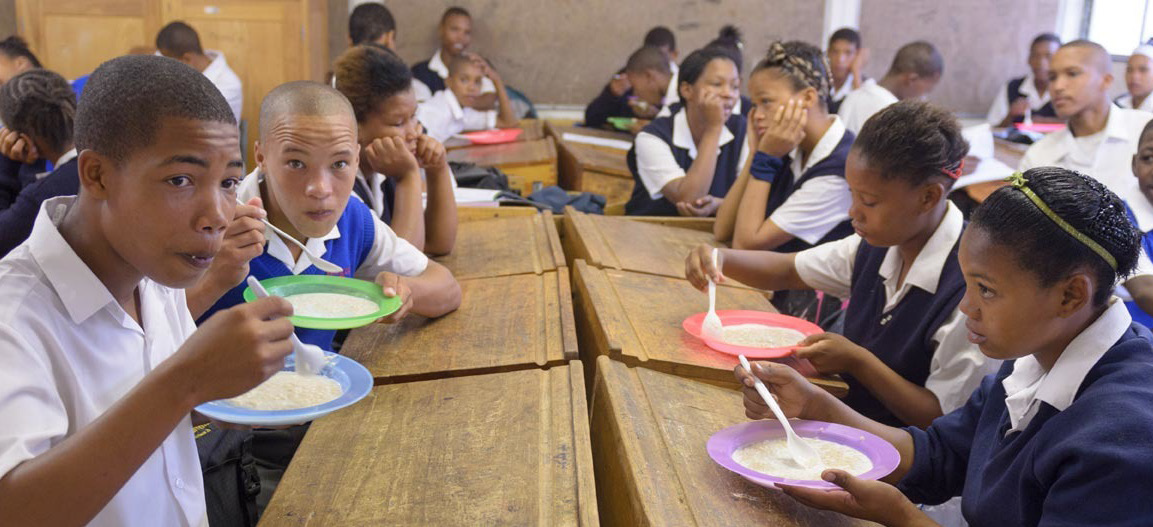
The Tiger Brands Foundation was established to enhance our community impact and assist a broader range of underprivileged people in South Africa, particularly communities with whom we interact most. It is managed by an independent board of trustees which establishes the criteria and procedures governing resource allocation. From six primary schools in Alexandra, this has expanded to over 100 schools in all provinces, providing the essential breakfast meal to around 72 000 learners. By September 2019, over 78 million breakfasts had been served to our country's most vulnerable learners.
School kitchens
Between October 2018 and September 2019, the Foundation has donated three school kitchens to schools that won top honours at National School Nutrition Programme (NSNP) Awards run by the Department of Basic Education (DBE). This donation flows out of the public-private partnership that the Foundation has with DBE.
In addition, the Foundation has donated two kitchens to other schools that are on the in-school breakfast programme. In total, the Foundation has donated five school kitchens during the financial year, with the total value of the donations being R2,4 million.
Addition of new schools
The number of schools on the Foundation's in-school breakfast programme has grown significantly over the reporting period. This was largely due to new corporate partners sponsoring schools on the programme. Sponsors elect the number of schools they want to bring onto the programme and make a commitment of a minimum of three years. Tiger Brands Limited's socio-economic development (SED) division has sponsored three schools for the breakfast programme. The three schools are situated in the Eastern Cape (Simekweni Junior Secondary School), the Free State (Phomolong Intermediate School), and Limpopo (St Martin de Porres Primary School).
An additional four schools have been added onto the breakfast programme through a sponsorship from Karoshoek Solar One (RF) Proprietary Limited. All four schools are based in Upington in the Northern Cape. This brings the total number of schools on the breakfast programme to 101 schools as at 30 September 2019.
Food and nutrition support
For over 10 years, as part of our socio-economic development (SED) strategy, we have provided nutritionally balanced food hampers to the most in-need beneficiaries across South Africa. These food hampers enable healthier lives through partnership with food-focused NGOs and university institutions. Through these initiatives Tiger Brands has managed to donate over 46 tons of food and we support nearly over 30 000 community members each month across South Africa.