
Enhanced livelihoods

Improving the livelihoods of thousands of people
There is an evident need to promote economic and social inclusion in South Africa and regionally. South Africa is one of the most unequal societies in the world, with a Gini co-efficient of 0,66. Currently more than half of the South African population live in poverty, an increase since 2015. This is constrained by a low rate of economic growth, making it difficult to generate jobs, with a high unemployment rate of 27%, and 50% youth unemployment.
In this context, we are committed to improving the livelihoods of thousands of people by providing opportunities across our value chain for inclusive economic participation. As part of our strategy, we are committed to supporting new black/black-women owned enterprises and create sustainable livelihood opportunities by 2030. We will achieve this during FY20 by launching the ESD fund and commit a R100 million investment, setting up new enterprises and facilitate at least 1 000 jobs, as well as setting up a business incubator to support emerging entrepreneurs. Some of these have already been partially achieved as seen above. By 2030, 50% of our total local procurement spend will be towards black/black women-owned suppliers. We will achieve this through a R1 billion incremental preferential procurement spend, having import replacement procurement plans in place, and driving the implementation of our BBBEE procurement policy. We will continue to annually contribute at least 1,5% of net profit after tax towards SED activities that promote sustainable thriving communities, continuing our work establishing food gardens for communities, families, schools and universities, providing food hampers to vulnerable communities and universities, and continuing with community social enterprise projects during FY20.

Enterprise and Supplier Development
Tiger Brands is committed to enterprise and supplier development (ESD), through development of operational and financial capacity of black-owned and black women-owned enterprises to become part of Tiger Brands' value chain – from sourcing to distribution.

For FY18, Tiger Brands spent
R14,3 billion
with BBBEE verified suppliers

To ensure that Tiger Brands delivers ESD that is responsive to corporate strategy, a Tiger Brands three-year ESD strategy was developed which fully aligns with the corporate strategy. This strategy provides a roadmap on the key focus areas for the development and support of black-owned and black women-owned suppliers, farming enterprises and distribution enterprises.
Tiger Brands launched the Dipuno ESD Fund which will be a conduit for provision of financial support to black-owned and black women-owned enterprises, suppliers and farming enterprises. An initial capital investment of R45 million has been made to Dipuno Fund to provide loans and technical support to beneficiaries and to provide Dipuno with a small operating budget. More information is available on: www.tigerbrands.com/sustainability/transformation/developmentfund
This year, we set up a market access accelerator to support those black-owned enterprises that need intensive business development assistance by providing support to enable them to access Tiger Brands' supply chain opportunities, build their products or service offerings, and assistance in ensuring compliance.
The accelerator has already successfully supported seven black-owned enterprises in securing logistics opportunities and trained more than 50 aspiring black entrepreneurs across sites where Tiger Brands operates factories.
R1,6 billion with suppliers classified as qualifying small enterprises or exempt micro-enterprises (QSE, EME) |
R3,5 billion with suppliers that qualify as black owned |
We also provided 58 black smallholder farmers with both financial and non-financial support, including agronomics and agrarian advice, business mentorship and interest-free loans, helping them to participate within our procurement chain.
- An investment of R4 million in the form of an unsecured input finance loan was invested in 10 black-owned grains smallholder farming enterprises to plant 500ha of wheat and oats in the Western Cape. This loan investment is secured by offtake agreements from Tiger Brands.
- Tiger Brands partnered with Anglo American Platinum through Zenzele Itereleng Community Trust; a 50/50 joint investment of R9 million in the form of an unsecured input finance loan was invested in 48 black-owned grain smallholder farming enterprises to plant 1 000ha of wheat in the North West Taung area. Additionally, an amount of R500 000 of 50/50 joint spend was invested towards the provision of technical and business support for the farmers.
In addition, we spent R14,3 billion with BBBEE verified suppliers, including R3,5 billion with black-owned enterprises.
R1,9 billion
with suppliers that qualify as black women-owned
Supporting livelihoods through preferential procurement
Tiger Brands is committed to supporting black economic empowerment and will prioritise procurement awards in South Africa to suitably qualified suppliers in line with the Broad-Based Black Economic Empowerment Act 53 2013 (BBBEE). BBBEE suppliers will be given preference among competing bidders where all other selection criteria are met. Tiger Brands reserves the right to restrict any business with suppliers suspected of BBBEE fronting.
This inclusive approach also ensures our requirements for the best-value package are met, comprising best price, quality, service and delivery performance.
Our procurement team has rationalised these strategies to deliver value to Tiger Brands and meet transformation obligations. This includes ensuring that suppliers improve their BBBEE credentials. Within five years, we aim to get as close as possible to the 40% target on this element in our BBBEE scorecard.
Transformation in the ingredients and agricultural categories remains slow due to the capital and skills needed to establish sustainable supply. Tiger Brands is actively engaging with suppliers to encourage transformation and identifying suitable BBBEE candidates for enterprise supplier development. Transformation is also slow due the input requirements and access to land. The volumes that Tiger Brands sources make it difficult for individual smallholder farmers to compete, which is why we introduced the aggregator model.
Review of preferential procurement
Our BBBEE scorecard as at December 2018 is in the table below. Our BBBEE score at present is level 6, discounted to level 7 against the amended agriculture sector (agri-BBBEE) codes gazetted in December 2017. To align to the revised codes, we have developed a broader group transformation strategy that will ensure focused and integrated execution in all elements of the BBBEE scorecard. Through this approach, we aim to achieve a level 3 contributor status by 2022. The group transformation strategy will guide all activities towards this score. Our 2019 results will only be available after this report is finalised.
| Tiger Brands BBBEE scorecard 2018 | ||||||
| Available points 2018* |
2018 | |||||
| Ownership | 25 | 18,3 | ||||
|---|---|---|---|---|---|---|
| Management control | 19 | 10,13 | ||||
| Skills development | 20 | 11,02 | ||||
| Enterprise and supplier development | 40 | 15,58 | ||||
| Socio-economic development | 15 | 15 | ||||
| Total | 119 | 70,03 | ||||
| Level | Level 6 discounted to 7 | |||||
* Tiger Brands is measured against the amended agriculture sector codes gazetted on 8 December 2017.
| BBBEE ownership 2018 | |||
| % by black people |
|||
| Thusani trusts (beneficiaries are children of black employees) | 1,88 | ||
|---|---|---|---|
| Tiger Brands Black Managers Trust | 0,64 | ||
| Tiger Brands Foundation Special Purpose Vehicle (SPV) | 4,78 | ||
| Tiger Brands general staff share trust | 0,07 | ||
| Institutional shareholders with black shareholding | 0,32 | ||
| Total | 7,69 | ||
Socio-Economic Development (SED)
Tiger Brands' recently revised Socio-Economic Development (SED) strategy is designed to deliver on the company's core purpose of nurturing and nourishing lives every day. Through our focus on food and nutrition, community skills development, and community enterprise development, we are striving to create resilient, healthy and food secure communities, which are the foundation of our longer-term success. Our SED strategy has been revised to be more responsive to the real and changing issues impacting communities, and to ensure that it is more effectively integrated into our broader business plans. In implementing the SED strategy, supported by our annual budget of 1,5% of NPAT (R27 million in 2019), we are seeking to make a meaningful contribution to the following SDGs: SDG 2 (Zero hunger), SDG 5 (Gender equality), SDG 8 (Decent work and economic growth) and SDG 10 (Reduced inequalities), each of which is underpinned by strong partnerships (SDG 17).

FOOD AND NUTRITION
Given the nature of our business, and the significant health and nutritional challenges in many of the communities in which we operate, we are fully committed to using our resources to promote food security. Recent statistics by Statistics South Africa reveal for example that almost 20% of South African households had inadequate or severely inadequate access to food in 2017. Providing nutritious food is a significant responsibility, and one that we take very seriously. We recognise, however, that this task cannot be achieved alone. Through our partnerships with various local non-profit organisations (NPOs), we have been supplying nutritionally balanced food hampers to approximately 30 000 families and 4 000 university students every month for the past decade. In addition, through the Tiger Brands Foundation's in-school breakfast programme, we have been providing nutritious breakfasts to vulnerable learners at over 100 schools across South Africa (see Health and nutrition).
COMMUNITY SKILLS DEVELOPMENT
Inspired by the UN's Sustainable Development Goal of ensuring partnerships, we believe that as a society that wants to transform itself, we must move away from the traditional donor-charity dependent relationships, to partnerships of equality and empowerment, and from philanthropy to sustainable community investment. Building on the company's history of working in partnerships to improve food security in South Africa, we have recently embarked on a new approach where we invest in our partnering organisations to build their capacity to become self-reliant and sustainable. This year we began to introduce a range of interconnected programmes aimed at developing the capacity of our SED partners, to ensure that they become sustainable beyond corporate support. This is being facilitated through our newly developed NPO Accelerator Programme, an incubator to build professional and globally compliant non-profit and self-sustaining businesses with access to capital and relevant business networks. The initiative provides our SED partners with skills in governance, compliance, business management and related areas. Through this programme, participants will gain important knowledge to be able to identify potential projects in their communities for sustainable income generation, and successfully manage their income-generating activities and small businesses, all in an environmentally responsible way. For more information, please refer to: https://www.tigerbrands.com/sustainability/transformation/small-holder-farmer-programme.
COMMUNITY ENTERPRISE DEVELOPMENT
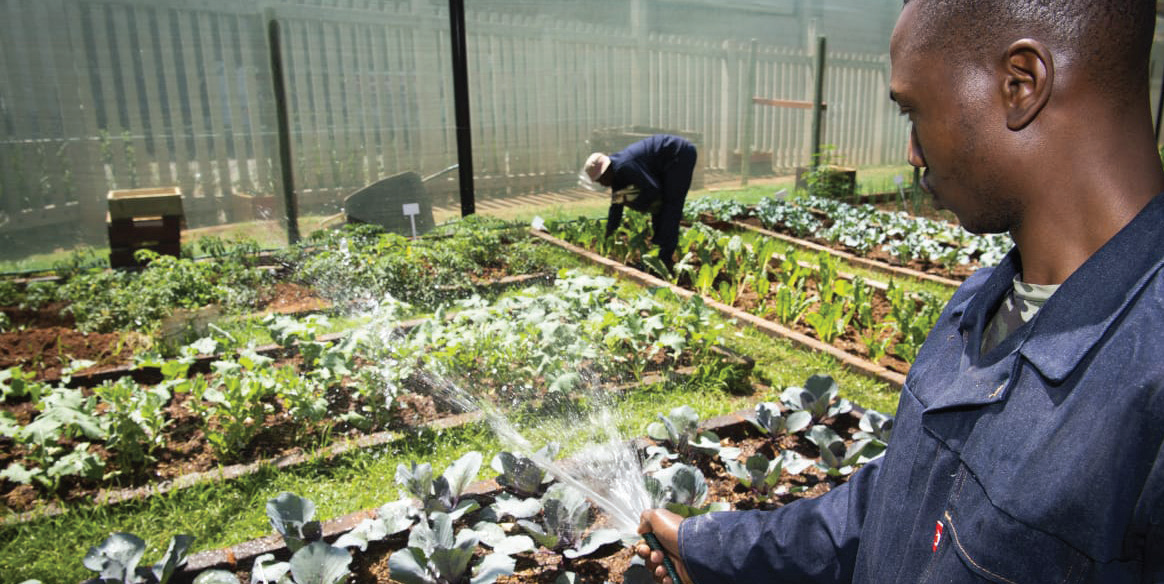
In addition to the food hampers that we provide to more than 30 000 families, we are working with community members to establish vegetable gardens for communities to grow their own food to supplement these hampers. It is our long-term view that these community gardens will grow into micro-farms and small-scale commercial farms that could be absorbed into Tiger Brands' enterprise supplier development programmes.
In collaboration with implementing partners, such as Food & Trees for Africa, Tiger Brands is educating communities in organic farming practices and assisting them to modernise their existing community food gardens. This is being achieved through Eduplant, a programme that teaches permaculture in schools and communities and that creates opportunities for people to start micro-farming enterprises and community food gardens. We have also partnered with various NPOs to establish community bakeries in local communities, with the aim of addressing both skills development and unemployment. This approach of empowering communities through skills and network access makes them less reliant on government and corporate partners. Ultimately, Tiger Brands would like to see community enterprises reaching a stage of self-reliance.
Tiger Brands University Food Gardens Initiative
Implemented in partnership with Siyakhana Multipurpose Cooperative, the University Food Garden Initiative is specifically designed to facilitate the establishment of university-based food gardens to support our existing university nutrition support programmes. The objective of the programme is not only to establish food gardens but to also facilitate activities such as research and curriculum change that address food security at higher education institutions in South Africa. The programme has the following five key objectives:
- Improving availability of a wide variety of good and nutritious food for the students through food gardens and food parcels;
- Conducting and documenting relevant and appropriate action-based research for the development of models to be replicated across all the universities in the country, thus influencing policy and strategies;
- Offering training to develop capacity among students and other stakeholders on food gardens and sustainable livelihoods;
- Engaging in advocacy and networking activities; and
- Achieving food production viability and sustainability through producing own food.
Tiger Brands currently supports the University of the Witwatersrand (Wits), North West University, University of Johannesburg, Nelson Mandela University and University of Free State.
WE WELCOME OUR SOCIO-ECONOMIC DEVELOPMENT (SED) PARTNERS

- Established in 2003
- Beneficiaries: 550
- Uplifts and develops disadvantaged people
- Provides nutritious meals to neglected children, elderly, disabled, those living with HIV/Aids, tuberculosis (TB) and unemployed families in seven wards.

- Established in 1945
- Beneficiaries: 413
- Focusing on alleviating poverty, running HIV/Aids awareness campaigns, setting up and organising community and individual feeding initiatives
- Coordinating community upliftment programmes including skills development, food gardening and early childhood development (ECD).

- Established in 2015
- Beneficiaries: 200
- Offers emotional support, friendship and nutrition to poor vulnerable families, parents and children.

- Established in 2005
- Beneficiaries: 100
- Provides nutritious meals to families whose lives are compromised by poverty in Kayamandi township in Stellenbosch
- Also supports with skills training.

- Established in 2002
- Beneficiaries: 739
- Focuses on taking care of orphans and vulnerable children in the community and helps them to develop their full potential
- Removes the stigma of HIV/Aids and helps with making responsible decisions for the future.

- Established in 2001
- Beneficiaries: 2 222
- Provides support services to families infected and affected with HIV and Aids in Clermont and KwaDabeka townships in KZN
- Programmes for home-based care, food, orphans and vulnerable children (OVC) and skills development are designed to assist vulnerable community members, by providing education, skills and support.

- Established in 2004
- Beneficiaries: 555
- Provides HIV testing services, bathing of bed-ridden patients, elderly wellness programmes, OVC and needy children.

- Established in 2004
- Beneficiaries: 521
- Provides nutritional support as well as a home-based care centre within the community. It also provides an after school programme for vulnerable children and establishes food gardens in the villages. A programme for unemployed youth to assist them with jobs and bursaries for tertiary studies.

- Established in 1998
- Beneficiaries: 1 075
- Yabonga Children's Project is a non-governmental organisation (NGO) working to enable children and youth disadvantaged through socio-economic circumstances and the impact of HIV to reach their full potential.

- Established in 1946
- Beneficiaries: 150
- Specialises in the provision of comprehensive primary healthcare and social services to mostly impoverished residents of informal settlements in the far northern areas of Johannesburg.
Employee Volunteerism at Tiger Brands
As part of the revised SED strategy, the Tiger Brands Employee Volunteerism Programme (EVP) was designed with the intention to build, nourish and nurture the communities around our sites, and to provide opportunities for all Tiger Brands' employees to engage in social causes that are close to their hearts and in the communities that they live and work.
Through EVP initiatives, we have managed to donate to communities that are indirectly supported by the company. We support Food Forward SA, a South African NGO that collects edible surplus food from manufacturers, wholesalers and retailers, and redistributes this food to hundreds of verified NPOs that collectively feed thousands of hungry people daily. In commemoration of national World Hunger Day, the Tiger For Good employee volunteering platform was used to donate over 15 tons of near-expiring food to deserving beneficiaries, equating to over 50 000 meals; this was distributed by FoodForward SA on behalf of Tiger Brands.
Sites have also been actively involved in contributing to the communities they operate in. This has been driven by the Tiger Brands Site Champions, a team of passionate employees across all our operations, who together drive positive change in their host communities.
Improving employability to enhance economic activity
Tiger Brands' skills development programme aims to empower communities to foster sustainable economic activity by improving employability. In collaboration with partner NPOs, programme participants are identified from the communities in which the company operates, such as communities in which the Tiger Brands Foundation's in-school breakfast programming is run. Participants, most of whom are women in rural communities, acquire skills relevant to the company, such as food handling. This is an accredited skill in high demand in the food manufacturing and consumable goods industry, which can lead to careers and small enterprise opportunities.
The end goal is to improve employability by creating a pipeline of employees with skills that are required by companies well beyond Tiger Brands. The company is also currently undertaking a social mapping exercise of the communities in which its SED programming is being run, to ascertain each community's specific needs.
Its SED strategy is underpinned by a sound monitoring and evaluation process, to track whether the company is achieving its intended outcomes, with particular emphasis on whether the sustainability of its implementing partner NPOs are being bolstered.
To further the agenda of a future that is co-created through partnership, Tiger Brands hosts workshops with all of its NPO partners from across South Africa, creating a platform to share insight and lessons from successful case studies, as well as to facilitate collective problem-solving and innovation.
The company is passionate about and committed to the sustainability of its operations, communities and society at large, and recognises the interdependency thereof. To this end, Tiger Brands will continue to ensure that its operations will not compromise the future of the planet, and that it creates a lasting legacy.