
Transformation
In South Africa, we promote social transformation in the interest of nation building, most notably through the continued advancement of broad-based black economic empowerment (B-BBEE) initiatives. Compliance with B-BBEE and employment equity legislation is a business imperative and our B-BBEE data and reporting is independently assured. Tiger Brands retained its Level 3 contributor rating for the year, as shown below.
The implementation of revised B-BBEE codes will have a significant effect on Tiger Brands, in common with most South African companies. Although our group falls under the agricultural scorecard, for which new targets are still to be published, we conducted an impact assessment in December 2014 to prepare for the change. In a phased action plan, closely tied to our strategic targets, we aim to return to a level 4 rating within three years and regain our level 3 status by 2020.
Tiger Brands B-BBEE scorecard
| Available points 2015* |
2015 | 2014 | 2013 | |||
| Ownership | 20 | 20,3 | 19,7 | 19,7 | ||
|---|---|---|---|---|---|---|
| Management control | 10 | 7,6 | 7,6 | 6,5 | ||
| Employment equity | 10 | 5,6 | 5,1 | 7,5 | ||
| Skills development | 20 | 12,9 | 11,2 | 8,1 | ||
| Preferential procurement | 20 | 19,2 | 18,8 | 18,8 | ||
| Enterprise development | 10 | 7,0 | 7,5 | 11,7 | ||
| Socio-economic development | 10 | 10,0 | 10,0 | 5,0 | ||
| Total | 100 | 82,6 | 79,9 | 77,3 | ||
| Level | 3 | 3 | 3 |
* Tiger Brands is now measured in terms of agriculture sector codes as gazetted on 28 December 2012.
Ownership |
||
| Brimstone (a black empowerment investment company) | 1,0% | |
| Tiger Brands Foundation | 5,0% | |
| Employees Black Managers Trusts (BMT I and BMT II) | 2,7% | |
| General Staff Trust | 0,1% | |
| Thusani Trusts (beneficiaries are children of black employees) | 2,0% | |
| Effective black ownership (using the exclusion principle) | 35,9% | |
| Total black women | 5,6% |
Management control
Our board includes five black directors (as defined by the B-BBEE codes), one of whom is female. Management control is driven at group level by the board and chief executive officer.
Employment equity
In South Africa, 92% of our employees are black (African, Indian and coloured), of whom 19% are women, and 1% are people with disabilities.
Tiger Brands’ workforce profile
| Outside of South Africa | Total staff |
||||||||||||
| African | Indian | Coloured | White | Disabled | Permanent | Temporary | Total | Permanent | Temporary | ||||
| 2015 | 7 648 | 698 | 1 189 | 844 | 53 | 10 379 | 4 222 | 14 601 | 3 841 | 2 149 | 20 591 | ||
|---|---|---|---|---|---|---|---|---|---|---|---|---|---|
| 2014 | 6 535 | 726 | 1 155 | 836 | 58 | 9 252 | 2 453 | 11 705 | 3 673 | 1 506 | 16 884 | ||
| 2013 | 6 178 | 739 | 1 192 | 881 | 68 | 8 990 | 1 500 | 10 490 | 3 770 | 788 | 15 048 | ||
| 2012 | 6 260 | 777 | 1 027 | 938 | 76 | 9 002 | 1 079 | 10 081 | 1 876 | 782 | 12 739 | ||
| 2011 | 6 172 | 769 | 1 067 | 996 | 74 | 9 004 | 990 | 9 994 | 1 751 | 1 149 | 12 894 | ||
International employees are accounted for only where Tiger Brands is the majority shareholder.
The increase in the number of permanent employees is largely due to the permatisation of temporary employees.
The increase in temporary employees is due to a change in legislation regarding the classification of casual workers whose working hours exceed a minimum threshold.
We remain committed to growing our black management talent pool. We realise that employment equity is a long-term challenge and we are investing in junior and middle management levels to develop a pipeline of future black leaders at senior and executive level.
Preferential procurement
Tiger Brands procured agricultural commodities, ingredients, packaging, consumables and services totalling R16,5 billion from B-BBEE suppliers in 2015 (2014: R15,6 billion). This represents 57% of our discretionary procurement. Preferential procurement is embedded in our sourcing process in South Africa, and developing and supporting B-BBEE suppliers remains a key element of our procurement strategy.
In addition to tracking progress on our suppliers’ B-BBEE scorecards, we have improved our management information system to allow for better transparency and quicker decision-making at the point of purchase. Compliance under the revised codes is expected to be a longer-term process as suppliers come to terms with new targets and implement the required steps to improve their scorecard levels.
We remain focused on supporting small and medium black-owned businesses, especially in our core spend. As detailed below, we regard this as a business imperative that will contribute to a vibrant and competitive supply landscape in South Africa in the longer term.
Enterprise development
Tiger Brands drives enterprise development projects across its value chain, focusing on growing small businesses that we can support over the longer term. While financial support of R39,4 million (2014: R28,5 million) is a cornerstone of our contribution, the sustainability of these initiatives is driven by the specialist support of our staff to mentor and develop skills in small businesses where required.
Our annual investment in enterprise development equates to 4% of FY15 net profit after tax, spread over most of our businesses. Albany’s owner-driver scheme is the main contributor (at R17,4 million). The balance comprises donations and loans to organisations that presently supply Tiger Brands.
As part of our strategy to comply with the revised B-BBEE Codes, we are increasing our investment in enterprise development to meet requirements within the next two years. While the scope of our investment is broad, the first phases will focus on emerging farmers to play a greater role in our supply chains. To support this initiative, we recently signed a memorandum of understanding with the Department of Agriculture, Forestry and Fisheries and allocated R10 million in the new budget year to fuel this initiative (see sidebar).
Developing small farmers
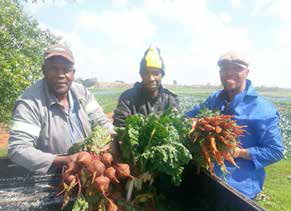
In August 2015, Tiger Brands entered its first privatepublic partnership of this scale by committing to the strategic development of projects in the agri-sector through our enterprise and supplier development initiatives, as part of the broader economic transformation of the country. Our key undertaking is to provide sustainable offtake agreements to small producers of identified crops. We aim to partner with rural communities to establish farming cooperatives and will provide technical and financial support where possible.
From a business perspective, the strength and growth of the agricultural sector is vital to us. This agreement will help us deliver on our supply chain strategy to increase the local supply of raw material. It also gives us the opportunity to build on our existing smallholder development initiative (tomato farmers) and to expand to other products. While we have a broad scope (that includes a variety of crops) within the agreement, the pilot project will focus on tomatoes, maize, sunflowers and beans.
This leverages our position as a key player in food security in South Africa, and reinforces our social licence to operate.
This partnership demonstrates our support of government’s aim to develop smallholder farmers as part of accelerating the agro-processing sector. It also has the potential to raise productivity, enhance food security and promote rural development, while creating jobs outside farming in the service and production sectors.