
Our people
Highlights
- Revised group-wide talent management policy implemented
- Tiger Brands certified in Top Employer SA survey
The group’s five-year strategy (page28) and related targets are focused on building a leading FMCG business in emerging markets. To achieve this, we will need high calibre employees and leaders with the right capabilities and a winning culture that enables employees to thrive.
Accordingly, over the last year, we reviewed our approach to talent and succession management to accommodate the needs of a broader Tiger Brands group. This unified group talent policy ensures we have a complete view of available talent and the appropriate development plans to address any gaps. Integral to this process is a model that enables human resource (HR) practitioners and management to identify and develop the skills that support our strategic goals.
| Strategic intent To build a leading FMCG emerging market business by having top-quality people with the right capabilities, enabled by inspiring leaders and a winning culture. |
||||
| Talent management | Leadership development | High-performance and engaging culture | Skills and capability development | Organisational development and effectiveness |
|
|
|
|
|
Brilliant HR basics and one aligned HR team
|
Under this approach, Tiger Brands is building talent sustainably by concentrating on internal appointments and promotions while increasing the investment in training and development to build capability and strengthen the talent pipeline. Key initiatives include a focused management trainee and leadership development programme. During the reporting period, 11 graduates joined Tiger Brands as trainees.
Regular talent reviews at appropriate levels ensure thathigh-potential individuals are identified, development plans are agreed, and progress against agreed targets is tracked.
In addition, a new short-term incentive scheme was introduced in 2015, focused on strategic and financial objectives. This will more effectively align individual performance with corporate performance.
| 2015 % |
2014 % |
2013 % |
|||
| Overall staff turnover rate | 7,9 | 9,6 | 10,2 | ||
|---|---|---|---|---|---|
| Retention rate of key talent | 87 | 86 | 87 |
Leadership development
In line with the revised approach to talent management, and to ensure we have leaders who can drive our strategy, we reviewed our model for leadership skills. To determine an accurate baseline and parameters for leadership development initiatives, the skills of all middle managers and above are being assessed, and a customised leadership development programme will be launched in 2016.
Tiger Brands Academy
This internal facility comprises separate academies for the disciplines of supply chain, leadership, finance, customer, human resources and marketing.
A total of 524 employees participated in programmes during the year (2014: 409), over 4 036 (2014: 3 322) training days.
Workforce
In 2015, the group employed 10 379 permanent staff and 4 222 temporary staff in South Africa, excluding 2 363 seasonal and casual workers.
Outside South Africa, the group employs 3 841 permanent staff and 2 149 temporary staff, bringing the total group workforce to 20 591 (excluding seasonal and casual workers) (2014: 16 884).
The total salary bill for the year was R3,6 billion, compared to R3,3 billion in 2014.
Key indicators
| 2015 | 2014 | 2013 | |||
| Employee headcount* | 20 591 | 16 884 | 15 048 | ||
|---|---|---|---|---|---|
| Female employees | 3 696 | 3 555 | 3 386 | ||
| Learnership participants | 264 | 285 | 159 | ||
| Total training spend (Rm) | 10,8 | 7,7 | 10,1 |
* Includes international operations but excludes seasonal and casual workers.
Skills development
In 2015, we invested R10,8 million (2014: R7,7 million) onin-house training in South Africa, led through the Tiger Brands Academy, as well as learnerships.
We believe training and developing all employees is a prerequisite to creating a competitive advantage. Our people have the opportunity to continually develop themselves through workplace qualifications and shorter, function-specific programmes. Documented objectives and targets are submitted to the sector education and training authority (FoodBev Seta) in our workplace skills plan and annual training report.
Workplace experience project
Young people receive workplace experience in food technology, engineering, marketing, production and operations. These students become a feeder pool for the graduate programme and other entry level appointments. Around 344 people have completed the programme since 2008 and, wherever possible, are employed by the business.
External programmes
Thusani Trust provides bursaries to qualifying black employees’ children. In 2015, R3,1 million (2014: R4,5 million) was spent on bursaries for 158 students (2014: 186). A total of 371 students have graduated from tertiary institutions since 2007 with the trust’s support, and 27 graduated in 2015.
We provided bursaries for nine engineering students. On graduating, these students are incorporated into our talent pool.
This programme is currently being funded by “trickle dividends” in respect of shares in Tiger Brands indirectly held by the trust. As a result of the success of the bursary scheme, the trust required additional funding. This will be facilitated by an increase from 10% to 25% in trickle dividend in respect of the Tiger Brands shares indirectly acquired by the trust in terms of the staff empowerment transaction implemented in 2005. The trust will benefit from the increased trickle dividend from January 2016.
Employee benefits
Tiger Brands generally offers employees benefits in excess of statutory requirements:
Retirement funding
– we have designed our retirement funding based on employee requirements and worker category. These are being reviewed in line with imminent legislative changes.
Medical aid
– we offer a closed scheme medical aid to which employees can elect to belong. This is structured on a benefit cost analysis as a very competitive proposition to employees. We have also limited our annual increase to single digits consistently below medical aid inflation over the last three years.Employees wellness – realising the value of this benefit for our people, we have recently reviewed the offering to extend its reach and further enhance benefits that support employee wellbeing.
Group personal accident
– in addition to normal death and disability benefits in each of the retirement funds, we also offer accident cover for all employees.
Leave
– we have recently reviewed our policy to include leading practice on parenting leave, for example adoption and paternity leave.
Discounted deals
– capitalising on the group’s purchasing power, employees enjoy preferential rates for a spectrum of lifestyle purchases.Tiger Brands regularly tracks market trends, legislation and best practice to ensure our employee benefits remain relevant and competitive to support our people strategy.
Labour relations
To ensure a constructive, safe and fair working environment for all our people, we work closely with employee bargaining units to ensure that all employees have a voice in matters that affect them daily.
Our employees enjoy full freedom of association. Some 62% of employees belong to 33 unions (including three* major unions) at South African sites, with site management and shop stewards meeting monthly. At each site, unions are represented on forums that monitor employment equity, skills development and any other issues requiring management attention.
Clear communication between staff and management helps to ensure that disputes are resolved and grievances are dealt with appropriately by all parties. Our disciplinary code serves as a guideline to all managers and employees to:
- create a fair and equitable structure for dealing with misconduct; and
- encourage timely corrective action in the event of an employee’s behaviour or conduct being unsatisfactory or unacceptable.
As part of our workplace culture, scheduled meetings are held daily at production sites. These focus on pertinent issues that improve productivity and safety, and provide a regular opportunity for feedback from our employees.
* SACCAWU (South African Commercial, Catering and Allied Workers Union), FAWU (Food and Allied Workers Union) and AMITU (African Meat Industry and Allied Trade Union).
Health and safety
The safety of our workers, visitors to our operations, and the public is key to our long-term success. We believe a safe and healthy workplace is both the fundamental right of every person and a business imperative.
The group health and safety policy stipulates our responsibility for maintaining productive workplaces across our company by minimising the risk of accidents, injury and exposure to health hazards for our own people, associates and contractors.
The chief executive officer is accountable for the safety of employees while the risk and sustainability committee maintains oversight on behalf of the board on health and safety issues. Health and safety committees, led by supply chain executives and site management, are responsible for implementing health and safety measures at manufacturing sites.
Our policies and standards for managing safety, the environment and quality are defined in operating requirements throughout the group. Our manufacturing facilities continue to adopt the requirements and principles of the internationally recognised Occupational Health and Safety Assessment Series (OHSAS) 18001 standard as the framework of an occupational health and safety management system.
Generally accepted food manufacturing standards are rigorously applied and food safety at all facilities is regularly audited by independent assurance providers.
The Tiger Brands environmental, health and safety risk management programme has been implemented at all our business units. Rigorous operational controls manage known risks and align with international best practice. An accredited independent risk management company assesses implementation and adherence, and provides third-partyverification. Any non-conformance is identified and assessed, and risk mitigation and corrective actions are implemented. In addition, compliance audits on applicable laws and regulations as well as the group’s occupational health and safety requirements are conducted bi-annually at each manufacturing operation.
During the year, all permanent and temporary employees in the manufacturing facilities received health and safety training. We continue to provide our safety managers and supervisors with the requisite knowledge, skills and attitude to recognise hazards and take effective preventive actions to reduce injuries and foster a healthy, safe culture at our manufacturing sites.
In support of our aim to achieve zero fatalities, zero injuries and zero tolerance of unsafe behaviour and practices, during the year a group of our safety managers attended theRISK-STAR training qualification, delivered by SGS – South Africa. This intensive 11-module programme focuses on practical application of the outcomes required for the health and safety qualification and has assisted our manufacturing facilities to improve key areas, including:
- Behaviour-based safety culture
- Interpreting hazard identification and risk assessments (HIRAs)
- Rigorous procedures for issuing work permits (such as lockout/tag out)
- Quality of root-cause analysis and understanding consequences of incidents
- Educating all employees and contractors on good safety practices and managing safety outliers
- Leadership skills for supervisors and safety officers through coaching for behaviour-based safety
- Safety audits to reinforce the integration of safety, health, environment and quality (SHEQ) management programmes
- Enforcing legal standards and a zero-tolerance culture on hazardous chemical substances
- Implementation requirements of the relevant ISO standards (ISO 14001 and ISO 9001).
We conduct ongoing training needs analysis for employees to identify any health and safety knowledge gaps. This includes specialised training requirements for safety, health and environmental representatives as well as first-aiderrepresentatives to raise health and safety awareness.Our safety programmes include training at induction and periodic refresher training for employees and contractors. In addition, ongoing on-the-job risk assessments are performed to identify safety risks. With a renewed focus on these safety programmes and initiatives, injury rates declined over the reporting period.
Route-to-market safety remains a focus area. In FY15, we recorded a fatality after an attempted armed robbery. We extend our sincere condolences to the family and friends of Michael Nkadimeng and his colleagues at Albany Bakeries. Continuous support on the route-to-market security and resolving safety incidents is provided by external specialists and local police authorities.
 In September 2015, contract worker Franck Mamoun A Befoung died in a forklift incident at the Chococam factory in Cameroon. Remedial steps are being taken and we extend our condolences to his family and colleagues.
In June 2015, a major incident was reported at one of our manufacturing facilities, but does not form part of our annual statistics as it was ruled not work-related. The protection of our employees remains paramount and every effort is taken to mitigate the risk to individuals and the group.
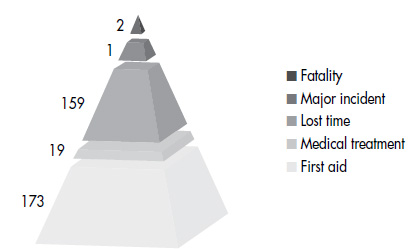
As shown below, first aid and lost-time injuries account for a significant portion of the total recorded during the year. Accordingly, we continue to deliver safety toolbox talks in multidisciplinary team meetings, conduct safety critical equipment inspections and deliver processsafety-related training to raise awareness on injuries recorded and share lessons learned.
In FY15, we formalised the use of lost-time injury frequency rate (LTIFR), a universal statistic to report on safety performance. By migrating to LTIFR as a group measure for safety incidents, we have eliminated subjective interpretation and introduced a measurable performance indicator.
LTIFR
| Key performance indicators | Target | 2015 | 2014 | 2013 | 2012 | 2011 | ||
| Fatalities | 0 | 2 | 1 | 2 | 0 | 0 | ||
|---|---|---|---|---|---|---|---|---|
| LTIFR | 0,86* | 0,36 | 0,74 | 0,67 | 0,78 | 1,03 |
* The group target is the average of the Grains, Consumer Brands and International divisions, and considers individual site targets set at an 8% to 12% improvement on actual performance in the reporting period.
Depending on the nature of each plant, our manufacturing sites have annual LTIFR improvement targets ranging from 8,5% to 12%. In FY15, 18% of our manufacturing sites achieved zero LTIFR, while 63% met their targets and 37% did not meet targets.
Activities to improve health and safety
Health and safety is a priority for all managers and executives. Key initiatives introduced in the review period include:
- Developing a workplace health improvement plan for implementation next year
- Further integration of safety into business processes, understanding that safety should be a core business and strategic value
- Extensively improving management commitment and leadership and employee participation as these are key to safety management
- In addition, safety skills development programmes and role-based competence matrixes are being defined and launched for our business units.
Employee wellness
Our employee wellness support programme offers a 24-hourtelephonic counselling service, and face-to-face professional counselling. Users can access psychologists, social workers, dieticians, biokineticists, and financial and legal advisers.
We also offer all South African employees voluntary membership to our in-house medical scheme that offerscost-effective comprehensive health cover. The scheme has 4 335 principal members (2014: 4 336) and 9 659 beneficiaries.
We have a comprehensive HIV/Aids framework that includes support for HIV-positive employees. In 2015, 331 employees were voluntarily counselled and tested (2014: 584) and 95% of employees who tested positive have enrolled on the programme. Our recorded prevalence rate in South Africa is 1,8% (2014: 2,7%).