
Our operating environment
South Africa
Given that 75% of the group’s turnover and 98% of its operating income is currently generated in South Africa, conditions in this market are critical to our performance and strategic progress.
Tiger Brands is the largest constituent by market capitalisation of the R195 billion JSE Food Producers Index. Listed and unlisted food producers in turn, supply a R231 billion retail market, ranging from national supermarket chains to informal outlets.
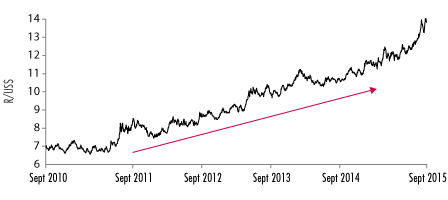
Economic growth in South Africa was lacklustre for most of the reporting period, with downward revisions to the GDP rate forecast for 2015. The increasingly unfavourable global economic environment, inflationary cost pressures caused by the weak rand, together with electricity shortages and unsettled labour relations have exerted further pressure on the domestic economic outlook and undermined business confidence. During the year, the rand weakened by 23% against the US dollar as concerns about China’s economy deepened and impacted emerging market assets. The continued depreciation of the rand over the last four years has exerted significant inflationary pressure on input costs and pricing, increasing the pressure on consumers and reducing demand.
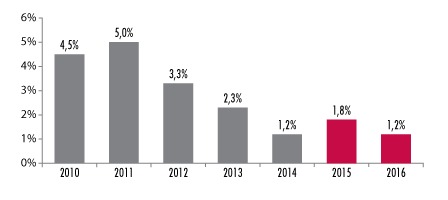
These factors together with the relatively high personal debt levels, rising interest rates, inflation and slower wage growth, have affected consumer confidence and constrained household consumption levels. Consequently consumers are adjusting their consumption habits, favouring lower priced products where necessary and deferring purchases of discretionary items.
In response to this increasing focus by shoppers on value, manufacturers are competing for volume sales opportunities through pricing and value offerings. The tough trading environment has been exacerbated by the increased pressure from customers for additional trade spend in respect of rebates, promotional activity, joint advertising, and supply chain efficiencies, thereby further impacting producer margins.
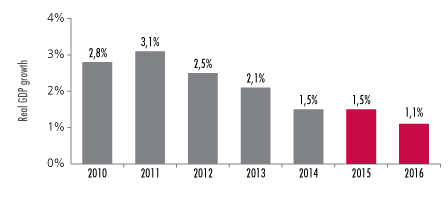
SA economic growth is expected to remain subdued over the medium term
Growth in SA household consumption remains constrained
Continued rand depreciation against the US$ has intensi ed pressure on input costs
Naira has come under pressure in a lower oil price environment

Key trends over the next five years
Demand
- Strong population growth in Africa – youngest in the world, with rapid adaptation to modern trends and technology.
- Urbanisation continues, with increased income and spending power changing consumer patterns.
- SA retailers strengthening their presence on the continent, although traditional trade remains the dominant channel.
- Economic pressures lead to the continued growth of value segments across markets.
External factors
- Domestic economic and infrastructure constraints compress South African economic growth.
- Slow recovery in global advanced economies and slowdown in emerging market economic trends will continue to impact Africa.
Supply trends
- Food markets characterised by volatile commodity prices and rising input costs.
- Skills shortage in emerging markets will make talent management critical for business success.
- A focus on a streamlined value chain will be imperative to manage efficiencies and costs in a competitive environment.
Rest of Africa
In the rest of sub-Saharan Africa, economic growth rates have fared better, driven by infrastructure investment, direct foreign investment and consumer expenditure. Rapid urbanisation and improving living standards are supporting growth in these markets. However, the larger economies have been affected by the effects of lower oil prices and inflationary cost pressures due to weaker exchange rates as a result of devaluation. This has led to pressures on consumer demand and increased competition. While consumers seek out aspirational brands and new variety, value for money remains key as the overwhelming majority of consumers remain in the low-income bracket. Nevertheless, most markets are showing robust growth, as purchasing patterns change from bulk, unbranded products to branded packaged goods.
Although consumers are embracing trade expansion in Africa, the route-to-market in sub-Saharan Africa remains largely informal. The resulting reliance on wholesalers and distributors to reach the final point of purchase is significant and key to achieving market success. Poor infrastructure and logistical problems continue to restrict business expansion while socio-political instability and growing political/regulatory controls in certain countries present business challenges.
Given the size, changing demographic profile and growing income levels of the population in sub-Saharan Africa, we continue to believe that expansion in the rest of Africa represents a significant growth opportunity for Tiger Brands.